
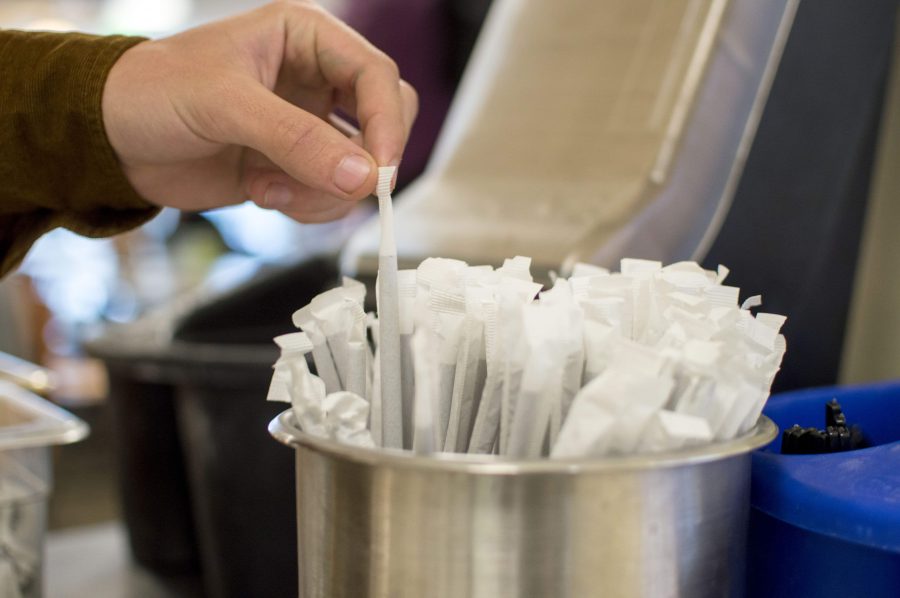
Every takeout order comes with a familiar ritual: a fistful of napkins, a handful of plastic forks and three ketchup packets nobody asked for. A national campaign called Skip the Stuff wants to flip that default, requiring restaurants and delivery apps to ask customers before adding single-use serviceware to an order rather than including it automatically.
New York City adopted the policy in 2023. New Jersey towns including Red Bank have followed with local ordinances, and California passed a statewide version in 2022. This year, Colorado came close to following suit. Senate Bill 26-146, dubbed “Restrict Single-Use Food Serviceware Distribution,” passed both chambers of the state legislature before Gov. Jared Polis vetoed it June 2. Now with a new governor set to take office in 2027, advocates in Fort Collins are watching to see whether the policy resurfaces at the state level, or whether cities will have to act on their own.
SB26-146 would have required restaurants and third-party delivery services to withhold single-use utensils, napkins, straws, stirrers, lids, condiments and similar items unless a customer requested them or confirmed they wanted them when placing an order.
The sponsors cited industry data showing U.S. restaurants spend about $24 billion a year on disposable serviceware, and that Americans discard 561 billion pieces of it annually, generating 4.9 million tons of waste.
The proposed method has seen success in the past: Postmates adopted the campaign in 2019 and eliminated 122 million pieces of plastic cutlery and saved restaurants roughly $3.2 million.
The bill built on Colorado’s 2021 Plastic Pollution Reduction Act, which phased out single-use plastic bags at large retailers and banned expanded polystyrene, the material used for plastic foam brand Styrofoam, at food establishments starting in January 2024. State Sen. Lisa Cutter, one of the bill’s sponsors, said the on-request approach has always struck her as straightforward.
“It just saves so much waste (and) puts all the restaurants on a level playing field,” Cutter said. “I don’t understand the downsides.”
Cutter said the 2026 bill originated when two Cherry Creek High School students approached her about strengthening the state’s Styrofoam restrictions. She said the students gathered signatures of support from restaurants and sat in on stakeholder meetings before the bill was introduced.
“They really thought it through,” Cutter said. “They did the fact sheet, they sat in on stakeholder meetings and it was awesome.”
State Rep. Meg Froelich, who co-sponsored the bill in the House, said she signed on in part because of her longtime work with Cutter on a legislative zero-waste interim committee. Both lawmakers are term-limited and will leave the legislature this year.
Maureen McCarthy, founder of the Fort Collins nonprofit FoCo Trash Mob, worked with the same students and said she was struck by their composure the day they learned the bill had been vetoed. “They were just unfazed,” McCarthy said. “They said, ‘Well, you know, we’re all sophomores, so we’re gonna be back next year.'”
In his veto letter, Polis wrote his administration remained committed to reducing waste but “the state should not play a role in mandating whether single-use serviceware is provided to consumers.”
He noted the bill placed enforcement at the local level and argued that decision should extend to whether cities adopt such policies at all, pointing to Denver and Breckenridge, which have already passed similar local ordinances. Polis also raised concerns about restaurants that take orders by phone or lack the technology to build an opt-in system and about diners eating outdoors who might not have a chance to request items.
Froelich offered her own account of the governor’s reasoning.
“He’s ultimately very libertarian,” Froelich said. “He has consistently vetoed bills that he views as too much government, unless he comes up with the idea, and then he thinks there should be big government.”
Cutter said Polis told her and the students at a follow-up meeting that his concerns centered on local control and enforcement, an explanation Cutter said she found inconsistent with his earlier decision to sign the Plastic Pollution Reduction Act, which used similar local enforcement provisions.
“You signed the Plastic Pollution Reduction Act, and it’s the same,” Cutter said she told the governor. “He said, ‘Well, you need forks, but you don’t need plastic bags.'”
Selina Lujan de Albers, a manager in Fort Collins’ Environmental Services Department, said the department was aware of SB26-146 but was not involved in drafting it, and the city has no current plans to adopt its own serviceware ordinance.
“Regulating businesses is not the goal,” Lujan de Albers said. “The goal is, like, how do we work together, educate and identify the resources needed?”
McCarthy said her group is surveying local restaurants, under contract with the city, to determine why some still use polystyrene despite the state ban. “This is 15 or 20 cents, and this other supposedly compostable one — which may or may not be compostable — is 70 cents,” she said. “The restaurants are down to pennies to be able to make a profit.”
Both Cutter and Froelich said they expect the bill to be reintroduced in the 2027 legislative session, with new sponsors, once the students return.
Reach Maci Lesh at science@collegian.com or on social media @macileshmedia.