
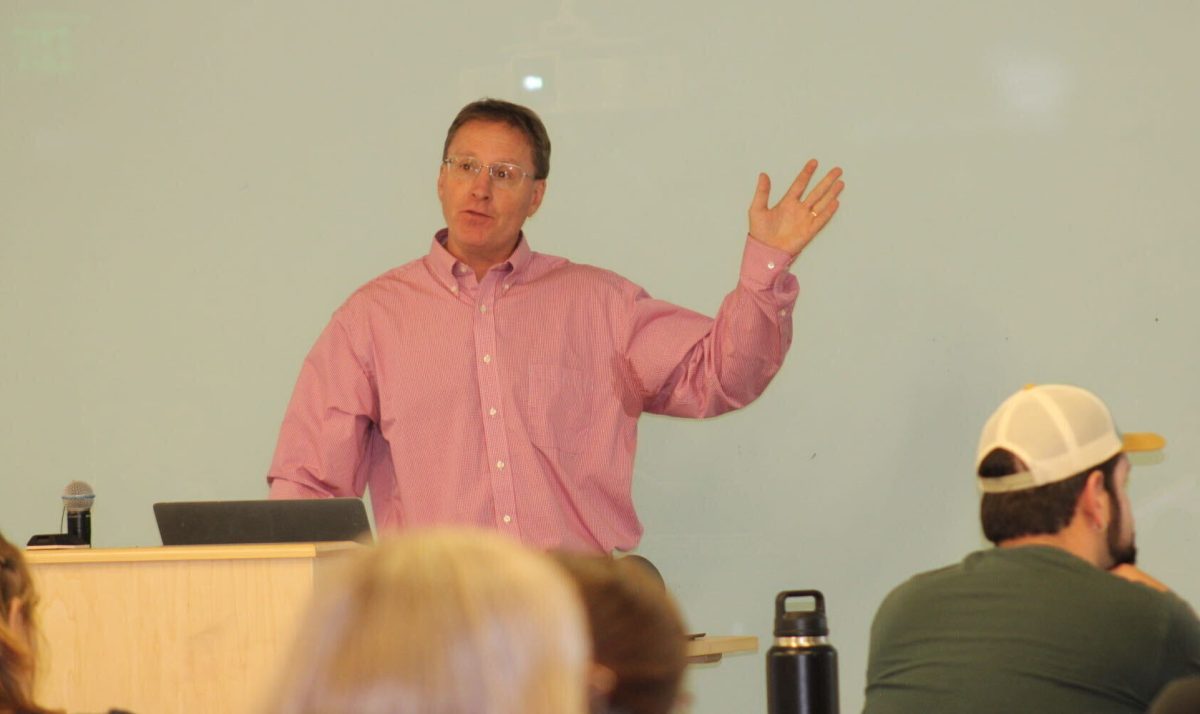
Thomas Santangelo began the department of biology’s fall semester seminar series at Colorado State University strong, presenting the progressive research behind microorganisms in extreme environments and how those observations can inform future research about biological resilience and adaptation.
Santangelo, a professor of biochemistry and molecular biology at CSU, was the main speaker of the “Surprises from the Archaea: New Paradigms for Survival in the Extreme” seminar that highlighted his lab’s research surrounding archaea, a domain of single-celled prokaryotes that are molecularly distinct from bacteria.
Dan Sloan, a professor in the biology department, hosted the seminar. Sloan said he got in contact with Santangelo so he could speak about his important research within CSU itself.
“Archaea are a group of organisms that I think a lot of biologists have heard about but don’t know a lot of the details of,” Sloan said. “So I suspect the title ‘Surprises from the Archaea’ was something that drew people in. Our seminar series in general is also just an opportunity to, like, bring the biology community and people outside the biology department together.”
Santangelo began his talk by laying the groundwork and speaking on the over 300 years of history that established the foundational principles his lab’s research is based on. He spoke about the different scientists who contributed to how life is classified, from the largest groups to the smallest cellular classifications.
“If we focus in on the archaea for a little while, they come in every shape and size you could possibly imagine,” Santangelo said. “They grow in clumps; they grow by themselves; they grow parasitically; they have viruses that infect them. … Everything that you could imagine is out there. ”
A prominent scientist Santangelo emphasized was Thomas Brock and his observations of microbial life in the Yellowstone Hot Springs. Brock’s groundbreaking research led to an expansion in the study of microorganisms that can survive in extreme conditions.
“There’s plenty of microbes that grow at high temperatures,” Santangelo said. “People have figured out that the organisms that grow at the highest temperatures are most often members of the archaea.”
After establishing the foundational principles, Santangelo went into greater depth on what his lab is doing regarding the epitranscriptome, or modifications that can maintain RNA structures in elevated temperatures.
To research archaea, Santangelo mentioned the importance of picking an organism, such as Thermococcus kodakarensis, that loves heat, can thrive in extreme environments and is the source of the enzyme Q5 DNA polymerase.
One of the purposes of Santangelo’s lab is to address how RNA modifications can stay regulated in response to stress.
“So that is all of what my lab addresses: how can (archaea) not only survive but thrive at these extreme temperatures (and) not scramble their DNA, not have all their proteins literally cook, how their lipids don’t fall apart and how archaea can metabolize and gain sufficient energy in the absence of oxygen,” Santangelo said.
Santangelo and his lab are approaching RNA by testing it in vitro and in vivo to expand the rules of mRNA modification. They are hoping to gain a deeper biological understanding of different RNA modifications.
Santangelo offered more insight into how they determine what the modifications actually are by fragmenting everything and processing the RNA into large, total and small RNA. Through sequencing and chemical treatments, Santangelo and his team are able to identify those modifications.
“These RNA modifications allow you to be more creative in building structured RNA,” Santangelo said. “The more nuanced you can get, the more structure, the more function, the more stability, the more interesting activities you can get out of them.”
Sloan said he thought Santangelo spoke on archaea well, having an equal balance between background information and his and his team’s primary research. He also said he appreciated how his research provides many experiences and opportunities for students and leadership.
“He works on this unique system, archaea, that lives in extreme conditions,” Sloan said. “I thought it would be really exciting for biologists to hear about.”
Sloan said he appreciated how Santangelo had provided historical and scientific background on archaea as a whole, providing more information particularly for those who have limited knowledge of the topic.
“(Santangelo) probably educated a lot of folks in the room about some broad fundamental biology of this whole group of organisms that people didn’t know about ahead of time,” Sloan said. “I love the technical aspects of the science and the RNA modifications and how he kept noting the uniqueness of it and how it was undiscovered territory and could be applied in different ways.”
Santangelo ended the seminar by discussing his team and the scientific research they are pursuing in their lab.
“It’s enriching for me,” said Andrew Dull, a graduate student and attendee of the seminar. “RNAs … can feel like such a mystery; seeing more of how these RNAs can adapt in crazy ways to support life is really cool.”
Reach Sananda Chandy at science@collegian.com or on social media @RMCollegian.