
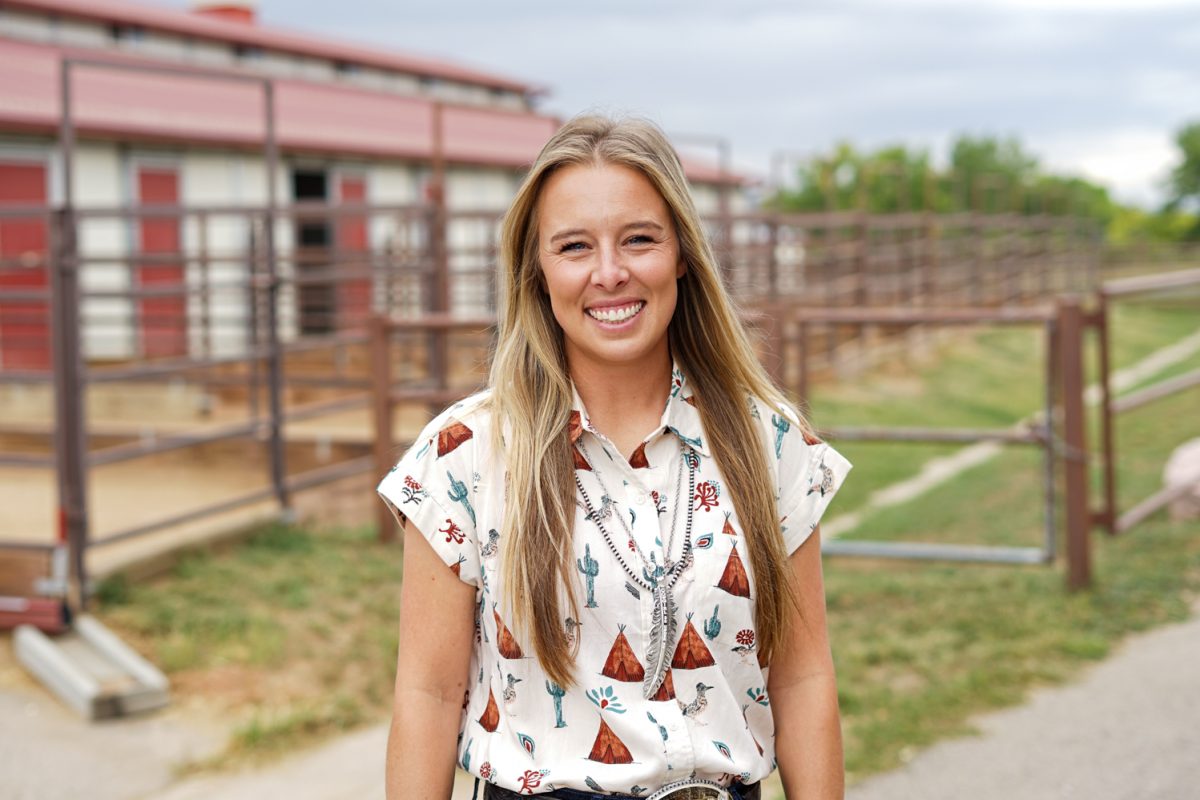
Maggie Murphy, a Colorado State University equine science instructor, is bringing together long lists of accomplishments in two separate worlds to create a unified classroom experience.
A three-time top-10 finalist at the Intercollegiate Horse Shows Association National Championship for horsemanship, Murphy was recently named the head coach of CSU’s Ranch Horse and Horse Judging teams. Simultaneously, she holds a Ph.D. in the field of equine sciences and teaches introductory and advanced horse evaluation courses as well a section of an applied horsemanship course at CSU.
In the classroom, Murphy said she follows a simple process of breaking concepts down to their basic components and ensuring students understand them before building back up the levels of complexity. She said this is a method inspired by Lance Baker, a former mentor of hers and a professor of animal science at West Texas A&M University.
“He told me that the smartest person in the room isn’t the one that can talk about these really challenging concepts and make them sound super confusing,” Murphy said. “He (said) the smartest person in the room is somebody that can take a really complex situation or … higher knowledge thinking and dumb it down so that a first grader could understand it.”
At the same time, Murphy makes an effort to explain the why behind something: Why is something done this particular way? Why is this feature in a horse being used for this purpose?
Murphy said she utilizes this practice often when coaching because it helps students fully understand a concept and deepens their understanding of the horses themselves.
While now a doctorate-holding instructor with an impressive horse-judging resume under her belt, Murphy’s career all began with an undergraduate degree.
She earned her bachelor’s in equine business at West Texas A&M, where she discovered her love for coaching horse judging. This discovery catalyzed her switch from business to science for her graduate degrees.
“You had to be an equine science student to be an assistant coach for the horse judging team and the equestrian team,” Murphy said. “So I chose to stay at West Texas A&M and got my master’s.”
Her master’s was in animal science, but she said all of her research focused on equine nutrition. At the end of her senior year, Texas A&M professors Baker and John Pipkin offered her the chance to assist with an equine nutrition trial. That experience led to her doctoral work in agricultural systems.
Several projects went into earning that advanced degree. Under the tutelage of Paul Morley, a professor at Texas A&M and director of research for the university’s Veterinary Education, Research and Outreach program, Murphy conducted four projects with the overarching theme of characterizing the developing microbiomes and antibiotic resistance genes, known as the resistome, in young cattle and horses.
All of the projects looked at how the resistome changed as calves and foals aged.
Murphy said her first project looked at calves on organic dairy farms, where she found antibiotics in their feces despite the cattle never having exposure to them. The calves’ mothers had not been exposed to antibiotics either, which made the discovery even more surprising. Her second project looked at how the microbiome and resistome of foals changed over the course of aging and at what point theirs became most similar to their mother’s.
The work on horses was done with Gregg Veneklasen, a veterinarian at Timber Creek Veterinary Hospital in Canyon, Texas. Veneklasen is well known among equestrians, especially those in the western disciplines because he works with many bucking and cutting horses, including famous ones, according to Murphy. He collects and breeds these horses, and their foals were used for the microbiome project.
It wasn’t just limited to microbiome and fecal research, though.
“The other thing that Gregg is very passionate about and does a lot of work with is cloning,” Murphy said. “And so there is a Przewalski, and then, we cloned that.”
The Przewalski’s horse — an endangered wild horse species native to Central Asia — was cloned to help with conservation efforts.
“Their genetic herds have gotten pretty inbred,” Murphy said. “And so we had some really, really old tissue from Mongolia that (Veneklasen) cloned.”
Other horses were cloned, too. Geldings, or castrated male horses, were cloned so the replica could be used for breeding, and horses with desirable traits were cloned so those traits could be passed on. This is where Murphy’s doctoral project came in, comparing the microbiomes and resistomes of horses with varying degrees of relatedness: unrelated, siblings, half-siblings and genetically identical clones.
All the projects Murphy undertook to earn her doctorate are being prepared for scientific publication; for now she is not conducting any new research. Science still plays a big role in her daily life, though. When working with students, whether in the classroom or at practice, she finds some concepts are best explained scientifically.
“I do try to use science to help me out with developing students into leaders, developing them into competitors and different things, whether they realize it or not,” Murphy said. “Honestly, everything in the horse world is tied into science about why we do things the way that we do.”
Reach Emlyn Monti at science@collegian.com or on social media @RMCollegian.