

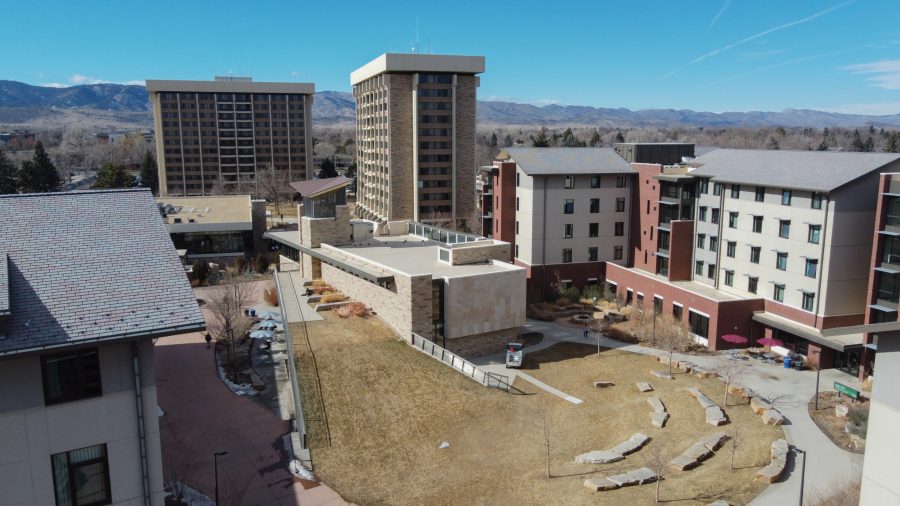
In November 2025, Colorado State University’s Housing & Dining Services announced changes to residence hall student staff positions to be implemented in fall 2026 in an effort to better support campus residents and student staff. Now, with the 2026-27 academic year underway, residents and student staff have displayed mixed reactions to the changes.
This change reassigned staff responsibilities and phased out some roles while introducing new ones. For example, the resident assistant — a live-in student staff member who was tasked with building community in their halls, addressing interpersonal needs, completing regular walks and check-ins and being on call overnight — has been removed.
In the new model, the bulk of these responsibilities have shifted to live-in student staff called community assistants. However, they no longer conduct walks of the halls or remain on call overnight. Instead, hourly student employees called operation assistants staff the front desk of each building, conducting regular walks and attending to the overnight needs of residents in addition to the clerical work previously completed by community coordinators and desk assistants. Notably, operation assistants are compensated at a rate of $19 an hour for overnight shifts and $15.16 during the day and are not required to live on campus, while community assistants are only provided room and board for their positions.
University Housing Director Joshua Maxwell, who has been with the department for three years, said the department engaged in a yearslong review process before the decision was reached. The department gathered community feedback, assessed trends in student staff models at other universities and created a committee of staff from across the department, all of whom were directly involved in the creation of the CA and OA roles.
“The impetus actually started before I even arrived,” Maxwell said. “For me, I wanted it to be a collaborative process within the department and not just one that was a top-down decision of what the director thinks we should do.”
He said during this process, the department identified several issues with the RA role, citing reported negative mental health impacts.
“(These positions) are regularly correlated with high levels of burnout, role complexity, stress (and) mental health,” Maxwell said.
Maxwell said community assistants, now unburdened by the responsibility of hall walks and overnights spent on call, can dedicate their attention to building relationships with their residents.
“(Our CA) has gone, like, door to door pretty frequently to, like, check in with us and how our classes are doing and if we, like, have any questions about anything,” said Gaby Suazo, a first-year student living in Newsom Hall. “She’s very, like, supportive but also, like, it’s not in an overbearing way, where I’m, like, scared to get in trouble or anything like that.”
Maxwell said the change was also informed by the reported success when implementing similar programs at other universities across the country. Virginia Tech, for example, implemented their Residential Well-being program in 2022, featuring changes to role structures, functions and processes with resident experience in mind.
With CSU implementing this new structure, Maxwell acknowledged the department expected there to be some issues during the transition.
“The focus right now is listening and learning and making improvements,” Maxwell said. “Whenever you make a big change, I always anticipate and expect that there will be areas for growth right away.”
Across campus, Maxwell said the department has encountered issues with hiring enough OAs to sufficiently staff the front desks and handle overnight responsibilities.
“We’ve also identified challenges,” Maxwell said. “Hiring and recruiting for an overnight position is a challenge across the country, and that’s an inherent one, and that’s one we’re continuing to refine and address to make sure that we’re getting exactly where we want to be from a staffing perspective.”
Some students living in the residence halls said the understaffing of the desks has directly impacted their experience in the dorms, citing delays in retrieving packages delivered at the desk and in communicating with staff.
“It has been pretty frustrating because (the front desk staff) are usually not there, and they usually have a sign saying that, ‘We’re understaffed, so our hours are cut shorter,’” Suazo said. “Which is understandable, but also, like, when I do want to, like, ask how I mail stuff or, like, if I want to give them an envelope and stuff, then, like, no one’s there, and I wish that I had, like, more clarity and support in that way, you know?”
This development has also impacted the staffing of the front desk at the Aggie Village apartments, which are owned and operated by CSU. Sienna Arellano, an Aggie Village resident, said her building’s front desk has rarely been staffed, and when it is, it has been at odd, unpredictable hours. One night, she said she got locked out of her apartment after hours when she found her key card didn’t work at any of the entrances. After finding the front desk closed multiple times, they issued her a temporary keycard she found did not work for the outside entrances either. Later, when she came back to the front desk to get a permanent keycard, she was told by a staff member the order for a new one had never been placed.
“It was very disturbing honestly, because, like, what if there was an emergency?” Arellano said. “What if I really needed to get into my apartment, and I couldn’t?”
A current OA, who was previously an RA for two years prior, spoke to The Collegian about their experience in the role on the condition of anonymity and said staffing shortages have led to a host of issues. OAs, who are assigned to “regions,” are responsible for several buildings at once and are, at times, obliged to leave one desk unattended and complete duties in other buildings. They said that OAs are often working up to 30 hours a week, most of which are overnight shifts.
“It’s pretty much a — pardon my French — shitshow across campus,” the OA said.
In the description for the OA job listing on Workday, the enterprise software CSU uses to hire student employees, it notes the position involves an estimated 15-20 hours of work a week but that “OAs may fulfill additional hours during training periods and various high need times of the year,” and job seekers will receive a “full position description” after applying. The OA said the requirements of the position have been overwhelming for many student employees.
“I know people who are taking 16 credits, 18 credits,” the OA said. “I have one coworker who’s taking 20 credits and is working this job, and I’m, like, ‘I don’t know how you guys are doing it because I’m struggling.'”
The anonymous OA also said they believe recently hired students have not been adequately trained for the position.
“Essentially, they’re doing a 10-hour Canvas module, like, on Canvas, and then just getting thrown out into the wild without any training on, like, ‘This is how you do mail; this is how you issue keys; this is how the desk works,’” the OA said.
While both residents and student staff are continuing to adjust to the transition, they said the new CAs also have large workloads in their halls.
“A lot of kids don’t even know who their CAs are,” the OA said. “I have friends who are CAs, who have, like, 80 plus residents, and they’re struggling, too.”
Reach Chloe Bjork at news@collegian.com or on social media @RMCollegian.






Current OA • Sep 15, 2026 at 1:06 pm
CAs are “only” compensated with room and board? At 15 hours a week for 32 weeks (2 semesters), that translates to almost $40/hour. And they’re not even the ones working overnight.
katherine • Sep 15, 2026 at 12:47 pm
this is a real big issue on campus, glad it’s being spoken on!