
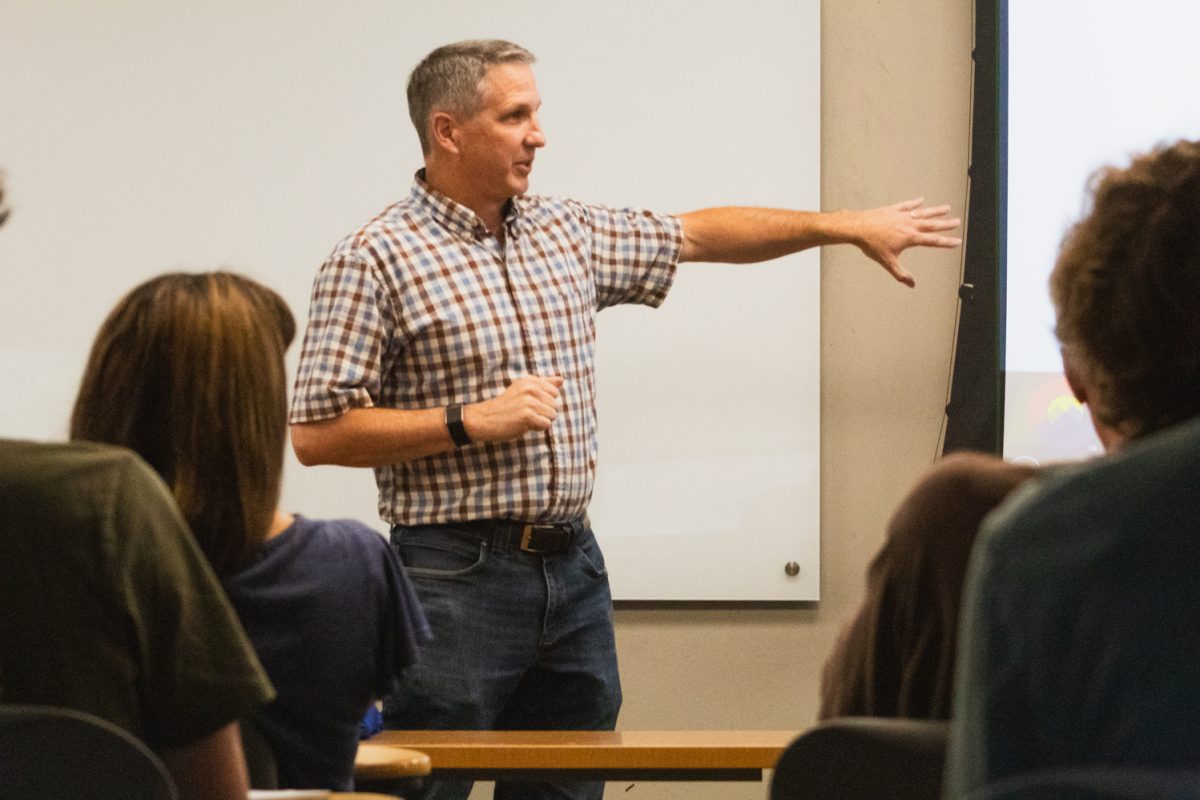
Jake Ivan, a wildlife research scientist with the Mammals Research section of Colorado Parks and Wildlife, spoke at a departmental seminar Aug. 28, discussing Canada lynx reintroduction and the species’ future prognosis.
The seminar encompassed the reintroduction of Canada lynx beginning in 1999 and discussed how the program evolved up over time.
Ivan studied wildlife science at Purdue University for his undergraduate degree, got his master’s degree in wildlife biology at the University of Montana and gained his Ph.D. in fish, wildlife and conservation biology at Colorado State University.
The continuous study on lynx habitat and the Canada lynx species has to fulfill specific criteria, including the Canada lynx requiring high initial and long-term survival, breeding and reproduction, satisfactory habitat space and population increase that is greater than mortality levels over an extensive period of time.
The research monitored Canada lynx using telemetry, a process that utilizes sensors, transmitters, antennas and more to measure data and physical values like temperature, speed or pressure.
The initial telemetry involved less-developed collars than those used more recently in lynx research in Colorado; the collars tracked where lynx were located and where they traveled.
Ivan said the scientists claimed success in 2010 when they believed their criteria were achieved. The researchers found survival was positive, habitat was fulfilled, diet fit the criteria and reproduction was successful.
“Each successive (population) peak is a little higher than the one before,” Ivan said.
Though at the time all of the criteria seemed to be fulfilled, further research and an improved understanding of lynx and their habitats proved their goal had not been achieved quite as early as believed.
“We checked off everything on the box, and the prognosis is at least stable, if not increasing,” Ivan said. “So that enables us to check off the last box and claim success, have all the press releases and pat ourselves on the back.”
Ivan continued to give an overview of lynx research from 2010 through 2024, splitting the research discussion into three main sections: winter recreation, bark beetle impact and forest management.
To analyze the impact of winter recreation, the researchers captured and collared 18 lynx and also tracked people at the areas of recreation. The lynx in areas of low recreation activity had limited responses and used many of the same areas as the visitors without changing their activity levels. Alternatively, the lynx avoided the areas of the highest recreation intensity observed, notably the ski areas.
The second part of his discussion surrounded the bark beetle outbreak in Colorado, with the composition of trees changing in response to the beetles. Ivan pointed out that snowshoe hares, one of the main prey species of the Canada lynx, are not majorly impacted by these beetles. Red squirrels, another main prey species, were far more impacted by the beetles because they altered the squirrels’ habitat.
“I thought it was interesting that the (bark) beetle kill doesn’t really impact very much,” Dylan Clements, a master’s student in the seminar said. “I grew up here and it’s devastating to see all the kills, so it was good to hear that’s maybe not a direct huge issue.”
The main conservation concern mentioned related to the hare population: If their numbers go down, researchers do not know whether red squirrels will be enough to keep the lynx satiated.
Ivan continued to speak about forest management and lynx reproduction. Researchers gathered the snow-tracking data and found den sites that have very different data: They have more coarse wood, are on steeper slopes and have a higher density of Engelmann spruce.
Ivan said he doesn’t believe they have lost much lynx habitat. Instead, the mapping and understanding of lynx habitat is believed to have improved. The current habitat and estimated distribution demonstrate minimal habitat and estimate a population of around 65 lynx, according to Ivan.
The speaker finished the talk with a focus on prominent future concerns like rapid snowmelt and wildfires, where model risk and incident managers are involved in working through these challenges. Other concerns involved the changing of carnivore relations and potentially genetic concerns.
Ivan spoke of the many researchers looking into these future challenges as well as other current questions, advising students looking into similar fields of reintroduction and restoration, saying, “Open yourself up to other jobs, other states and other systems because you never know.”
Reach Abby Barson at science@collegian.com or on social media @RMCollegian.