

He cried before he ever coached a game.
Not after a certain loss, not after a heartbreaking game-losing play but before he was responsible for wins and losses. That’s just the type of person Ali Farokhmanesh is.
“I Tweeted out yesterday that I am a crier,” Farokhmanesh said at his introductory press conference last spring. “My players know that I’ve cried with them multiple times. They put Kleenex up here for me. This is surreal. It’s the dream that I’ve had since I was a little kid.”
It wasn’t the last time he showed his emotions in his first year as head coach.
Standing there in Moby Arena with a Colorado State men’s basketball program fresh off a conference title and people trying to figure out what came next, the coach addressed his family, blood and otherwise.
Northern Iowa head coach Ben Jacobson sat among them with a Panthers shirt on, having made the trip to Fort Collins after hearing about Farokhmanesh’s promotion.
“Coach Jacobson called me this morning; he just said, ‘Congratulations,’ and, ‘Are you too big-time to answer my phone call anymore?’” Farokhmanesh said. “The next thing you said is, ‘I’m in Fort Collins.’ That says everything to me about what I want to build in a program that is going to be a family atmosphere, the same way Coach (Niko) Medved (did) it.”
Farokhmanesh learned from two of his mentors, with a combined eight years of NCAA Tournament experience, and talked about their ability to build a family within their teams.
At the time, it still sounded like something he’d say, but it didn’t have anything attached to it yet. CSU retained six players going into 2025-26, but it also received six transfers, offering an opportunity to create something new.

By March, there was.
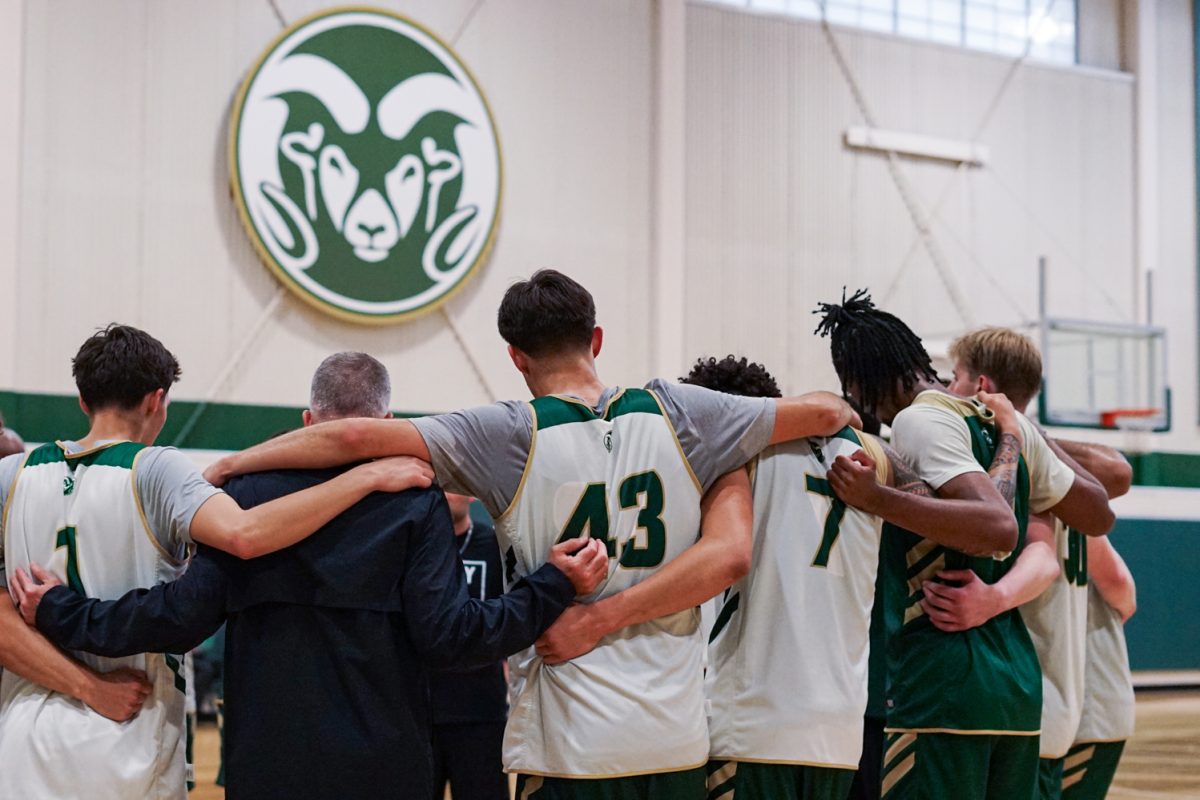
“Every single one of them was emotional,” Farokhmanesh said after CSU’s Mountain West Tournament loss against San Diego State. “Guys that I wouldn’t expect to be emotional got emotional. That’s probably because their coach is emotional. … And I told them, ‘At the end of the day, you want to be a part of a team in a program that you care enough that you do feel like that, and that’s the journey you want to go through.’ Because there’s other people that don’t get to experience that.”
The setting had changed with time. The stakes were higher in that game, but the way he talked about his team hadn’t; the emotion wasn’t tied to the result as much as it was tied to the people in it.
That part of him showed up all year, even when the season had its ups and downs.
Starting strong and then dipping into a stretch when things didn’t quite work, the roster was still shifting roles into the postseason. When the record sat at 12-10 overall and 3-8 in conference play, the year could have tilted in a different direction if it wanted to.
“It’s easy to give in, not quit necessarily, but just kind of give in and go your own separate ways.” Farokhmanesh said. “And we never changed who we are, what we did. We continue to stay together and stick to the process of things.”
There are teams that don’t come back from something like that, teams that flatten out or drift a little when things stop going their way, and this one could have, especially with so many new pieces trying to learn each other in real time. But it didn’t split like that, and CSU’s undefeated February had less to do with basketball ability than it did with everything around it.
That part wasn’t accidental, though.
“If we’re trying to develop it in the season, that’s hard now because now we’re dealing with adversity and everything else, and it gets a lot harder when you talk about playing time and who’s in the game and all these things,” Farokhmanesh said in an interview last year about Kyan Evans’ ability to connect with his teammates early on. “That’s hard if you don’t already have that initial connection built in so that you can withstand all those adverse situations that do come up.”
That foundation often showed up later, not all at once but gradually.
In the way Kyle Jorgensen had his breakout in November after a year of development under Farokhmanesh, players responded to roles and then grew into them. Jase Butler found his rhythm late in the year and stepped into something bigger than what he had been doing early on, earning a starting spot down the stretch and blossoming into one of the most important contributors.
“You look at Jase from the start of the season, right?” Farokhmanesh said after CSU’s National Invitation Tournament loss, which ended the team’s season. “Coming off the bench, making plays (and) just, like, really just competing every single possession, to what he’s become in the last two months. And I’ve told him this before, but that is who I thought he was when we first recruited him. And I think that’s the best part. He’s just starting.”
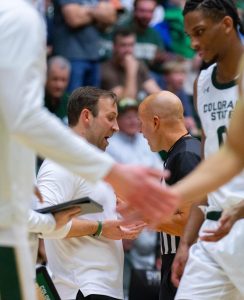
That same stretch included multiple players adjusting roles, like with Jevin Muniz moving to the bench midseason and responding with an All-Mountain West recognition, helping bind the team as a passer when it could have fallen apart.
There’s a version of a season in which Jorgensen and Rashaan Mbemba stacking injuries derailed the rest of the year, where something small might have turned into something bigger and the group started to pull apart a little. But this one held together, and that shows up in the way players talk about it when they take a step back.
And a largely different squad last year felt the same way.
“I wish I was (at CSU) even longer,” Nique Clifford said after CSU’s NCAA Tournament loss last season. “It was just the best time in my life. Like, I really can’t thank Coach Ali and the rest of the staff enough for what they’ve done for me. They really changed my life, and I’m just so thankful for my teammates.”
As an assistant coach, Farokhmanesh learned a thing or two about building something special with his players, and that energy came with success in recruiting players like Clifford and Isaiah Stevens.
For him, one thing has made all the difference.
“You (have) got to find the people and a team that you can lose with first,” Farokhmanesh said back when he first got promoted. “And I had no idea what that meant until I, until we, started coaching here, and I started learning even if we lost by 20 or we won by 20, I wanted to see these guys every single day, and I was excited to see them when I walked in the office, when I walked in the gym or when we started shooting.”
A year later, after everything that came with his first go at the helm — the ups and downs, the rough conference stretch, the way the group held together and then found something late — he came back to the same place without really changing his message.
“Surround yourself with good people,” Farokhmanesh said, talking about what stood out from his first year as a head coach. “I think that’s the biggest thing. … (The players are) high character, they’re willing to work and have a positive mindset, (and with) that you can figure out a way to get through things.”
Reach Michael Hovey at sports@collegian.com or on social media @michaelfhovey.
Interested in more sports content? Sign up for Ram Report here for weekly CSU sports updates!