
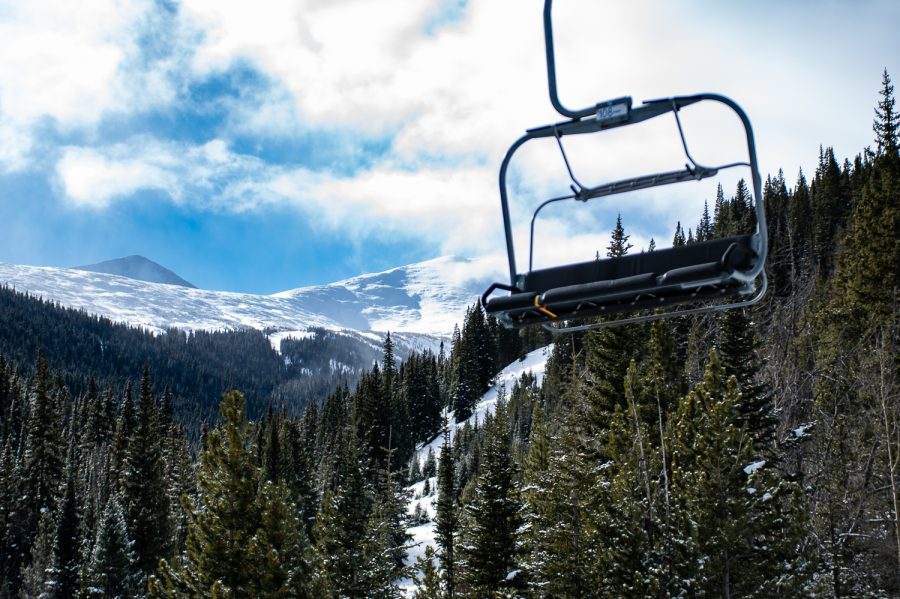
Colorado just experienced one of the lowest winter season snowfalls in recent history. Colorado State’s ski and snowboard team, CSU Freeride, felt the impact.
Grace Smith, the president of the team, said it was “definitely the worst snow year” she’s seen.
The Freeride team has prescheduled competitions, for which the team books all travel accommodations in advance.
“The biggest effect (of the low snowfall) would be all the canceled competitions that we had,” Smith said. “It’s a lot of time, work, energy and stress that goes into making the (competitions) happen, and we had the majority of our competitions canceled due to low snow this season.”
The last-minute cancellations and location changes added layers of challenge for this year’s officers.
Chase Clark, the competition officer and sponsor outreach, said these challenges brought him many difficulties.
“It’s hard to get more people interested in doing (competitions) and show them what it’s all about,” Clark said. “We only had so many (competitions) that we were able to take people to. We had them all planned out, got housing and everything, and then they just canceled it because we had no snow conditions.”
In addition to cancellations, the team also dealt with injuries when they did get on the mountain.
Clark himself suffered a season-ending injury.
“If the snow was deeper and it wasn’t so hard, there probably would have been less injuries,” Clark said.
With limited good snow on the mountain, when a rare powder day happened, the team had to be bolder than they may have been during a normal season.
“We did not have practice this season or (a) single snow event that went without an injury,” Smith said. “If you’re sending as big as we do in low snow conditions and you get injured, the consequences are pretty big.”
The Freeride team competitions feature teams from many other schools, making intense practice necessary. These practices would ideally be in the mountains with more snow than the season brought.
“Freeride is a sport where you push yourself, and if you push yourself in not ideal conditions, you will get injured,” Smith said.
Team members suffered injuries such as broken collarbones and arms. At times, the snow was so low that rocks could be seen, causing riders to hit them.
When members go for high level and big jumps, they refer to it as a “send.” The quantity and quality of sends were limited this past season.
“For send of the month, we post a clip of our members every month, (and) I would only get, like, three submissions a month,” said Piper Boonkham, team social media chair. “I would say that is probably because there wasn’t enough snow for people to be sending. There was definitely less clips being sent in.”
The low snowfall of this winter prompts uncertainty for any Colorado snowboarder or skier.
For the team, these concerns affect how they view their future.
“We’ve talked about how we’re worried that we are not going to get as much member interest because our practices and everything were affected by low snowpack,” Boonkham said. “It just took away from people’s desire to ski.”
Despite the unknowns surrounding snowpack, the team’s officers are looking to control what they can. Their financial officer, Booker Whittington, said he remains optimistic.
“I think that the club itself has been getting a lot more recognition,” Whittington said. “In the last couple of years, we’ve been growing our membership, and I expect to see that continue next year. Hopefully we get a lot of people joining the club.”
Throughout the year, the team was creative in making sure they still got practices in. Dry-land practices and slower days at the mountain were part of that. Even with low snow, being a member of the team has its perks.
“If you are a member of our team, you get free housing for practices and competitions,” Whittington said. “We’re looking to expand that even more next year.”
The team remains dedicated to building next season with fewer cancellations and complications.
“We’re just praying that (the low snowfall) will go away and be better,” Smith said. “We had high membership this year but low involvement, and if that continues, it will make it much harder for the club to keep going.”
Although the team can’t do much when it comes to snowfall, they still have their ways of preparing.
“We have a tradition where, right around November, when the resorts are starting to open up, we have a big bonfire,” Whittington said. “We burn skis as a sacrifice; we call it, ‘pray for pow.’ Our strategy for next year will be burning more skis than we did last year.”
Reach Caleb Morrow at sports@collegian.com or on social media @RMCollegianSpts.
Interested in more sports content? Sign up for Ram Report here for weekly CSU sports updates!