

After the 2024-25 Colorado State men’s basketball season ended, some fans were frustrated about the lost chance to see the Rams battle in the Sweet 16, but more than anything, there was pride. CSU had one of its most successful seasons yet, but as star players graduated or transferred out, one question remained: What could this next team be?
The answer was a 21-13 season with a winning record in conference play and a place in the NCAA National Invitation Tournament.
The Rams got the ball rolling and welcomed Ali Farokhmanesh to the helm as CSU’s 21st men’s basketball head coach after he spent the past seven seasons as the assistant and then associate head coach under former head coach Niko Medved, who departed the program to join his alma mater, Minnesota.
Soon, the transfers started coming in, with Carey Booth and Jase Butler among the first to join the Rams. Although fans might not have been familiar with them when Booth and Butler first announced their commitment, they would become some of the team’s most prominent players — ending the season with a combined 680 points.
“The way that these guys have fought all season and the way that they’ve played and competed, … I think they’ve sacrificed a lot,” Farokhmanesh said. “That’s one of the No. 1 traits as a group, is they love to compete. I would not want to go to war with anybody else.”
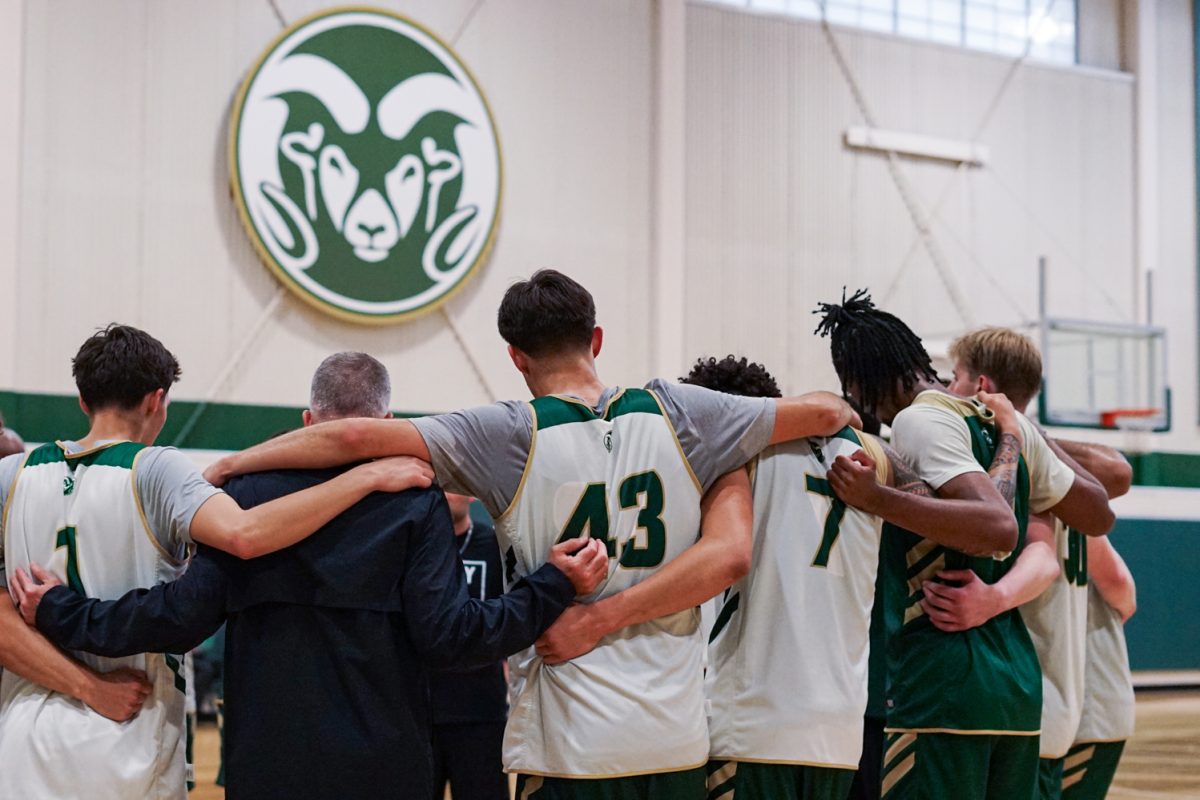
What was once a mixed group of transfers, returners and first-years melded into a brotherhood that carried through until the very end.
“When you have a bunch of new guys coming from different places that also haven’t had success where they had been before necessarily, I think it’s easy to give in,” Farokhmanesh said. “For them to stick together and trust in us, and our staff did a great job of staying together, too., … we never changed who we are, what we did. We continued to stay together and stick to the process of things.”
With every season comes challenges, and for CSU, some of the biggest hiccups came in January. Near the end of December, the Rams lost their leading scorer at the time: Kyle Jorgensen.
Before he went down in the game against Utah State, he was averaging just over 15 points and shooting 64% from the field, leaving a big presence on the court to be filled. But Jorgensen wasn’t the only one out during the height of the season.
Rashaan Mbemba, another high-intensity player, had been out for the majority of the first half of the season due to injury. He returned in January, but the Rams still struggled throughout the month, as they ended with a 3-6 record, offsetting their solid start to the season.
“We went through probably as much adversity, or more, than anyone in the conference,” Booth said. “We had guys come in (and) out of the lineup; we had injuries, but at the end of the day, the goal is a tournament. … But we can be happy knowing that we fought the whole season and fought the adversity and (were) still able to finish the season … with (21) wins.”
Although January sent the Rams far down the rankings in the Mountain West conference, when February came, a new CSU stepped on the court.
Jorgensen and Mbemba were healthy and ready to play; meanwhile, other players were getting settled and finding their rhythm. And even though that power boost came at the end of the season, it came nonetheless, showing that the Rams could compete at a high level and succeed.
CSU went from its poor winning record to a 7-0 run in February, and a big player in that was Booth.
The 6-foot-10 junior joined the Rams after a season at Illinois, where he played a total of 21 games throughout the season and scored 26 points, averaging 1.2 per game. But Farokhmanesh knew he was capable of more.
“I’m grateful to CSU for embracing me,” Booth said. “I’m grateful to the parents, the community. And I’d say the biggest thing, just believe in yourself. Like, good or bad people are going to say what they say. You can’t listen to that. Like, I know the truth about myself, and I’ll never let anything I heard, like, impact me.”
Booth found his stride in February, putting up a career-best game against San Diego State Feb. 21.
He started seeing backdoor cuts better, but he also started playing up to his size. The force on Booth’s slams and his positioning for blocks got better throughout the season, and he became more of CSU’s starting center with Mbemba seeing more minutes off the bench down the stretch.
And like Booth, Butler also experienced growth in his first year with the Rams, but it was more dramatic.
“It’s funny: It’s everything I thought Jase was going to be coming out of high school,” Farokhmanesh said. “It’s awesome to see Jase from June to now, how much confidence he has. He’s earned all of it, and there’s a reason why he’s in the position he is. … He’s one of the hardest playing guys, not only on our team but I think in this whole league.”
Butler found himself a starter with big minutes by the end of the year, and the main way he got there was through being consistent.
Early in the year, Butler came off the bench as a player without a heavy scoring expectation, but he actually led the team with 36 minutes in CSU’s MW quarterfinal loss and put up 14 points and three steals in a game which no player had an answer.
“Just stay together,” guard Jevin Muniz said. “Just keep fighting together.”
And although CSU’s postseason wasn’t glamorous, the final record showed a team who figured out the coach and roster turnover.
A hot start to the season, a rough conference patch and a fizzled end to the postseason, the Rams leaned on multiple players this year and figured out how to adjust until the last game.
“The end of the games and the season, like, all that stuff is the way that matters,” Jorgensen said. “You could go win this whole year and win the tournament. So I’m proud of us for just sticking to it and fighting as hard as we can.”
Reach Sophie Webb at sports@collegian.com or on social media @sophgwebb.
Interested in more sports content? Sign up for Ram Report here for weekly CSU sports updates!