
Editor’s Note: All opinion section content reflects the views of the individual author only and does not represent a stance taken by The Collegian or its editorial board.
Every March in the United States, Ireland gets flattened into a costume.
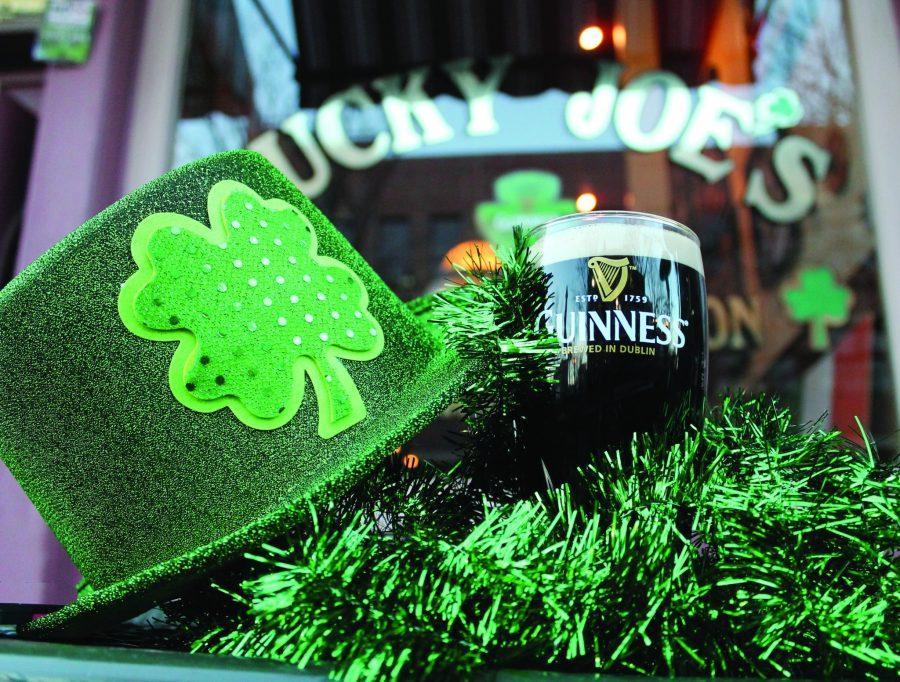
It shows up in neon beer, plastic shamrocks, leprechaun caricatures and the annual permission slip to act like being Irish is just being loud, drunk and covered in green glitter. St. Patrick’s Day is marketed as harmless fun. It stops being harmless when an entire people’s history becomes a joke, and a feast day tied to colonization, conversion, famine and migration becomes a commercial theme party.
And every year, someone threatens to pinch me if I’m not wearing green.
It’s surreal because the day they’re joking about is tied to the religious upheaval my own ancestors lived through. The version celebrated in the United States is a party. The version my family knows is quieter. We stay home. We make corned beef and cabbage. Nobody is chugging green beer.
The first complication begins with the man at the center: St. Patrick was not ethnically Irish. He was born in Britain, kidnapped by Irish raiders and enslaved in Ireland. After eventually escaping, he later returned as a Christian missionary.
The story most Americans celebrate is a simplified myth about a figure whose life was far stranger and more complex than what is observed in the U.S.
That complexity matters because Ireland’s religious history was never as neat as the U.S. holiday suggests. Patrick did not single-handedly “convert” a blank pagan island in one triumphant sweep. Historians note that Ireland was not entirely pagan when Patrick’s mission began, and the island’s Christianization unfolded gradually over centuries. Early Irish literature and mythology were often preserved by monastic scribes who recorded older traditions even as religious structures shifted. “Irish folklore” and “Celtic myth” did not disappear; they were carried, rewritten and reframed through changing religious and political systems.
That doesn’t make the process innocent. It makes it complicated, and the complication is exactly what gets erased in American St. Patrick’s Day culture.
Pre-Christian Ireland contained rich mythic traditions, sacred landscapes and complex cosmologies that still shape Irish culture today. But the spread of Christianity in Ireland, while often described as relatively peaceful compared to other regions, still involved cultural displacement. Older religious worlds were absorbed, reinterpreted, demonized or subordinated. The Irish language was suppressed and criminalized. While it may be true to say the conversion was not one massive campaign of forced baptisms, to pretend it was therefore painless or apolitical is false.
Religious change is rarely just theological. It is about power: whose symbols remain visible, whose worldview becomes official and who survives only as folklore.
And that history becomes even more complicated when Catholicism itself is treated as an important aspect of Irish culture. Catholic identity in Ireland later became closely tied to resistance against British rule, but the church also accumulated enormous institutional power within Irish society. That power carried its own consequences. Institutions linked to the church — including the Magdalene laundries — operated well into the 20th century, subjecting thousands of women to forced labor and social punishment.
Any honest discussion of Irish identity has to reject easy narratives. Catholicism in Ireland has been both refuge and instrument, both a marker of cultural survival and a source of institutional harm.
St. Patrick’s Day marketing rarely acknowledges this. Instead, it transforms Irish culture into an aesthetic. My mom’s ankle tattoo of the Irish Claddagh wasn’t simply because she liked the aesthetic of it — it was a tribute to my great-grandmother.
Historically, March 17 was primarily a religious feast day in Ireland. It became an official bank holiday in 1903, and for much of the twentieth century, pubs were actually closed on the holiday out of respect for its religious significance. Ireland’s modern St. Patrick’s Festival deliberately expanded the celebration into an international cultural event, supported by tourism and the country’s exportation of the holiday’s imagery.
But commercialization should not be confused with authenticity.
The American version is especially distorted because it exists on top of a long history of anti-Irish prejudice. During and after the Great Famine of the mid-19th century, roughly one million people died in Ireland, and another two million emigrated. Those refugees arrived in the United States only to encounter hostility and discrimination. “No Irish Need Apply” signs were real, as well as newspaper cartoons portraying Irish immigrants as ape-like, violent and dirty.
The stereotype of the “funny drunk Irishman” did not appear out of nowhere. Those are the stereotypes American St. Patrick’s Day pays tribute to.
Today that same stereotype has been repackaged as party decor. Irishness is marketed through leprechauns, shamrocks, fake brogues, green beer and “Kiss Me, I’m Irish” T-shirts. The tone has shifted from open hostility to a cheerful caricature, but the stereotypes’ structures and origins remain intact.
The obsession with Celtic imagery often functions less as engagement with Irish language, literature or myth and more as decorative branding. A culture shaped by invasion, colonization, famine, religious struggle, migration and resilience becomes a whimsical aesthetic.
Defenders of the holiday respond the same way: It’s just fun. But “just fun” is often how stereotypes become normalized. It is how people excuse behavior they would immediately recognize as offensive if directed at almost any other ethnic group. And it’s how a solemn feast day tied to a complicated history turns into a green-tinted excuse to forget that history altogether.
If you’re going to celebrate St. Patrick’s Day, at least understand what you’re celebrating. Spell it “Paddy,” not “Patty.” Buy the memorabilia if you want. Just don’t mistake green beaded necklaces and public drunkenness for an appreciation of Irish culture.
If the goal is celebration, support Irish businesses, engage with Irish art and language and leave the stereotypes behind.
Reach Maci Lesh at letters@collegian.com or on social media @RMCollegian.