
Editor’s Note: All opinion section content reflects the views of the individual author only and does not represent a stance taken by The Collegian or its editorial board.
We all grew up hearing tips on how to reduce our water intake. Our parents would tell us, “Only take five-minute showers!” or, “Turn off the faucet when you brush your teeth.”
Now, “Don’t use artificial intelligence,” has become the mantra for reducing water usage.
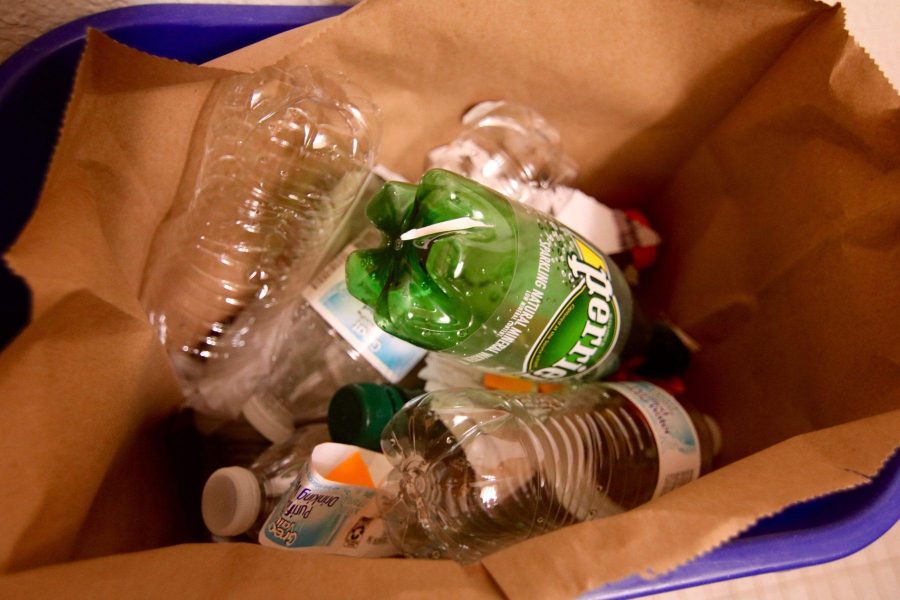
I have another to add: Stop buying bottled water.
People have surely told you to stop using bottled water because of the plastic waste it produces. Now, that is a good reason; single-use plastics are a completely avoidable nuisance, but that is not the only reason.
Bottled water companies are contributing to a global lack of safe and reliable drinking water, and they do so at a massive upcharge.
Most bottled water is extracted from groundwater. Nestlé Waters takes around 3 million liters a day from Florida Springs. In other countries, like parts of France or China, that number is even higher, at 10 million and 12 million liters a day.
People across the globe rely on groundwater for various reasons, including for personal use and agriculture. According to a study from the United Nations University, “Over 2 billion people rely on groundwater as their primary water source.” Because bottled water companies use water at such a high rate, there is not enough time for it to naturally replenish, which depletes the overall amount of water at an alarming pace.
It’s also important to note that the market space of bottled water, which is growing faster than any other category in the food market, accounts for 60% of sales in some global regions. In 2025, the industry on a global scale made an estimated $451.47 billion. I cannot even fathom that amount of money.
Yet, it would take a fraction of that money to globally fund safe drinking water — around a yearly $114 billion USD with sanitation, waste management and hygiene included.
The bottled water industry can make this profit because of their massive up-charge on water. As researchers Zeineb Bouhlel and Vladimir Smakhtin said, “Bottled water corporations exploit surface water and aquifers — typically at very low cost — and sell it for 150 to 1,000 times more than the same unit of municipal tap water.”
These corporations get away with up-charging due to the pervasive idea that tap water is unsafe. And, in some impoverished countries, this is true. Many governments worldwide do not or cannot regulate water to provide a safe water supply, which is why the “rising consumption of bottled water can be seen as a proxy indicator of decades of governments’ failure to deliver on commitments to safe public water systems,” according to Bouhlel and Smakhtin. This allows for the continuation of bottled water’s exploitation and sometimes offers such governments an excuse to not improve water supply purification.
Yet, for many places including the U.S., this is not true. Bottled water is subject to less testing than tap water. The Food and Drug Association requires that bottled water plants test at the plant at least once a week and at the source at least once a year. But in the City of Fort Collins alone, 13,834 tests were done on 3,239 samples across the water supply system in 2024. That’s roughly 266 tests per week. Tap water in the U.S. is safe to drink — and if you’re really that scared, get a Brita filter.
At the end of the day, where you get your water from is your business. But I would think long and hard about where it does come from and whether the price of a bottled water really beats out the global benefits of a reusable one.
Reach Audrey Weishaar at letters@collegian.com or on social media @RMCollegian.