
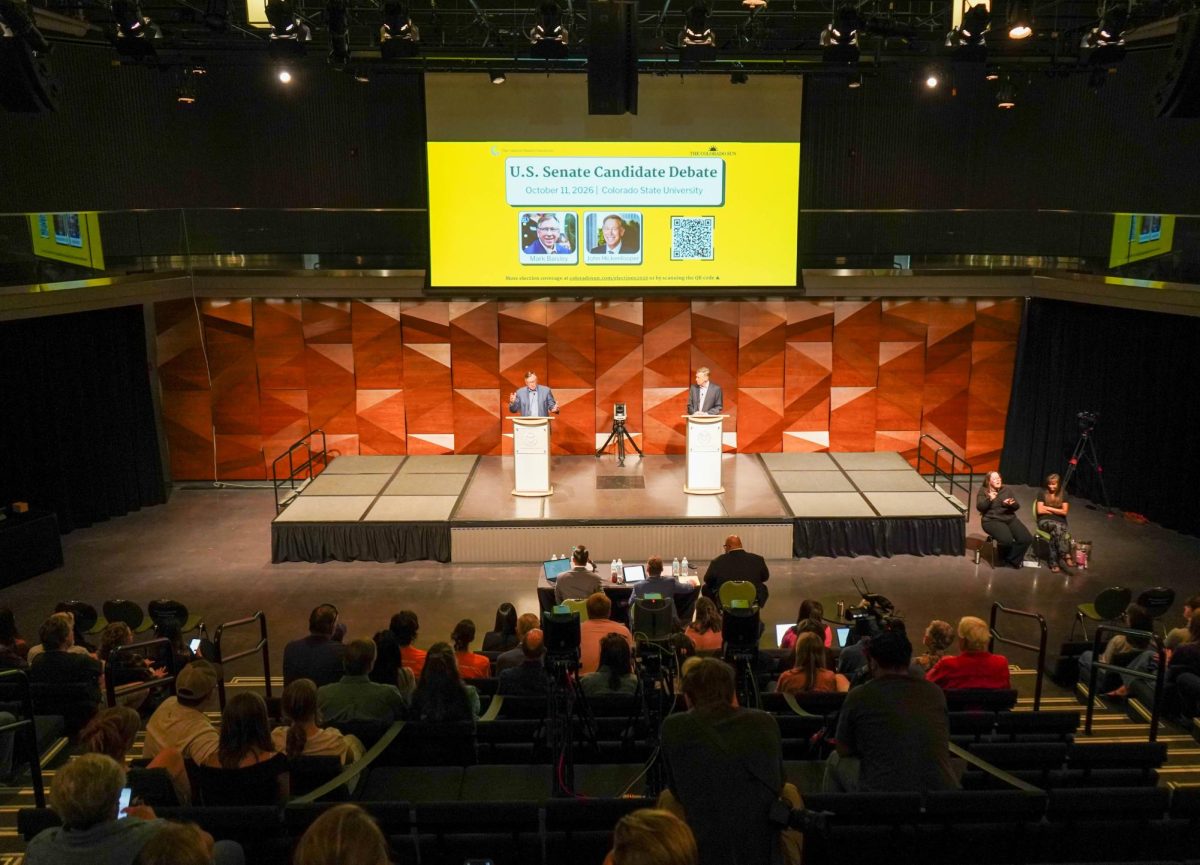
Two candidates competing to represent Colorado in the United States Senate met at Colorado State University’s Lory Student Center Theater Sunday, Oct. 11 to debate topics including the cost of living, immigration and data centers ahead of the Nov. 3 midterm elections.
Candidates present at the debate included incumbent Democratic U.S. Sen. John Hickenlooper and Republican state Sen. Mark Baisley. The event was hosted by The Colorado Sun, a nonprofit news organization, and the moderators for the event were Colorado Sun elections editor Jesse Paul and Entravision News Anchor Rafael Contreras.
Hickenlooper has been a United States senator since January 2021. With a long-standing career in politics, Hickenlooper formerly served as the mayor of Denver from 2003-11 and as the state’s governor from 2011-19. According to Hickenlooper’s campaign website, the senator prioritizes opposing the actions of President Donald Trump’s administration, working toward equitable solutions in the economy, opposing violence committed by Immigration and Customs Enforcement and more.
Baisley currently represents Colorado District Four in the Colorado State Senate and previously served in the Colorado House of Representatives. He ran unopposed in the Republican primary and is not seeking re-election in the state senate. According to his campaign website, the current state senator focuses on affordability through the private sector, the promotion of safe communities through increased law enforcement funding, enforcing immigration standards and backing private agriculture.
Attendee Linae Warden said while the debate didn’t change her mind about who she’ll vote for in November, she believes the event underscores the power of information and sharing it with others.
“We don’t often get to see and hear people who are running for significant offices,” Warden said. “That is, offices that hold a great deal of power and influence, and put them next to each other and (have them answer) the same questions. And I think it’s really important. A lot of voters don’t have a lot of time or bandwidth to look into what’s going on. And a lot of people don’t vote. The fact that it’s here at CSU is great because I’m hoping more students look at this. A lot of young people feel like, it seems to me, they don’t have any power, and voting is a huge part of power, but voting with information has the most power.”
Here are some key stances the candidates took:
Cost of living and affordability
According to a 2026 poll from The Colorado Health Foundation, 85% of Coloradans view the rising cost of living as a serious issue.
Baisley, who answered the question regarding affordability first, said the nation needs a smaller federal government to get the “economy cooking,” saying a free-market-based economy may buy itself out of being unaffordable over the next few decades.
“Our economy will cook when our government is smaller and just facilitates commerce, rather than trying to take over Congress and getting in the way,” Baisley said.
Hickenlooper discussed Trump’s tax cuts for the wealthy and his One Big Beautiful Bill Act, saying these tax cuts “put that burden in terms of healthcare costs, reducing Medicaid.”
Baisley posed a question to Hickenlooper asking him to explain what he would do differently to address a decline in Colorado’s cost of living.
Hickenlooper said Colorado is taking a pause after growing at an above average rate for over a decade and referenced withdrawn federal funding, explaining how the state has faced attacks from the president’s administration. With support from Washington D.C., he said the state could make “great strides” again.
Immigration
Baisley said illegal immigration isn’t the only way to get people into the United States and blamed former President Joe Biden’s administration, which he said “caused this problem in the first place.”
Baisley also said ICE should respect the people they’re picking up and follow expectations other law enforcement are obliged to. He claimed he could build “healthy constructive relationships,” with the Trump administration, which he claimed Hickenlooper has failed to do.
Hickenlooper said he has a problem with ICE and the way it hires and trains its agents, describing ICE as “a secret police force that operates without any rhyme or reason.”
The two candidates also discussed the GEO Aurora ICE Processing Center, which was revealed to have had a tuberculosis outbreak over the summer, as well as a new ICE facility planned to open in Hudson, Colorado.
Data centers and artificial intelligence
The candidates discussed the Ratepayer Protection Act that would’ve addressed the costs of data centers by protecting ratepayers from paying increased prices. The act passed the U.S. House of Representatives with a 417-3 vote, however the U.S. Senate blocked the bill.
“This was one of those bills that would do a lot of good for the residents within the area of a data center, and it made sense to everybody in the House, but when it got to the Senate, it was a political vote,” Baisley said.
Hickenlooper, who voted against advancing the bill, said it “was a fake solution,” even though he said he was in favor of data centers paying their share and that they “have no right to impose themselves on communities.”
“What we need to do is pass a law that says every community, every county (and) every state has a right to make their own rules around data centers, and the data centers don’t get a free ride,” Hickenlooper said.
Working with Trump
While Baisley is a supporter of Trump, he said he is thinking long-term about the role, noting if he were elected, only two years of his term would be spent under the Trump administration.
“I have a statue on my desk at all times, and it’s not a statue of Donald Trump — it’s a statue of Thomas Jefferson,” Baisley said. “I have him facing me, holding the Declaration of Independence, to remind me at all times of the family principles of the nation. So if I’m anybody’s sycophant, I’m Thomas Jefferson’s.”
Throughout the debate, Hickenlooper frequently expressed his opposition to Trump, saying “we need a change,” and “Mr. Baisley applauds every single step of what the president’s done.”
When asked if there was any room to work with President Trump or if it would be pure opposition, Hickenlooper said he supported the president’s “no tax on tips” policy implemented through the One Big Beautiful Bill Act.
Reach Chloe Rios at news@collegian.com or on social media @RMCollegian.