
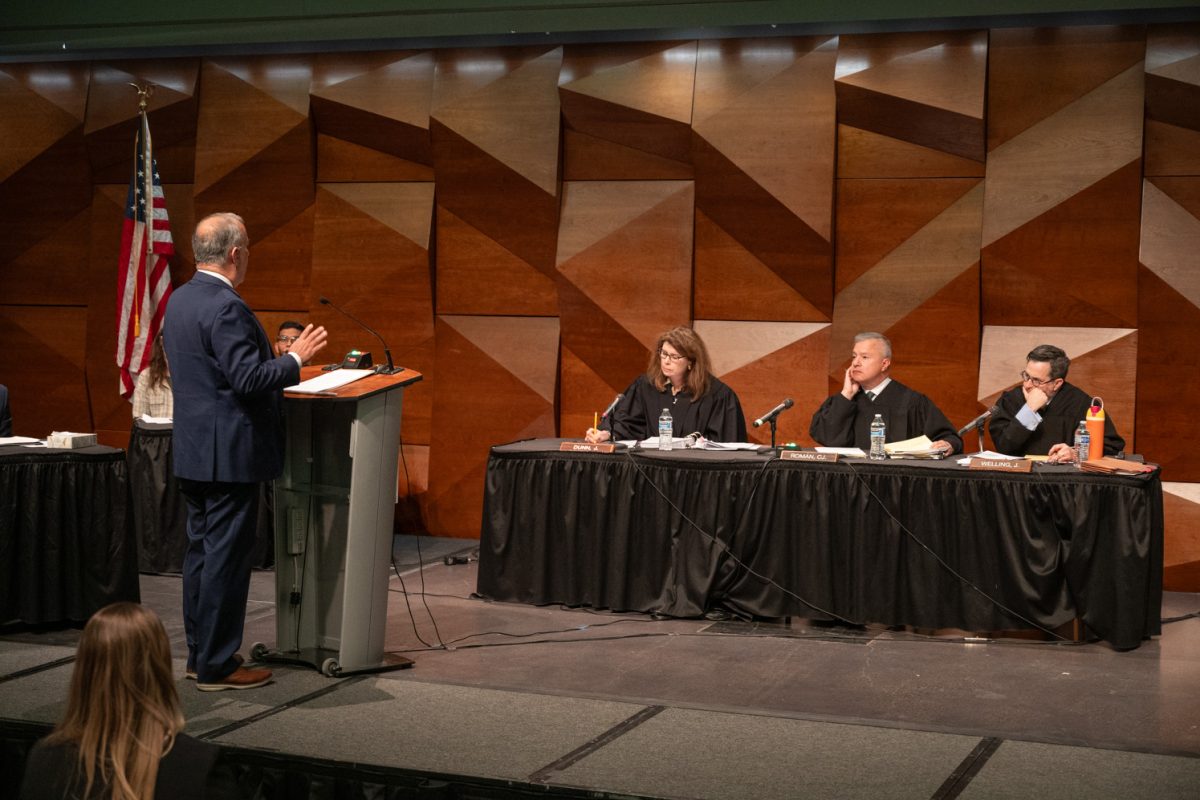
Tuesday afternoon, the Colorado Court of Appeals heard two oral arguments at Colorado State University. The event was part of Courts in the Community, an educational outreach program operated by the Colorado Judicial Branch that aims to connect students with Colorado’s judicial system.
The event was one of many during the third annual Democracy Summit hosted by Colorado State University and allowed students and community members to see the Colorado Court of Appeals in action.
“The Democracy Summit began in 2024 as part of CSU’s Thematic Year of Democracy,” said Courtenay Daum, a professor in the political science department and member of the Democracy Summit. “It’s organized by the College of Liberal Arts and aims to bring students, faculty and community members together to explore, celebrate and strengthen the many ways that we participate in democratic life. Today’s Courts in the Community session helps to put that mission into action by transforming civic education from something we study into something we’re able to witness and experience firsthand.”
The Court of Appeals acts as a court of review, meaning it does not hold trials or decide cases based on new evidence. Instead, it reviews procedures during trial to ensure laws were applied correctly.
Oral arguments presented to the Court of Appeals were heard by a panel of three judges: Chief Judge Gilbert M. Román, Judge Stephanie Dunn and Judge Craig R. Welling were the judges present for Tuesday’s cases. Román and Welling were CSU alumni, and all three judges emphasized the importance of bringing the courts closer to the people.
“It’s been 40 years that the Court of Appeals and Colorado Supreme Court have gone around the state in what we call a ‘Courts in the Community’ program doing these kinds of oral arguments,” Román. “We do them because we think it’s important to get out of the courthouse in downtown Denver and get out among our citizens and among the voters who are part of the community of Colorado; because in the end, we are Coloradans. We represent you.”
The Court heard two cases: one civil and one criminal. Each oral argument was 15 minutes and presented by an attorney. Students and community members could observe these arguments as if they were in a courtroom.
The civil case, SMB Advertising, Inc. v. City of Boulder, concerns the issue of whether a city may require a fee payment by a news outlet requesting unreleased, unedited police body-worn camera footage after an allegation of police misconduct. The trial court ruled that Colorado state law prohibits these fees, which led to the City of Boulder appealing the decision.
The criminal case, People v. Albat, is the denial of a post-conviction motion, meaning that the defendant was convicted during trial but is now appealing this decision. The defendant was convicted of first-degree murder but claims that he had ineffective assistance of counsel during trial. The appeal discussed whether trial counsel was ineffective for relying on self defense theory, rather than investigating and presenting a voluntary intoxication defense, given the mental health of the victim.
Viewing the presentation of these cases acted as a way to connect the court system to the public that it serves.
“There’s distance in most people’s minds between the public and the court,” said Sonya Bauer, a student who attended the event. “We think of the court as these stony, immortal beings, but they’re real people. They think like normal people and talk like normal people, and they’re more relatable than I think most people would assume.”
For students and community members interested in pursuing law, the event was a firsthand experience of what a Court of Appeals courtroom feels like. It displayed the reality of oral arguments and allowed the audience to better understand how appeals cases are presented.
“One of the things I liked about seeing oral arguments for the first time was, I was like, I can do that,” said Daniel Williams, an attorney representing SMB Advertising. “I hope that is something you take away from today.”
Reach Samantha Whitted at news@collegian.com or on social media @RMCollegian.