


Editor’s Note: All opinion section content reflects the views of the individual author only and does not represent a stance taken by The Collegian or its editorial board.
The Turning Point USA chapter on campus recently invited Gays Against Groomers, which has been labeled by the Southern Poverty Law Center as an anti-LGBTQ+ hate group, to speak at one of their meetings.
Essentially, members of GAG shared their views on queer concepts — calling gender-affirming care a “lie,” saying there’s a “trans-rights movement” that wants to “strip women and girls of their right to consent” and proclaiming that “the whole transgender movement is literally built on a foundation of pedophilia.” For more context and information, I recommend reading this article.
The organization itself — that quite possibly has the least thought-out acronym I have ever encountered — claims “gender ideology isn’t just a neo-religious cult; it is biotechnological warfare in drag.”
To call these claims questionable would be an understatement, and the list of them made by GAG is long. But the debate on trans rights transcends any individual organization. This event is but a snapshot — a thermometer of where we are culturally on campus and as a nation.
As someone who identifies as transgender, I’ve found there are a lot of people discussing trans rights for us and not so many listening to us. This is frustrating, and it was something I planned to address more in this piece until I came across something unexpected: an invitation to speak for myself.
The Turning Point chapter said at the event that their goal is to “hear all perspectives” and “make sure that (they) are very well educated on any type of topic,” and they “have a reason to stand firm in (their) beliefs for that topic.”
I appreciate the thoughtfulness and will graciously accept the opportunity to share my perspective with Turning Point and anyone else who is confused about “gender ideology.” Please allow me to educate you.
Firstly, there is no such thing as “gender ideology.” If you go to Merriam Webster, you’ll find there is no definition attached to the term. While there are organizations that advocate for human rights for trans people, there is also no “trans movement.”
We are just people. Not an ideology, not a movement and not a political opinion. Just people.
People who get up in the morning. People who pour cups of coffee and walk to class. People who drive to work and who feel the fatigue of a long day. People who laugh, cry and make mistakes and who have hopes, dreams and fears. People who love, and people who live.
I lived the first 14 years of my life as a man, and it just wasn’t for me. I don’t think masculinity is wrong or bad, but the aesthetics and expectations of it didn’t make me feel like I was being myself.
I don’t like wearing suits and ties, having facial hair or being “one of the dudes” — no offense toward the dudes, of course. For those 14 years, I was so confused, and I didn’t know why I felt so weird — why I hated going shopping for clothes, or why I didn’t want to get my hair cut. I just felt so different.
When I came out and started wearing women’s clothes, it was the first time I felt I was wearing something because I actually liked it, and not because society said I should like it.
What also wasn’t and isn’t for me is most gender-affirming care. Despite what GAG — ironically, what I refrained from doing as I researched this — would have you believe, not all trans people want or need gender-affirming care.
Being transgender is largely a social transition. It’s about finding an identity and aesthetic that feels right for you. We don’t, nor have we ever, denied biological sex — I am, in fact, very aware that I have a penis. But there’s just so much more to the experience of being a person than what’s between your legs.
However, as many people across our society can attest, society sometimes puts a lot of emphasis on what a man’s or woman’s body should look like. As a woman, whether cisgender or transgender, you might struggle wearing some dresses simply because you don’t have the body type or shape society pressures you to have, and that can feel like there’s this impossibly high bar you can never reach. That’s dysmorphia, and it’s something anyone, cis or trans, can feel.
For trans people, that feeling of not being good enough can compound over months and years to become an ever-present weight — a perpetual feeling of inadequacy. Gender-affirming care, for some, provides a chance to release that weight.
Do those treatments have potentially life-altering side effects? Yes. Binders need to be used properly, changing hormone balances requires expert physicians and surgery can be permanent. Deciding whether you want gender-affirming care, and if so, how much, is a huge decision that needs to be taken seriously.
But do you know what else is serious? Being able to feel like you’re enough, like you can be yourself and be satisfied with yourself. Those are needs, too.
In the way I experience transness, I don’t need much, if any, medical treatment, but some trans people 100% do. Just because it’s not right for everyone doesn’t mean it isn’t right or necessary for some.
And all of that — the stress, the weight, the decisions — is without even considering the stigma toward having a trans experience. The anxiety is truly amplified when your rights are treated as a political position, having people accuse you of “grooming” children because you don’t want to wear a suit and tie or having people call you an alphabet person, a faggot or a tranny.
All I hear is how terrified people are of me using a women’s restroom — which I find truly hilarious, because I promise I’m just as terrified of using a women’s restroom with cis people as they might be of using one with trans people.
As others have pointed out, violence against trans people is very real. With the amount of rhetoric saying I’m supposedly a dangerous predator out to perv on people pissing, and how people should take enforcement into their own hands, I have, in my five years of being trans, never once used a women’s restroom out of fear for my safety. I probably never will.
Truly biotechnological warfare at its finest.
Because I use she/her pronouns, GAG considers my life an unholy temple fundamentally built in service of pedophilia. My question to our Turning Point chapter is: Don’t you think that might, just maybe, be a bit of an exaggeration?
Turning Point, I’ll be honest: I’m just a little disappointed in you. I mean, surely, in all of your hours of tireless research, did you not notice GAG is kind of manipulating you? Was the irony lost on you that, for all its talk of shielding children from gender ideology, GAG sure does sell a lot of baby clothing, and the official GAG children’s picture book seems to push a lot of GAG’s own ideology on how gender should be expressed.
For a group that’s supposedly not a hate group, the GAG calendar, which depicts a trans rights activist as a vampire frothing at the mouth, looks a lot like fearmongering. Since you’re so educated, Turning Point, didn’t that flag you as textbook hate group behavior?
Can you not see the root of all hate is fear? That hate groups such as GAG gain prominence because some people — say, young conservatives — are afraid that allowing different experiences somehow threatens the validity of their own experience? You realize that makes no sense, right? Or that none of what GAG says makes much sense? How does something like puberty blockers equate to pedophilia? What is the logic behind that?
GAG knows if people understand trans people, then they cannot fear them, and thus, cannot hate them, which is why hate groups attempt to diminish understanding.
Turning Point must understand this is why the Nazis burned books, right? Or that this is why GAG uses terms like “gender ideology,” a phrase with no definition — because if there is no explicit definition, then there is no way to understand it, and thus, it’s easier to make it a thing to fear and hate.
This is why GAG tells people to be wary of empathy; for if you see yourself in someone else’s experience, then you have gained some fundamental understanding of them. Are you really so blinded by bias that you listen to someone who tells you to be less empathetic?
GAG says my goal, as part of my pro-trans playbook of responses, is to shame you, Turning Point. And if you feel like you are being shamed, my advice is to consider refraining from such shameful behavior as bringing a hate group to campus.
How’s that for a perspective?
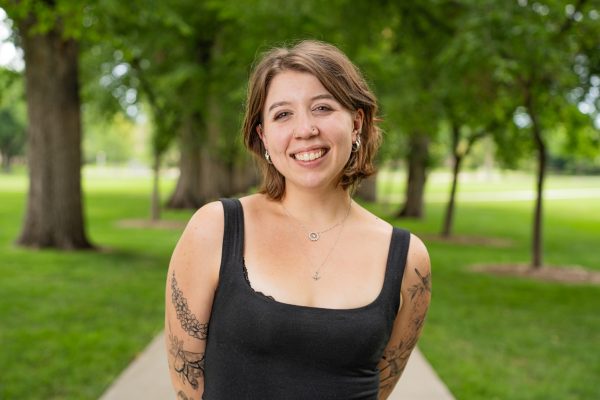
Reach Maxine Bilodeau at letters@collegian.com or on social media @RMCollegian.





Ella • May 8, 2026 at 9:04 am
While I think this article does a good job at unpacking the dehumanization put forth by GAG and platformed by TPUSA I do feel that you project your own experiences of transness to speak for all trans people. Take this statement, “ Being transgender is largely a social transition. It’s about finding an identity and aesthetic that feels right for you. We don’t, nor have we ever, denied biological sex.” As a trans woman who medically transitioned very young this feels to me like it comes from the perspective of someone who hasn’t required medical transition. For those of us who require HRT and/or surgery transition is social transition is a small part of our transition. We understand that by medically transitioning we do in fact change our “biological sex” characteristics. I don’t think the statement in the article reflects the experiences of medically transitioning trans people and I wouldn’t make assumptions that all others experiences are the same as your own.
Additionally, there is a conflation between body dysmorphia and gender dysphoria. The discomfort a cis woman feels due to societies pressure towards women is not the same as a trans woman’s distress caused by effects of testosterone and the biopsychosocial consequences of having to engage with the world in that way. Medical transition is often the answer for this rather than just accepting this distress as was implied in the article.
There is an excellent dismantling of the rhetoric used by GAG in this article. However, that is intermixed with over-generalizations of the experience of being a trans woman. While I appreciate your own experience I also think it’s important to realize that many others do not share the experience as you.
MachaLou • Apr 30, 2026 at 3:15 pm
Well said. Thank you.