

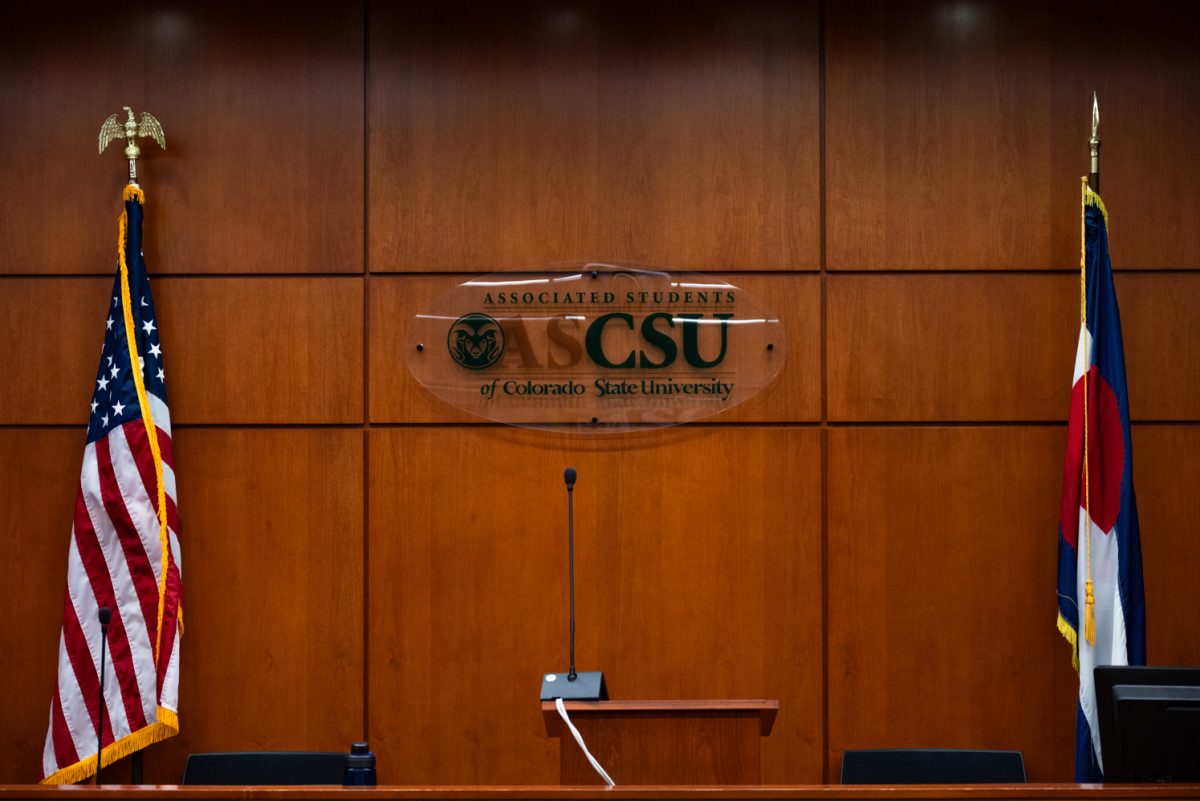
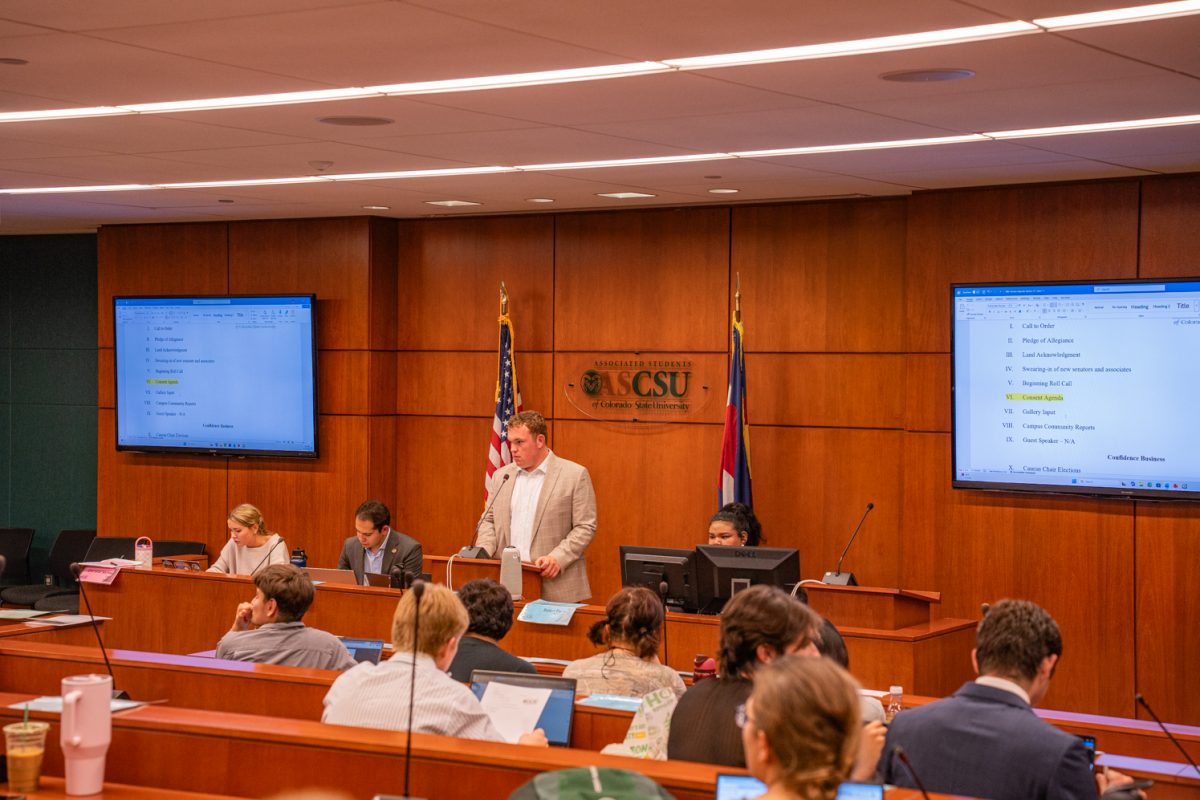
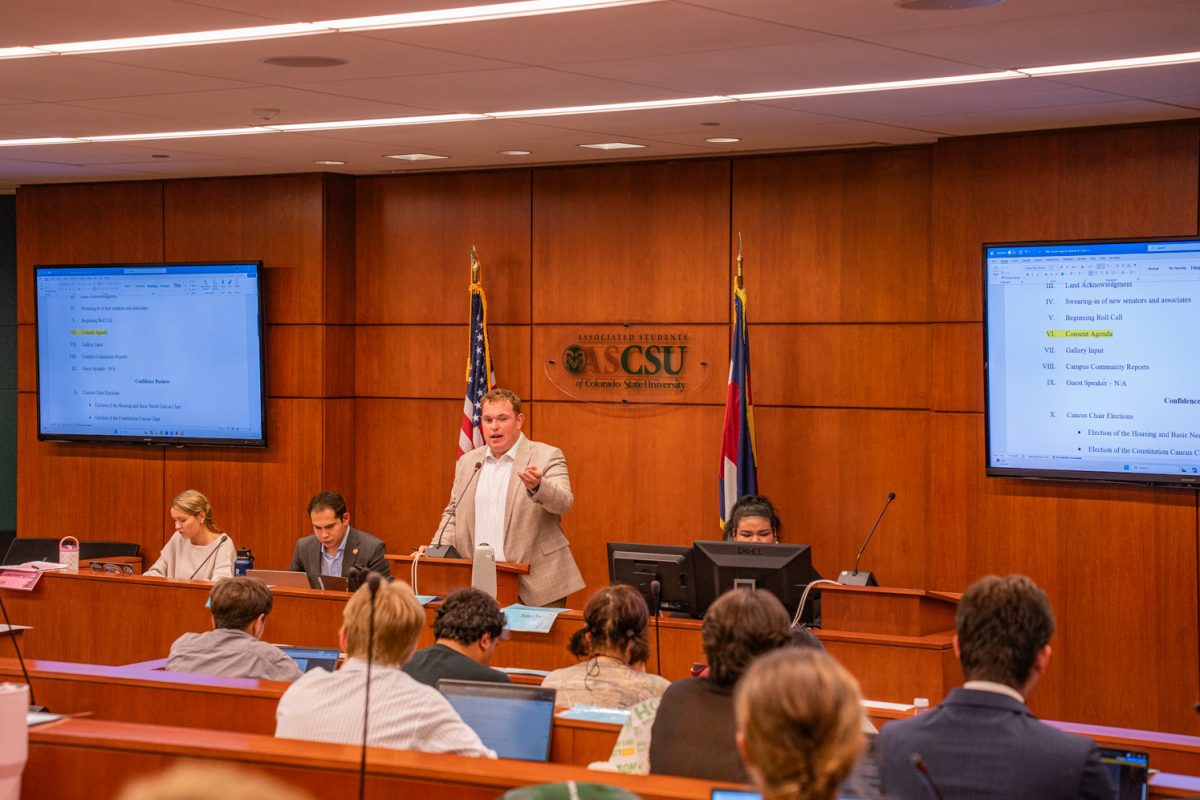
The Collegian has confirmed that for at least four years, Associated Students of Colorado State University election campaigns and elected officials have been approached by and accepted funds from Campus Victory Project, a student leadership subset of conservative political nonprofit Turning Point USA.
Several former ASCSU elected officials have confirmed that multiple elected student-government members have attended CVP conferences with the financial backing of the organization.
CVP, an initiative by TPUSA, aims to “commandeer the top office of student body president at each of the most recognizable and influential American universities,” according to a CVP-designed brochure obtained by The Collegian.
In reference to these student government offices, the brochure reads: “These select leaders that we have supported and financed will have direct oversight and influence over more than $500 million in university tuition and student fee appropriations.”
ASCSU’s Student Fee Review Board, chaired by the vice president, oversees a $57 million budget of student fees every year.
The Collegian received an anonymous tip Thursday, March 5, that a current ASCSU campaign is being funded by CVP. While gathering information, The Collegian received a second anonymous tip that previous ASCSU administrations received funds from CVP for their campaigns.
To investigate, The Collegian reached out to the last five ASCSU presidential administrations: Christian Dykson and Merry Gebretsadik from 2021-22; Rob Long and Elijah Mason, formerly Sandoval, from 2022-23; Nick DeSalvo and Alex Silverhart from 2023-24; DeSalvo and Braxton Dietz from 2024-25; and Jakye Nunley and Joseph Godshall, the current administration.
Godshall said he was not aware of whether his campaign took any funds from CVP but noted that he attended conferences.
“I did attend a leadership conference before I announced my campaign to run a ticket with Jakye (Nunley),” Godshall said. “The conference that I attended did not influence me to try and influence any policy at all on campus. It was just an opportunity to connect with other student leaders around the country.”
Godshall said he was not aware of his campaign’s finances and deferred to Nunley.
“I didn’t handle the campaign finances for my team, and also, I wasn’t responsible for networking or reaching out to these people,” Godshall said. “It was simply for me — just an opportunity to connect with other student leaders and help me grow as a leader, and I think it did just that. They don’t influence any policy, but they do offer a lot of educational resources about how to connect with other leaders or other state leaders.”
When The Collegian contacted Nunley, he said he would not comment and deferred to a legal team for further questions.
“I am declining to comment,” Nunley said. “My current campaign that I’m under is not operating with any affiliations to this organization. … I’m unclear on the motivations that came about for all of this. … If there (are) any (other) questions that you have for me, I can move you (to) somebody who can answer those. It’ll be legal counsel, but that’s what I have right now”
As for the former student body president, DeSalvo said CVP targets moderate student campaigns for election.
“To be honest with you, it was in order to elect more moderates, I think,” DeSalvo said. “I think the organization understood that the typical far-right conservative types couldn’t get elected to student body elections, so they would seek out moderates and even, in some cases, liberal candidates that weren’t, for lack of a better term, super far-left or progressive in order to get elected to leadership.”
ASCSU campaigns can be funded by either donations or personal expenses. If candidates claim donated funds, they must be reported on a donation and expenditure report, which campaign treasurers submit to the elections management team each week. This includes receipts of expenses covered by donated funds.
However, if a campaign chooses to use personal funds, the rules are less strict, with the ASCSU Elections Code only requiring campaigns to keep to a spending maximum of $1,250 between personal, donated and imposed funds.
According to the Elections Code, “(The donation and expenditure) report must also disclose all sources of donated funds to the campaign, whether received prior to or during the campaigning period.”
The Collegian also contacted all current ASCSU candidates for president and vice president to ask if they had been contacted or took money from CVP. In addition, The Collegian contacted the speakers of the senate from the same time period.
Long, who served as ASCSU president from 2022-23, confirmed he was contacted by CVP in relation to campaign funding.
“I received a phone call from them and they were like, … ‘You know, we usually fund campaigns, but yours already started so we can’t — we’re not going to fund yours,” Long said. “I didn’t need their money anyway, but they essentially just wanted to introduce themselves to me.”
Long said that although CVP initiated contact with him during his presidential campaign, he did not accept any funding from the organization while he was running or during his tenure as student body president, nor was he aware of any prior or current activity between the organization and other ASCSU campaigns.
“No, I’m not aware of any (past activity),” Long said. “All I know is that my campaign, me and Elijah Sandoval, we never took a cent from them.”
Mason, who was in office with Long, said she did not attend CVP conferences but was aware that Long and DeSalvo had.
“I do remember when we got elected; we were told about this conference in Florida that Rob and Nick DeSalvo went to,” Mason said. “And from what I understood, it was this, like, higher-education, universitywide conference that had hosted, like, different universities throughout the U.S., and it just so happens to be in the same conference hall as a Turning Point USA conference.”
That event was the Student Action Summit held in Tampa, Florida, in 2022. President Donald Trump was a speaker at the event.
Mason said she knew the conference trips were compensated in terms of reimbursement for travel expenses, noting it was up to $10,000 from what she had heard. She said she declined to attend, and DeSalvo went instead.
Because Long handled the finances, Mason said she was unaware if CVP approached the campaign for funding.
DeSalvo also confirmed CVP contacted him following his speaker of the senate election, along with both presidential campaigns, and was introduced to the group at the same time as Long.
“Yes, (they approached me), and they’ve approached pretty much every other student-body president campaign in the state or the vast majority of them,” DeSalvo said. “They would send candidates on leadership retreats with other student body presidents across the country.”
DeSalvo said he did not directly accept money from CVP but that he did attend CVP conferences. He did not confirm whether either of his vice presidents attended with him.
“I’ll speak for myself (by) saying that, of course I went to them,” DeSalvo said. “They were opportunities to exchange ideas between different universities, and for example, I was able to talk about some of the governmental affairs work that I’d done. There were a lot of conversations about food and housing insecurity. That made up the bulk of the conferences.”
DeSalvo said “probably” half of the student body presidents within the state of Colorado also attended during his tenure. While DeSalvo denied accepting campaign funding from CVP, he said financial compensation came in the form of covered expenses for trips to conferences.
“Most people thought it was a scam just because, from my understanding, how the process would work, someone from the organization would (direct message) people who were running for president or people who were president and, from there, invite them to these conferences,” DeSalvo said.
DeSalvo said that CVP never attempted to influence his campus policies.
“No (they did not), and a lot of the work I did at the State Capitol or locally was with Democrats, and I was very open about that,” DeSalvo said. “I was open about my relationship with different members of the legislature whom I was endorsing in certain races, so no one from the organization ever reached out to me and said, ‘You have to stop doing this.’”
Silverhart said he was not aware if his campaign with DeSalvo had taken funds, as DeSalvo managed finances for the campaign.
“Not to my knowledge, (as) I wasn’t the main contact person,” Silverhart said. “If we had an individual from CVP who was our liaison, (DeSalvo) would have chatted with him.”
Dietz, DeSalvo’s vice president for his 2024-25 term, declined to comment on the matter.
Dykson was unable to be reached for comment at the time of publishing. Gebretsadik, vice president from 2021-22, said she had never heard of CVP but confirmed that she and Dykson attended a conference hosted by the Campus Leadership Project, historically another name for CVP, in July 2021.
“The one that contacted us (was) the Campus Leadership Project,” Gebretsadik said. “We weren’t contacted until after we were in those (elected) positions.”
Gebretsadik said her campaign did not accept any funding from the organization before or during her tenure as vice president.
Following DeSalvo’s confirmation that CVP contacted him during his tenure as speaker of the senate, The Collegian contacted the other speakers of the senate from 2021-26: Kyle Hill, Ava Ayala, Hayden Taylor and Brooke Reese.
Hill, former speaker from 2021-22, did not respond to requests for comment.
Ayala said she was not approached by CVP and did not take funds from them.
“I know from (DeSalvo’s) campaign to (Long’s) presidential years that they both had been funded by TPUSA,” Ayala said. “They both took trips to Israel under TPUSA’s dime.”
DeSalvo confirmed that a trip to Israel was funded. Long, however, denied the allegation.
Ayala was succeeded by Taylor, who confirmed that previous ASCSU elected officials encouraged him to accept and pursue resources from CVP.
“It was somebody that I knew closely, that because they took that funding themselves, they wanted that to be a resource available to me,” said Taylor, who wished not to disclose specifics or if his campaign had been funded by CVP.
Reese, the current speaker of the senate, said she was not contacted by CVP but knew others had been.
“I think my understanding of the people that have accepted funding, I don’t think I can name a specific name, … but to my understanding and in my private conversations with members of last year’s administration and the administration prior, it’s far more likely for someone to have accepted funding rather than them not having been funded by this project, is my understanding,” Reese said.
The allegations provided to The Collegian’s tip line claimed that a current campaign was funded by CVP; however, those allegations could not be confirmed after contacting candidates.
Abraham Mapatano, Nunley’s running mate for reelection, did not respond to calls for comment at the time of publishing.
Estevan Vega and Miriam Hill, also candidates for president and vice president, said CVP had not approached them.
“Even if they did, we wouldn’t have accepted their money anyway,” Vega said. “When we were collecting donations at the beginning of the campaign, or I guess it’s two weeks before the campaign period officially starts, we got a lot of friends and family to donate. That doesn’t change anything.”
Current candidates Victoria Quesada-Stoner and Ben Gregg also said CVP had not contacted them.
“No, we definitely have not been approached by them,” Gregg said. “We’re very aware of their existence and that CSU is one of their targeted universities.”
The Collegian contacted TPUSA’s CSU chapter and was told that TPUSA at CSU is not aware of any involvement, as CVP is a national organization. TPUSA cannot endorse or influence ASCSU elections, said Alex Smithhisler, former CSU TPUSA president.
“I had no idea what (CVP) even was until someone dropped it as a thing that existed, something that (TPUSA) did, but I don’t think anyone asked about it,” Smithhisler said. “We weren’t told about it at all, and we definitely had no idea that they were funding elections.”
Current CSU TPUSA President Jules DeVigne declined to comment.
The Collegian was referred to Vega Stamatien, TPUSA’s field director for CSU, who directed to Dominic Frattura, a senior representative of CVP. At the time of publishing, Frattura had not returned emails asking for a comment.
Regardless of campaign funding, elected officials in ASCSU are held to an ethics code that states, “An official shall not, except pursuant to such reasonable exceptions as are provided by regulation, solicit or accept any gift or other item of monetary value from any person or entity seeking official action from, doing business with, or conducting, activities regulated by the official, or whose interests may be substantially affected by the performance or nonperformance of the official’s duties.”
The ethics code does not distinguish between personal and professional travel or any campaign funding.
When contacted for comment, ASCSU Assistant Director Julia Pratt and Lory Student Center Associate Executive Director Pam Norris directed The Collegian to the ASCSU Referenda and Elections Code, which stipulates that any donated funds must be disclosed on the D&E reports.
The Collegian reviewed D&E reports going back to the Long-Sandoval administration and was provided with what had been left from previous election management teams. No candidates disclosed any donations from CVP.
Other schools across the country have also seen influence from CVP in elections. At Iowa State University, the student body president was impeached in late February after seven articles of impeachment were brought forth alleging ties to CVP. Student senators that led the impeachment proceedings claimed the former president had accepted a recruiter role, attended an “all-expenses-paid” conference and attempted to recruit other student government officials while in office, according to an article published by the Iowa State Daily.
At Utah Valley University, the winner of its 2025 student body presidential election disclosed $1,715 of campaign donations from CVP, and the winner of the vice president of connection campaign disclosed $1,775 in donations from CVP.
A former ASCSU official, who agreed to speak with The Collegian under the condition of anonymity, confirmed that CVP would pay campaigns $150-200, although the specific former campaigns were not disclosed.
“ASCSU has a longstanding relationship with TPUSA behind closed doors,” Reese said. “A number of ASCSU presidents and speakers … have been heavily involved with TPUSA, including Connor Cheadle, who rewrote the ASCSU Constitution. Right now in the current administration, we have the least amount of TPUSA involvement that we’ve, like, ever had, and that’s still not 100% not involved in TPUSA.”
Reese said both the senate and executive branch have historical ties to the organization.
“There’s a longstanding history of the funding aspect of trying to get their specific people, or not necessarily people that are in TPUSA, but people that fit their initiatives and vision over others via this funding,” Reese said. “(There’s) just, like, a long, historical tie of TPUSA membership and TPUSA being involved in ASCSU.”
Reach Claire VanDeventer, Laila Shekarchian and Allie Seibel at news@collegian.com or on social media @RMCollegian.




Debra Walker • Mar 13, 2026 at 10:11 am
This is a very well researched piece. I rely on the Collegian since the Coloradoan is weak sauce on pretty much everything. Thank you for your reporting.
Javier • Mar 11, 2026 at 11:01 am
Love how some of them are pretending like they thought these “conferences” were just networking events that CVP or TPUSA was paying for out of the kindness of their hearts. Just admit you are bought and stop insulting CSU students’ intelligence.
Abby • Mar 10, 2026 at 11:54 am
Get Israel out of our student government!!!!
Hans • Mar 10, 2026 at 10:37 am
Seems a little weird that Jayke won’t comment… probably receiving funds. Corrupted States of America.