
“Every artist needs a cheap line,” said Lynn Boland, executive director of the Museum of Art Fort Collins, quoting artist John Baldessari.
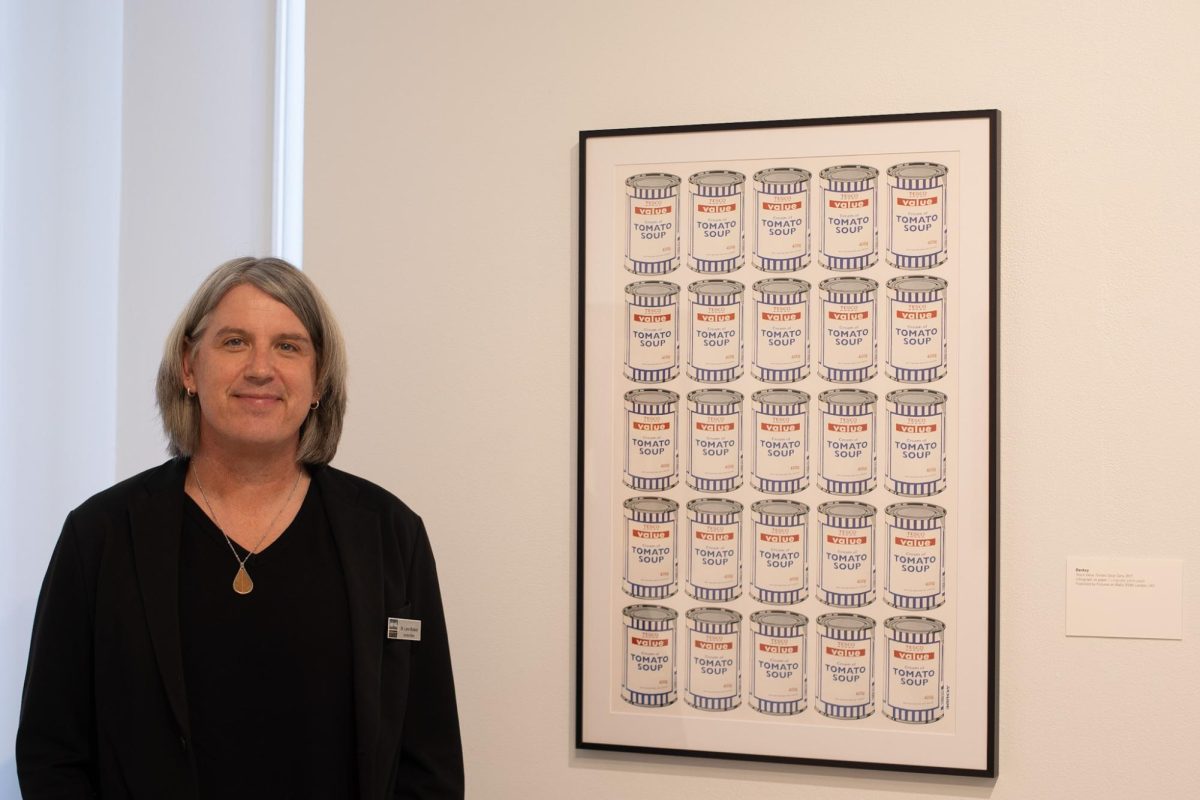
Boland, alongside curator and art appraiser Katherine McQueen, curated the Art and Access: New Directions in Prints and Multiples exhibition with the goal of emphasizing the accessibility of contemporary art. The exhibition, which will be open until Jan. 3, 2027, displays prints and multiples in a variety of mediums by world-famous artists, including Banksy, Judy Chicago and Shepard Fairey. By displaying global artwork within an institution meant for local audiences, the MoA brings contemporary art to an accessible scale.
Boland said it’s a misconception that contemporary art is inaccessible due to its high prices.
“There’s so much more to the contemporary art world,” Boland said. “Prints and multiples are an avenue that artists have always used.”
Through replicative strategies and forms, artists are able to share their creations with broader audiences.
“One of the things the show tries to demonstrate is just the relative affordability of recognizable names who might be in the news for, you know, multimillion-dollar sales,” Boland explained.
One section of the gallery contains prints and multiples from well-known street artists, like Shepard Fairey, Mr. Brainwash and Banksy.
“The best at making his art affordable, or one of the best, is Shepard Fairey,” Boland said. “You go on his website right now, and these prints are still available. The framing costs more than the prints. … The prices are basically the same as getting a reproduction poster, but it’s an original work instead.”
Also on display are a series of works by Steve Keene, a New York artist, who “will hang a bunch of pieces of cut plywood on, like, a chain loop fence or something, and then just go through and paint the same image,” as Boland explained. “It is very much this assembly-line production style. He’s always said he wants his paintings to be as affordable as CDs.”
In the United States, artwork typically enters the public domain around 70 years after the artist’s death. The prints and multiples on display at the museum are not merely posters or flat reproductions of artwork, like the Monet and Van Gogh prints that can be found in gift shops. Rather, Art and Access highlights the different forms prints and multiples can take with material replicas of sculptures and pieces.
“Especially when you’re talking about multiples, I think so often people are only thinking it’s prints,” McQueen said. “And so it was important to us to show the range of sculptural multiples as well.”
The exhibition also emphasized affordability in the construction of their replicas, focusing the space on the various ways art can be made accessible to the public.
One of the pieces in the exhibition is a sculpture by the artist Kehinde Wiley, who Boland said is “most famous for painting the official portrait of President Obama for the National Gallery.” Wiley’s pieces usually sell for quite a bit of money, but the sculpture on display in the exhibition was affordable because it is a multiple made with cheaper materials than pure marble.
“It looks like marble, and it is,” Boland said. “But it’s marble dust and resin mixed together and then cast into the form.”
In addition to sculptural and three-dimensional multiples, the gallery also displays a variety of print types, including screen prints, digital prints and textured prints.
“Often if you say, ‘prints and multiples,’ (people) have this idea of a relatively small, very flat image,” Boland said.
Boland and McQueen both said they wanted to show the true potential of print varieties by including stamps, playing cards, blankets and even a series of basketballs within the exhibition.
The Museum of Art Fort Collins applies the same theme of financial accessibility found in the Art and Access exhibition to the way they price their tickets: Colorado State University students, Front Range Community College students and anyone under 18 qualifies for free admission, and admission is free between 5-9 p.m. on the first Friday of every month for all visitors.
“So much of the art world is people (thinking) that they don’t know what they’re looking at, that they’re thinking about it wrong, that they can’t be part of that world (or) that they can’t have access,” McQueen said. “And the truth is, you can and you should. … You just have to pay attention and be curious. You know, that’s what it’s all about. Just dive deep into what you love. There’s a way to get there.”
Reach Emma Pelto at entertainment@collegian.com or on social media @RMCollegian.