

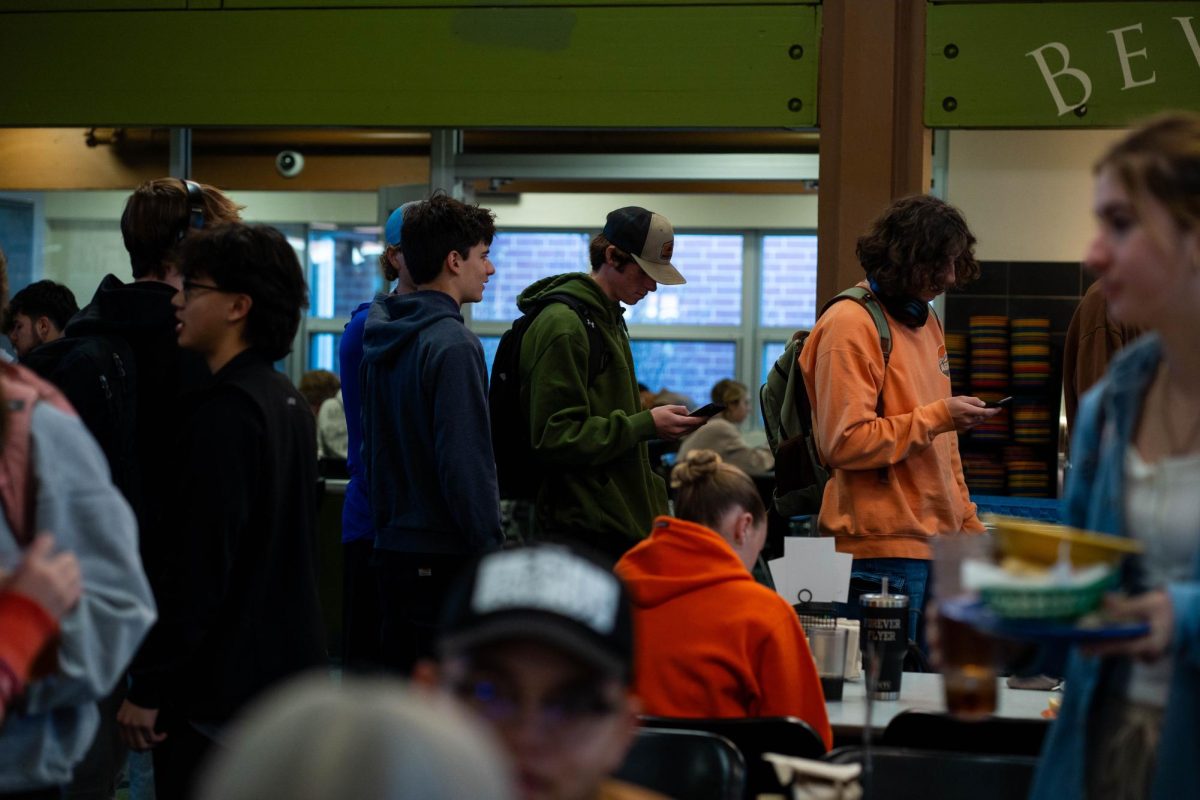
Starting this semester, several changes were made to campus dining, including the closure of Braiden Dining Hall and the removal of the Grubhub delivery robots.
“Braiden Hall all-you-care-to-eat Dining Center was discontinued because it was the least-visited dining center on campus and accounted for only 13% of meal swipes,” said Sarah Oehler, assistant director of communications for Colorado State University’s Division of Student Affairs and On & Off Campus Life, in an email-based interview.
Oehler said the statistic was from the total number of meal swipes spent last academic year across all dining centers, retail locations and markets. Braiden’s percentage — which included swipes at RAMwich — had been consistently hovering around 13% for several years.
“Dining staff at Braiden were either retained on-site or transferred to other dining centers on campus,” Oehler said.
RAMwich, the express location in Braiden, remains open from 11 a.m. to 2 p.m. for lunch on weekdays. Additionally, a new all-day mini market is planned to open in Braiden this fall.
“The mini market is expected to open between September and October, assuming there are no construction delays beyond our control,” Oehler said.
Due to the increase in foot traffic to the remaining dining centers, the downstairs stations and seating area at Ram’s Horn were opened to increase capacity.
Steve Kelley, senior production chef at Ram’s Horn, said despite Ram’s Horn becoming busier since Braiden’s closure, the overall experience at the dining hall has improved, as the majority of Braiden’s staff were reassigned to Ram’s Horn.
“It’s actually been positive because now we’re fully staffed,” Kelley said. “We’re able to open downstairs for all-you-can-eat during lunch. … It’s kind of better because, like, once you serve 1,000 people, serving 1,200 people isn’t much different. So it is busier, especially (during) that first week when move-in is, like, crazy, … but right now it’s really good. It’s starting to even out now.”
Apart from ordering more food and managing a larger staff, Kelley said the logistics of running the hall hasn’t changed much, and the staff increase has enabled more stations to be open, including the salad bar during the late-lunch period between 2-5 p.m.
“I’ve worked at Braiden and Ram’s Horn and The Foundry throughout my career, and there’s been a lot of changes in dining, but I think what we’re doing now is a good, positive change for the students because we have a lot more options at Ram’s Horn,” Kelley said.
Despite the positive changes, some students expressed dismay at Braiden’s closure.
“I’m kind of disappointed,” sophomore Russell Carlson said. “It was positioned in a really convenient location. Everything else, I kind of have to cross campus from my classes to eat. But Braiden was kind of, like, smack in the center there.”
Adelle Hazelhurst, a third-year student who worked as a residential assistant last year in Braiden and now works as a community assistant, said she was sad to see Braiden closed.
“Braiden being a smaller dining hall was really nice for a lot of people,” Hazelhurst said. “That’s really sad that we’re not going to have that anymore.”
Matthew Powley-Young, a junior who worked as a student supervisor in Braiden dining hall before it closed, spoke of a loss of community.
“I really loved my job,” Powley-Young said. “It was really sad leading up to those last few weeks, and the (full-time staff), they all loved their jobs, too, because it was really quite a wonderful community there.”
Powley-Young, who now works at Ram’s Horn, said he preferred working at Braiden much more.
“I’m so frustrated about it,” Powley-Young said. “Braiden was good. We put out food that we were proud of, and we served a lot of people, like, a ton of people, and our team worked really hard, and we did a good job. … I don’t think it was a good thing to close Braiden.”
In addition to Braiden closing, the Grubhub delivery robots that were implemented on campus in January 2025 were removed in June, due to Starship Technologies shifting their focus toward grocery delivery.
“We built something remarkable on U.S. campuses, and we’re proud of that work,” said Ahti Heinla, CEO and co-founder of Starship Technologies, in a statement on the company’s website. “When we started in 2018, operating in closed, controlled environments was the right foundation: It gave us the operational depth and real-world delivery data that no lab could provide. Now we can operate reliably at scale in open urban environments, which is exactly what grocery delivery demands.”
Reach Maxine Bilodeau at news@collegian.com or on social media @RMCollegian.