
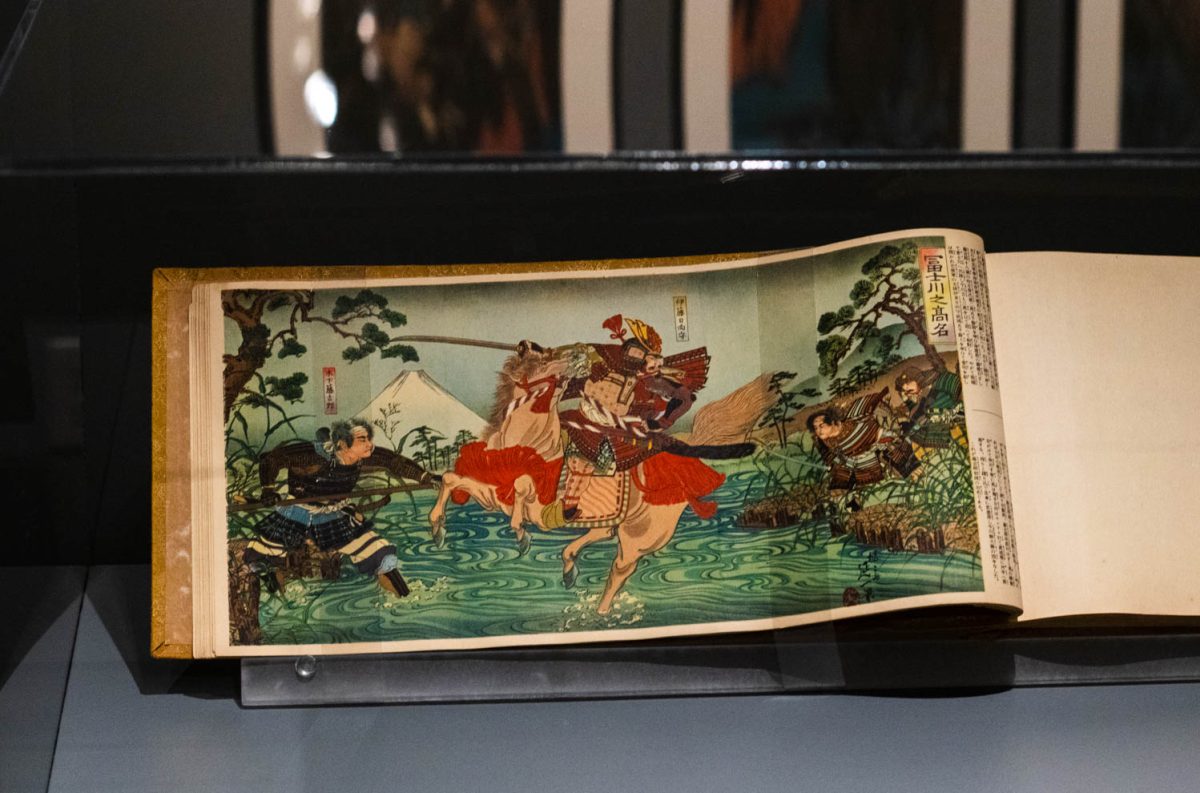
Framed woodblock prints line the dimly lit walls of the new “Printed Dreams: Edo Woodblock Prints to Modern Manga” exhibition at the Gregory Allicar Museum of Art.
Moments captured long ago by Japanese artists have been given new life through a gallery that explores Japanese printmaking traditions and how they are portrayed in contemporary Japanese art manga.
Open until May 17, the exhibition originally started through an internship with the Gregory Allicar Museum of Art. CSU master’s student and co-curator Tiffany Hajicek had the idea for the project, which was based on her childhood love for Japanese prints, and later pitched it to museum staff.

“(The idea) was very good, and we had some vacancy in our gallery where we were thinking it would work,” said Suzanne Hale, registrar and collections manager at the Gregory Allicar Museum of Art. “So we ended up saying, ‘Let’s see if we can just make this happen.'”
From there, CSU graduate and current University of Denver master’s student and co-curator, Garrett Schroeder, was contacted to expand the exhibition.
Walking into the gallery, viewers are greeted with a tableau providing information on the “visual universe” of Ukiyo-e — or “floating world” — art pieces: “In the cities of Edo-period Japan, artists carved and printed scenes of daily life, famous actors, elegant courtesans, lively festivals and dramatic landscapes,” the tableau reads.
While these prints started as a form of depicting everyday life, they later shifted to a style that portrayed landscapes and stories.
“Japanese woodblock prints eventually became a form of storytelling, and they’d get published into different types of books and scrolls, and their artistic linework kind of translated into modern manga,” Hajicek said.

Another aspect the curators dove into was explaining the context of “high” and “low” art forms in order to shed light from the Japanese point of view. Such woodblock prints were meant to be used as pictures and advertisements — and supposed to be enjoyed purely by the middle class — but became a version of a high art form when they were discovered by impressionist artists.
“One of the things that we were kind of thinking about (was), ‘Why, within our history, is it only within the Western perspective rather than the Japanese perspective?'” Schroeder said.
To convey this distinction, the gallery displayed pieces dating back to the late 1700s and early 1800s, even including a reproduction of a print from the 11th or 12th century. Alongside the artwork lay detailed backgrounds on the pieces, their creators and their messages, helping to amplify Japanese perspectives.
Additionally, the lighting of the room remained low to not only preserve the light-sensitive prints but to create an enjoyable atmosphere for visitors.
“(We) wanted people to have … a relaxing experience where they get to really enjoy the different moods and characters in the pieces,” Hale said. “These things were sort of made for everyone to enjoy.”

Separate from the main gallery is a room featuring modern Japanese art, such as digital prints and shelves containing manga books, including “Cinderella” and “Demon Slayer.” Visitors were encouraged to pause and explore the books’ pages as well as the other pieces that fill the room.
Schroeder said one of the themes they focused on when curating the exhibit was storytelling, sparking the idea to set up a reading room to allow viewers to see where the art ended up.
While the exhibit focuses on Japanese artwork, some found that the prints contain similarities and reminders of different styles and periods of art.
The gallery’s focus on the evolutionary connection of Japanese art conveys a message of reflection as well as artistic preservation.
“Art is everywhere,” Schroeder said. “Visual culture is all around us and is constantly orienting us. … I’m hoping that more people will see the manga that they pick up … as artworks in the same way that they see the woodblocks hanging on the walls.”
Reach Lilly Vollmar at entertainment@collegian.com or on social media @RMCollegian.