

The postseason doesn’t wait for anyone to figure themselves out.
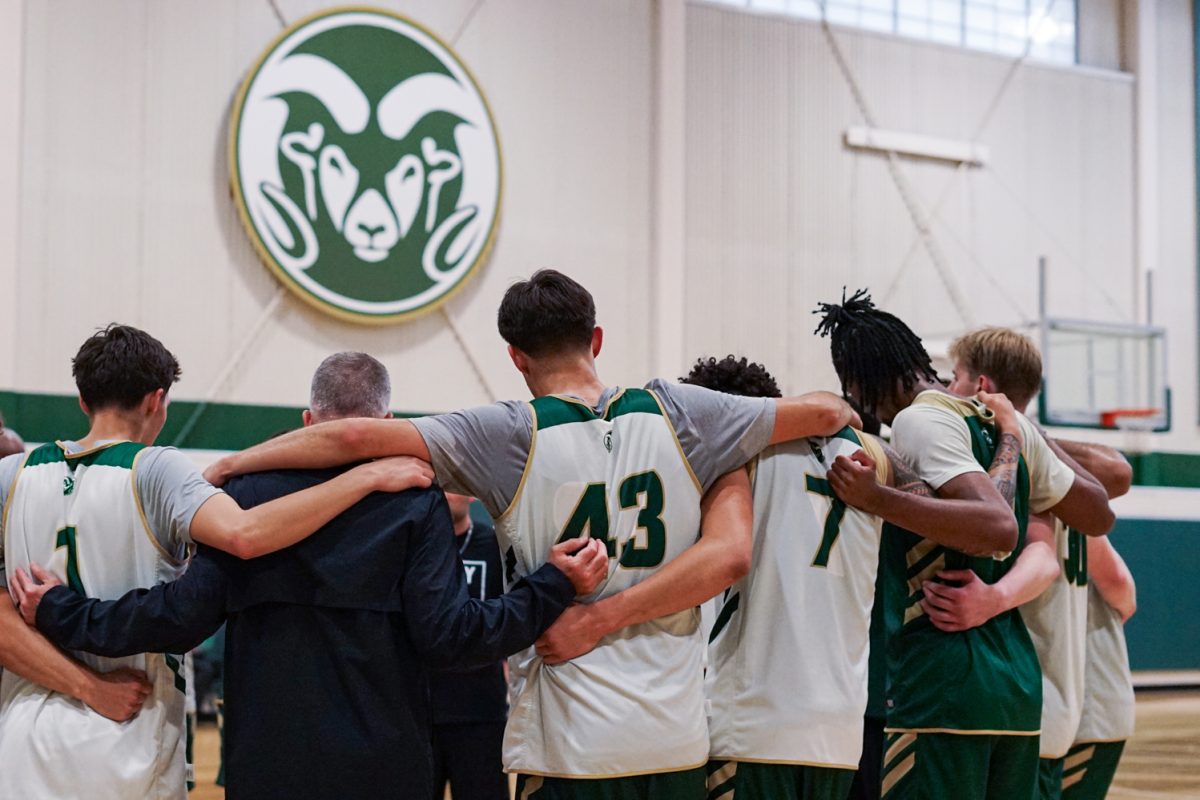
And even though the regular season ended without a bow on top, Colorado State men’s basketball is back in Vegas, looking at a path without an easy championship run. As the Mountain West No. 7 seed (20-11, 11-9 MW), the Rams will faceoff against No. 10 Fresno State Wednesday, carrying some uncertainty into the first night.
Since the two teams split the regular-season series, CSU has seen both sides of this particular matchup, and there aren’t many secrets left between any conference teams this time of year.
Each win came at home between the two, and the main factor came down to offensive comfortability for CSU. In many games this season, the Rams have lived and died by the three, lighting up opposing defenses when Josh Pascarelli got hot from deep. But it also stalled when shots weren’t falling, unable to generate points inside the arc until later on.
When they’re playing at their best, the offense flows and doesn’t really stick to one person, moving through players like Jevin Muniz, who led the conference in assists and was recently recognized as a third-team All-Mountain West selection. The jack of all trades finished with 10.3 points, 4.9 assists and 3.7 rebounds in conference play and had one of the better assist to turnover ratios in the country.
And even with Brandon Rechsteiner’s big scoring nights, and often streaky tendency, CSU’s style works with space, becoming one of the more efficient shooting teams in the country with a 59.4% effective field goal percentage and ranking ninth in the nation.
But the line between CSU’s best offensive nights and its more frustrating ones can be thin, and sometimes it’s as simple as whether the first few shots fall.
The first meeting in Fresno showed how quickly that rhythm can disappear.
CSU started the game reasonably well before slipping into a stretch where the offense slowed down and the perimeter shots stopped falling altogether. At one point the Rams missed 15 straight three-point attempts while FSU gradually built its lead.
The Bulldogs didn’t necessarily dominate every aspect of the game that night, though.
They simply forced CSU into a pace that felt uncomfortable. Possessions became shorter, less connected, while FSU’s offense, led by guard Jake Heidbreder and first-year forward DeShawn Gory, produced just enough to keep the Rams chasing the game.
That pairing matters because FSU’s two main threats create pressure in different ways.
Heidbreder, who averages 16.7 points per game, has been one of the conference’s most efficient scorers largely because of how often he gets to the free-throw line. During conference play, he made 81 of his 88 attempts at the stripe and even set a program record earlier this season with 16 made free throws in a single game, allowing FSU to keep points coming even when outside shots cool off.
Then Gory presents a different challenge.
The first-year forward averaged nearly 16 points and more than seven rebounds per game in conference play, using his size around the basket to generate second chances and force defenders to collapse toward the paint.
Those two accounted for much of FSU’s offense in the Bulldogs’ earlier win, but the rematch in Fort Collins showed how quickly the flow of a game can change once CSU settles.
The Rams trailed by seven at halftime that night, and yet the second half looked different once CSU began attacking the interior more aggressively instead of relying almost entirely on perimeter shooting. That adjustment forced FSU’s defense to collapse toward the rim, opening cleaner looks outside and allowing the offense to stretch the floor again.
That’s when players like Rechsteiner, along with Pascarelli and Kyle Jorgensen, can become particularly dangerous.
The junior guard has been CSU’s most reliable perimeter scorer this season, averaging 12.6 points per game while shooting nearly 39% from beyond the arc. His scoring often arrives in bursts rather than steady increments, the type of player who can flip momentum with two or three possessions after having empty possessions earlier.
Rechsteiner knocked down consecutive threes early in the second half, helping ignite the Rams’ comeback from a 13-point deficit.
Still, the offense rarely revolves around one player for long.
Jase Butler has become a more consistent presence as the season progressed, handling the ball in key stretches and attacking openings rather than simply moving the ball along. And Carey Booth has also grown into his role, using his size and activity to impact both ends of the floor in ways that didn’t always show up earlier in the year.
Those developments helped fuel CSU’s late-season surge.
The Rams won eight straight games during February before the run ended in the regular-season finale against Boise State, in which the 78-67 loss largely came down to rebounding. Boise State controlled the glass throughout the night, turning offensive rebounds into 19 second-chance points and creating a gap the Rams struggled to overcome.
Even so, CSU still enters the tournament having won eight of its last nine games. And in a setting where momentum can shift quickly, that stretch likely carries more weight than the final result of the regular season.
The Rams also bring some historical comfort into the matchup, too.
CSU has won nine of the last ten meetings against FSU and holds a 4-1 edge in previous MW tournament matchups between the programs. The two teams even met in Las Vegas in 2023, when the Rams edged out the Bulldogs 67-65 in a tightly contested opening-round game.
But tournament games have a way of resetting everything around them.
And what matters is simply finding a way to win the next one.
Reach Michael Hovey at sports@collegian.com or on social media @michaelfhovey.
Interested in more sports content? Sign up for Ram Report here for weekly CSU sports updates!