
Progress doesn’t always announce itself. Sometimes it just clears the bar.
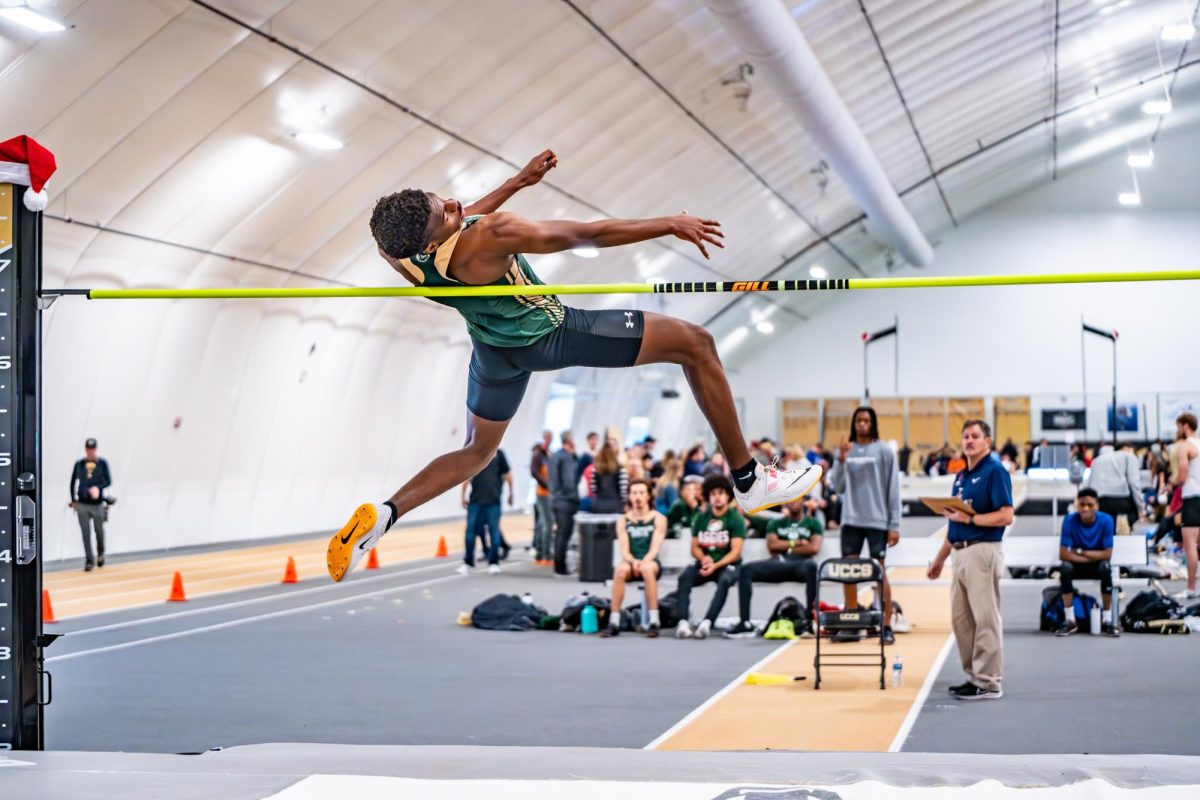
For Colorado State sophomore Ndayiragije Shukurani, that bar has kept moving upward, often before anyone outside the program fully understands what he’s doing. As a first-year last season, he became the third Ram to clear seven feet in the high jump outdoors. This winter, only weeks into his sophomore indoor season, he raised it again, breaking the program’s indoor record at 7 feet, 1.75 inches, while being currently tied for No. 12 in the nation.
“I have other tall guys, and I have other guys who I’ve coached before, and they don’t move the same as him. He’s like an elite alien. It’s fantastic.” -Maria Creech, CSU track and field jumps coach
Inside the jumps group, it didn’t register as a shock.
“I mean, I’m not surprised,” CSU’s jumps coach Maria Creech said. “We knew it was coming. … I mean, we knew he was going to jump seven feet last year. It was just a matter of timing, just a matter of when everything came together. The kid’s a freak; he’s going to do whatever he wants.”
When Shukurani talks about jumping, the focus stays narrow and immediate.
Preparation, for him, doesn’t turn into overthinking. And that’s been the key to unlocking greater heights. Once competition starts, he said he keeps it simple.
“I’m not going to lie, when I’m actually jumping, I just go for it,” Shukurani said. “I get in my flow, and I just continue jumping.”
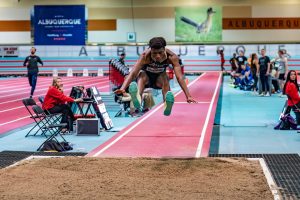
That approach is intentional as someone with a great frame and a developed instinct as a young athlete. Too much instruction, he said, works against him and “throws things off.”
That balance especially matters because Shukurani isn’t just a high jumper. He’s also nationally competitive in the triple jump, ranking No. 17 in the nation at 52′ 2.5″ — a rare pairing that usually forces athletes to choose early.
The high-flyer said there weren’t any “special characteristics” he saw in himself, though.
But Creech saw the difference immediately, especially through a biomechanical lens as a coach, athlete and someone with a master’s degree in kinesiology.
“He’s got the perfect body type for both,” Creech said. “If you look at, like, a lot of elite high jumpers, he’s tall (and) he’s lean. If you look at a lot of elite triple jumpers, they look the same. And he’s really kind of floppy but strong at the same time, which is, I think is a rare combo.”
Creech said that tall athletes often struggle with movement quality in the world of jumping.
But somehow, Shukurani doesn’t.
“I say to people, ‘He’s anatomically perfect,’” Creech said. “I have other tall guys, and I have other guys who I’ve coached before, and they don’t move the same as him. He’s like an elite alien. It’s fantastic.”
That hasn’t always made him easy to coach, though. Early on at Shukurani’s first meet at UCCS, feedback wasn’t necessarily beneficial. He had difficulty processing and adjusting to all the new cues.
Since then, Creech has shifted how she approaches him, letting him dictate when feedback lands.
“I just let him be him,” Creech said. “I don’t push him to talk to me more than he wants to. I let him kind of come to me with cueing. Sometimes I’ll even ask him, ‘Do you want me to give you a cue? Do you want me to talk to you right now?’”
And the philosophy behind that approach is simple.
“Coach (Brian) Bedard says this all the time,” Creech said. “He says, ‘Don’t crash the Ferrari.’ And I think Shuku is that Ferrari, and sometimes you just (have) got to let the car drive a little bit.”
That restraint is deliberate, and Shukurani’s progress has been steady since refining their coach-athlete dynamic. The duo now focuses on one cue at a time, if any, and when it happens, it’s a cue they both agree could use attention.
Shukurani said he feels the difference, even if he doesn’t frame it as change. But he also pointed to the two remaining years he has left and how much improvement he could still use.
Within the jumps group, his rise hasn’t altered much about how he carries himself. Senior jumper Ismael Dembele said it never felt sudden.
“Like, it’s crazy, but nothing he’s doing is out of the ordinary,” Dembele said. “We knew he was going to do it. We train with him every single day. We see what he does. So like, it’s not a shock to us.”
What stands out more to Dembele is how Shukurani operates day to day.
“He’s a natural leader, not in a sense of vocalizing but a sense of, like, his actions,” Dembele said. “He doesn’t say much, but he does a lot.”
To Dembele, that shows up in how he handles feedback, too.
“(He is) always ready for criticism,” Dembele said. “And yeah, he probably doesn’t know that he’s a leader yet, but as he gets older, his leadership has gotten a lot better. Compared to last year, (he’s) a whole different person (than) this year.”
Shukurani said he reached all the goals he set for himself last year. This year, however, he’s more focused on staying open and not limiting himself to where he wants to be — something that has worked well for him early in the indoor season.
So he leaves it undefined.
Creech said she believes that openness is what allows everything else to work. In her third year as coach of the “flight crew,” Creech has become a mentor and someone who values building close relationships with her athletes.
“Sometimes you just (have) got to let an athlete be an athlete,” Creech said. “And Shuku is one of those athletes that, if he just kind of lets go and does what his body does best, he’s going to be successful.”
Dembele said he sees where it’s headed, even if others do not.
“The nation’s waking up,” Dembele said. “And they better wake up.”
Reach Michael Hovey at sports@collegian.com or on social media @michaelfhovey.
Interested in more sports content? Sign up for Ram Report here for weekly CSU sports updates!