
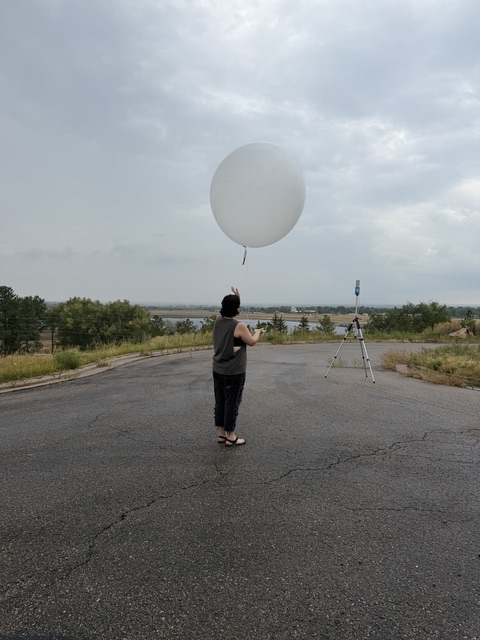
On mornings when Colorado’s Front Range looks primed for trouble — hail, flash floods or a burn scar about to give way — a small team wheels a laptop, a GPS antenna and a tank of helium out onto the Foothills Campus. Within about 20 minutes, a balloon roughly five feet across lifts off, carrying an instrument called a radiosonde into the atmosphere.
The launches are part of a yearlong partnership between CSU’s Department of Atmospheric Science and the Colorado Department of Transportation, which, according to Mike Chapman, CDOT’s winter operations program manager and chief meteorologist, is contracted for around 30-35 balloon launches. As of early August, the team completed 11 soundings since the project’s April start, with potentially 24 more planned over the next eight months, according to Brenda Dolan, a CSU research scientist who helps oversee the project.
According to Brendan Eckerman, a CDOT meteorologist and CSU master’s student who bridges both sides of the project, each balloon carries its radiosonde as high as 15 kilometers, deep into the upper troposphere, measuring temperature, relative humidity, air pressure and wind speed along the way. The ascent takes roughly an hour, and the data streams back to a laptop on the ground in real time.
“Understanding the current state of the atmosphere is critical for predicting short-term weather, including the potential for severe weather like icing, rain, hail, flooding and tornadoes,” Dolan said. Radiosondes, she added, remain “one of the few ways we get actual measurements of those variables throughout the depth of the troposphere.”
The partnership arrives as the nation’s balloon network, run almost entirely by the National Weather Service, has been shrinking due to national budget cuts. Denver had already stopped launching because of a separate, ongoing helium shortage. The NWS typically launches balloons from more than 100 U.S. sites. Still, fewer launches mean meteorologists have lost a real-time slice of the atmosphere that satellites and models can’t fully replace.
That’s the gap CDOT is trying to plug locally. Chapman said he’d wanted a partnership like this for years, citing “some funding issues on the federal side with weather service and also some capabilities issues.” He connected with CSU a little over a year ago after graduate student Rachel Auth reached out asking if CDOT still wanted to use its available budget.
Chapman said the program costs about $10,000, covering materials while CSU students volunteer their time. “It’s a very small cost for very high benefit,” he said, noting CDOT shares the data freely with the NWS and other users.
Auth, a balloon launch lead who coordinates volunteers and processes the data CDOT receives, said she got involved in summer 2024 during a separate CSU field project when CDOT first inquired about special soundings. She spent the following spring working to formalize the arrangement.
Data is usable within about an hour of launch, Chapman said, giving his three-person forecasting team “a few hours” of tactical lead time to warn crews.
This year, the project has focused on a second purpose: monitoring burn scars. The barren, water-repellent ground left behind by wildfires, can trigger flash floods and debris flows onto highways for years afterward. Eckerman said the balloon data provides important information over vulnerable burn areas, including the Aspen Acres fire west of Pueblo, which has already produced a “pretty nasty” flash flood on a day the team happened to have a balloon in the air.
Twelve graduate students have volunteered on launches so far, and Dolan called them essential to the project’s success: “This project would not be possible without all of the graduate student involvement.”
For the students, the appeal is hands-on fieldwork with stakes that reach past a grade. Auth said hearing from forecasters who’ve used the data on high-impact weather days has been “really encouraging” and said it echoes why she pushed to get the project going in the first place: “If you feel passionate about something, make it happen.”
Eckerman put it more plainly: Most people’s relationship with weather starts and ends with checking a phone before grabbing a jacket, but “this project is really having a tangible impact that people don’t necessarily always see on their day-to-day.”
The work hasn’t been without mishaps. An early practice balloon popped during a snowstorm, and one balloon was likely struck by lightning shortly after launch over the summer, cutting off its data feed. Eckerman said the incident was a lesson in avoiding launching once storms are already building nearby.
For now, the partnership is expected to continue past its current contract, which runs through February 2027, with Chapman calling it a near-certain renewal. Expansion beyond Fort Collins, to southern Colorado or the Western Slope, remains a long-term possibility but would require a mobile launch setup and significantly more funding.
“If we want to do better at forecasting across short- and long-term, we need to have measurements of what is currently in the atmosphere,” Dolan said. “And soundings are a critical piece of that.”
Reach Maci Lesh at science@collegian.com or on social media @macileshmedia.