
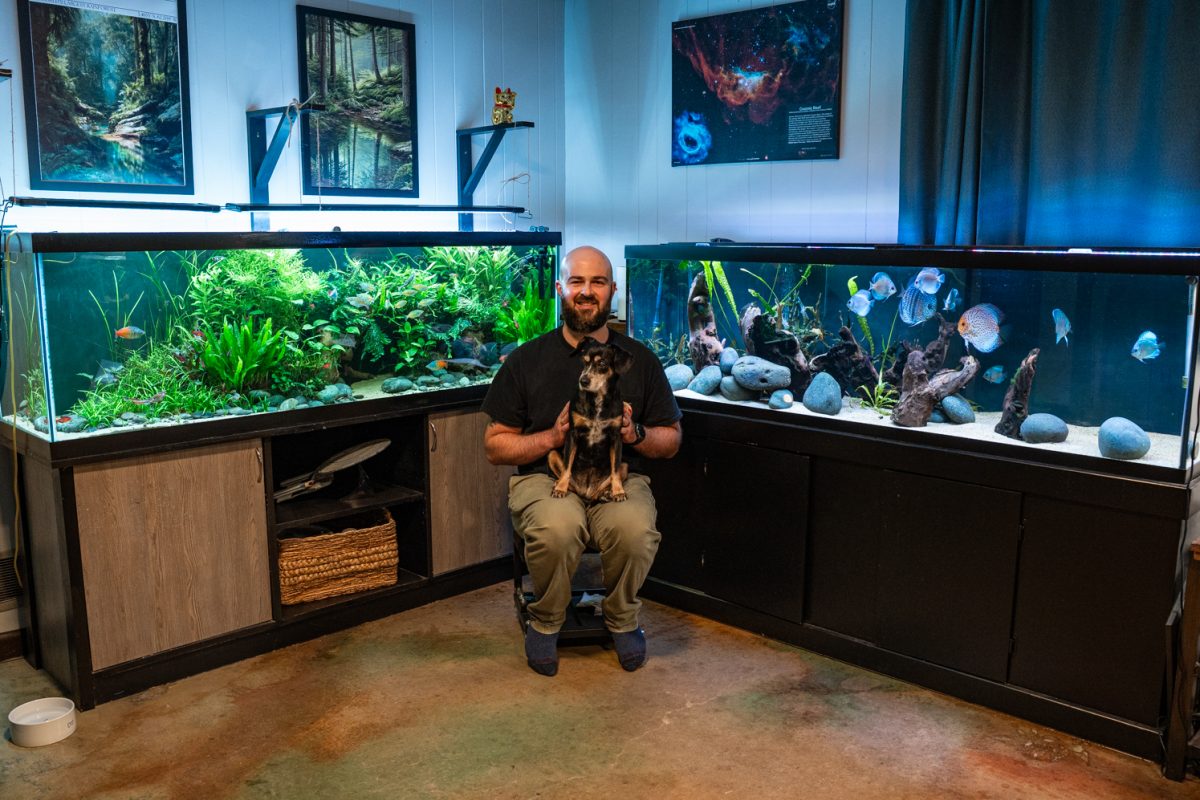
Michael Amato, owner of Fresh Flow Aquatics, said there are two kinds of fish keepers: people who enjoy the challenge of maintaining an ecosystem and people who love the artistry.
With roots as an ecologist at Colorado State University and a passion for natural design, he said he knows how to work alongside people in both categories.
“I was actually working at CSU when I started my business,” Amato said. “It was during COVID, and I used to do some field research and stuff like that, but my job became all office work, so I just needed something a little more exciting.”
He began doing tank maintenance, cleaning and custom building in his free time. After a year of this, he got another job as an executive assistant before transitioning to part-time gigs. After three years, he trusted his skills and business knowledge enough to make Fresh Flow Aquatics his full-time job.
One of Amato’s first clients, Sara Vanderheyden, said she found him by mistake while searching for someone to fill a CO2 tank. Around the same time, she said she took an interest in the hobby due to her son’s influence. She noted Amato’s genuine love of the work as a part of what makes the business special.
“It was really, really fun because (Amato) was super excited and just doing really neat things,” Vanderheyden said. “He was very handy to have around as a new hobbyist for sure.”
Amato is both the owner and sole employee behind Fresh Flow Aquatics, meaning each custom tank is his to design with the rare input from his clientele.
“Sometimes people have some partial vision,” Amato said. “They want it to look like a picture of a tank they found, maybe on my portfolio or just something online … but people rarely give me a lot of specifications for setting up the tank.”
When designing the inside of a tank, Amato said he pays careful attention to the dead-space inside and is influenced by natural aesthetics.
“I was pretty influenced by this one guy, Takashi Amano, who blended a lot of those Japanese concepts as well as nature photography,” Amato said. “Just something that’s tranquil to look at and peaceful. So it’s like an art to be able to set it up.”
On top of the artistry, educating those he works for is a large factor of the services Amato provides.
“Sometimes people don’t know where to start getting their fish tank going, and they just need someone to kind of give them a, like, one-hour rundown of everything,” Amato said.
Amato also runs a YouTube channel that creates content about maintaining tank ecosystems. The channel is meant to explain the most important and recurring parts of aquatics that people don’t know when they begin to experiment with tank-keeping.
“I get some new clients that are always asking the same questions, and it’s not even a matter of having the same conversation over and over,” Amato said. “Sometimes some graphics are really helpful in learning things. … I’m super visual, and so if we’re talking about numbers, they almost need to see graphs and charts.”
Amato’s most viewed video dives into the process of cycling an aquarium, which is a process done prior to adding fish to the tank. Cycling is done to prevent buildup of ammonia. Amato explained the process is necessary to reduce harm to fish, as even the most resistant species can only tolerate up to 0.25 parts per million of it.
Ed Hall, an associate professor in the department of ecosystems science and sustainability, said observing systems in action can be the first step toward getting excited about ecology.
“I do remember the role of interacting with puffer fish in an aquarium as an undergraduate to be really exciting, and (it made) me think more about the microbes in that tank,” Hall said. “It can be a gateway drug.”
Hall claimed tanks are often used in professional ecological research because variables can be quickly altered and outcomes easily observed.
“I might take sediment from a stream and put them in a flow-through system and then add different nutrients or metals … and then measure how the microbes respond,” Hall said. “Or I might take individual populations of bacteria that we’ve isolated and identified and grow them up in liquid media and expose them to different conditions and try to see how they respond to those different conditions.”
Hall said one of the best ways to learn is by observing and that tanks offer a chance to see changes in seasonal and daily cycles. He stated that although there are clear differences between tanks and natural environments, such as a lack of predation due to the regular food supplied by owners, they can be equally complex.
“Ecosystems don’t read textbooks,” Hall said. “But sometimes they do what the textbook says they’ll do. … On the flip side, an aquarium is supposed to be real simple and straightforward, and sometimes it can be really tricky to get the water chemistry and the water clarity right in a healthy environment for the fish to grow in.”
Vanderheyden said she was impressed by the scientific side of maintaining a tank and believed it allowed her to learn more about the relationships between fish, plants, soil and water.
“It’s like a whole mini Earth inside of your fish tank, and it can be as complex as you want it to be or as simple as you want it to be,” Vanderheyden said.
Reach Maiya Kreamer at science@collegian.com or on social media @RMCollegian.