

Buying an engagement ring no longer has to mean following an old rule about spending three months’ salary. For students, recent graduates, young professionals, and anyone trying to balance a meaningful purchase with other financial priorities, the smarter approach is to focus on value rather than a traditional spending formula.
That is particularly relevant when shopping for lab grown diamonds. Because these diamonds are available through a growing number of online retailers, buyers can compare individual stones, grading reports, prices, return policies, and customization options before committing.
But having more choices can also make comparison harder. Two diamonds that look similar in an online search can have different prices because of differences in cut, color, clarity, certification, proportions, retailer pricing, and supply-chain structure.
The good news is that shoppers can take several practical steps to avoid paying more than necessary.
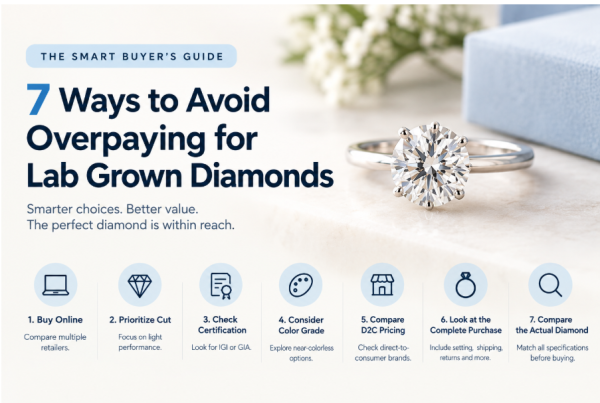
Here are seven ways to shop more strategically.
Quick Guide: 7 Ways to Save on a Lab Grown Diamond
| Smart-shopping move | What to do |
| 1. Buy online | Compare individual diamonds instead of relying on a single store |
| 2. Prioritize cut | Put attention on light performance and proportions before chasing higher clarity |
| 3. Check certification | Look for a grading report from an established laboratory such as IGI or GIA |
| 4. Consider dropping one color grade | Compare near-colorless options when your setting allows it |
| 5. Compare D2C pricing | Look at direct-to-consumer and manufacturer-direct options |
| 6. Compare the complete purchase | Check setting, shipping, returns, resizing, and other costs |
| 7. Compare the actual diamond | Match carat, color, clarity, cut, certification, and proportions before comparing prices |
Prices, availability, promotions, and policies can change, so product pages should be checked before purchasing.
1. Buy Online and Compare More Than One Retailer
One of the simplest ways to reduce the risk of overpaying is to shop online before making a decision.
Online diamond retailers allow shoppers to filter by carat, color, clarity, cut, shape, certification, and price. Instead of comparing only finished rings in a physical showroom, you can often look at individual loose diamonds and compare their specifications.
That distinction matters.
A diamond listed as 1 carat does not automatically have the same value as every other 1-carat diamond. Cut quality, color, clarity, certification, proportions, and retailer pricing can all affect the final price.
For example, the Loose Grown Diamond listing supplied for this guide is a 1.00-carat round D/VS1 diamond with an ideal cut, currently listed at $236. The listing identifies it as CVD-grown and non-certified.
Ritani’s supplied listing is a 1.01-carat round D/VS1 diamond with an Ideal cut and IGI certification, currently listed at $261.
These are not identical diamonds, so the prices should not be treated as a direct apples-to-apples comparison. Instead, they demonstrate why checking the specifications behind a price is important.
2. Prioritize Cut Before Paying for Extra Clarity
If your goal is a beautiful diamond without unnecessary spending, cut deserves serious attention.
Cut influences how a diamond interacts with light and can have a major effect on its visual appearance. A well-cut diamond can produce strong brightness, fire, and scintillation.
That does not mean clarity is unimportant. It means buyers should understand what they are actually paying for.
For many shoppers, moving from a high clarity grade to a slightly lower grade may have little visible benefit if the diamond remains eye-clean. Paying for a clarity grade that cannot be distinguished without magnification may therefore offer less practical value than investing in a well-cut stone.
The same principle applies when selecting lab grown diamonds for an engagement ring.
Instead of automatically choosing the highest available clarity, compare diamonds at different clarity grades and inspect the actual stone, grading report, proportions, and available imagery.
The objective is not to buy the lowest clarity possible. It is to find the point where the diamond meets your visual and quality requirements without paying for specifications you may not notice.
3. Demand an IGI or GIA Grading Report
Certification is another important part of comparison shopping.
A grading report provides independent information about a diamond’s characteristics, helping shoppers verify details such as carat weight, color, clarity, and other grading information.
The exact laboratory and report should be checked on the individual product page.
The supplied Ritani listing, for example, identifies its 1.01-carat D/VS1 round diamond as IGI certified and provides the IGI report number.
The Clean Origin listing supplied for this guide also identifies a 1.00-carat, D-color, VS1-clarity, Excellent-cut round lab grown diamond and lists IGI as the grading certificate.
Certification does not automatically mean one diamond is a better purchase than another. It gives you documented information that can make comparisons more meaningful.
Before buying, check:
- Carat weight
- Color grade
- Clarity grade
- Cut grade
- Measurements
- Polish and symmetry
- Laboratory
- Certificate/report number
- Any disclosed treatments or additional information
This is particularly useful when comparing several diamonds that appear similar in search results.
4. Consider Dropping One Color Grade
Color is another area where shoppers may be able to find value.
The diamond color scale begins at D, with D representing the highest colorless grade. But that does not necessarily mean every buyer needs a D-color diamond.
The setting, metal color, diamond shape, personal preference, and viewing conditions can influence how noticeable color differences are.
If your budget is tight, compare D, E, F, and potentially G-grade diamonds rather than automatically selecting D.
For example, moving from D to a lower color grade can sometimes reduce the cost while still providing the appearance you want.
The key is to compare actual diamonds rather than assuming that the highest grade always provides the best overall value.
This is especially useful for buyers shopping for affordable engagement rings who would rather allocate part of their budget toward a larger carat weight, a stronger cut, a preferred setting, or other features.
5. Compare Direct-to-Consumer Brands Such as Loose Grown Diamond
The retailer’s business model can also influence the price you see.
Direct-to-consumer and manufacturer-direct businesses can sell diamonds through online channels without relying on the same retail structure used by traditional jewelry stores.
Loose Grown Diamond’s current product page describes its model as direct-from-source pricing and states that it offers a price-match/beat guarantee. The supplied product is currently listed at $223 for a 1.00-carat D/VS1 round diamond.
The company also lists 30-day returns, insured shipping, and access to certified expert guidance on its product page.
For shoppers, the important lesson is not to assume that every D2C diamond will automatically be cheaper. Instead, use D2C retailers as another comparison point.
A smart comparison should look at the same or closely matched specifications across several sellers.
Example Price Comparison
The following examples use the specific product pages supplied for this article. They are not a controlled market comparison, because the diamonds differ in some specifications and some listings have changed or sold.
| Retailer | Example diamond | Cut | Certification | Listed price/status |
| Loose Grown Diamond | 1.00 ct Round D/VS1 | Excellent | Non-certified | $223 |
| Clean Origin | 1.00 ct Round D/VS1 | Excellent | IGI | $430 |
| Brilliance | 1.01 ct Round D/VS1 | Ideal | IGI | $771 |
| Ritani | 1.01 ct Round D/VS1 | Ideal | IGI | $261 |
| With Clarity | 1.33 ct Round D/VS1 | Excellent | IGI | $534 |
This is exactly why price comparison should be based on diamond specifications, not just the headline number.
6. Look Beyond the Diamond’s Sticker Price
A low diamond price does not necessarily mean a low total purchase price.
When building an engagement ring, remember that the final cost can include:
- Diamond
- Ring setting
- Metal choice
- Customization
- Shipping
- Taxes
- Resizing
- Insurance
- Optional upgrades
Return and warranty policies also have practical value.
For example, Clean Origin’s product page currently lists a 60-day return policy, free shipping both ways, and free resizing. It also states that the company offers a price-match guarantee for qualifying loose diamonds from certain online retailers.
These services do not make one retailer universally better than another, but they show why the total shopping experience should be included when comparing prices.
A $200 difference in the diamond itself may look significant, but the overall value can change depending on the setting, return terms, shipping, resizing, and other conditions.
7. Compare the Diamond, Not Just the Brand
The final step is perhaps the most important: compare the actual stones.
If two websites both advertise a “1-carat D/VS1 lab grown diamond,” that description alone is not enough.
Check:
Carat → Shape → Cut → Color → Clarity → Certification → Measurements → Polish → Symmetry → Price
This approach makes it easier to identify whether a price difference reflects a genuine difference in the diamond or simply a difference in retailer pricing.
It also helps prevent a common mistake: choosing a diamond because its headline specifications look impressive while overlooking its proportions, certification, return policy, or the complete ring price.
For shoppers looking for solitaire engagement rings, this comparison process can be particularly useful because the center diamond is usually the visual focus of the design. A carefully selected center stone can allow you to keep the setting relatively simple while concentrating your budget where it matters most to you.
How to Avoid Getting Ripped Off When Buying a Diamond
The easiest way to avoid paying too much is not to chase the lowest price blindly. Instead, become a careful comparison shopper.
Start by deciding your target carat range and preferred shape. Then compare cut quality, color, clarity, certification, and actual diamond measurements. Look at multiple retailers, including direct-to-consumer options, and check the total purchase price rather than only the loose-diamond price.
Most importantly, remember that a higher grade is not automatically better value for every buyer.
A D-color VS1 diamond may be an excellent choice, but an E, F, or G diamond may also meet your visual expectations at a different price. Likewise, paying for extremely high clarity may not provide a noticeable benefit if a lower grade is already eye-clean.
Final Takeaway
The smart way to buy lab grown diamonds in 2026 is to replace the old “spend a certain number of months’ salary” mindset with a more practical process: compare, verify, and prioritize.
Buy online when it gives you more useful choices. Prioritize cut and visual performance. Check the grading report. Consider whether you actually need the highest color or clarity grade. Compare direct-to-consumer retailers such as Loose Grown Diamond with other sellers. And always look at the complete cost and policies before placing an order.
The goal is not simply to find the cheapest diamond.
It is to find a diamond that meets your requirements at a price you understand and are comfortable paying.