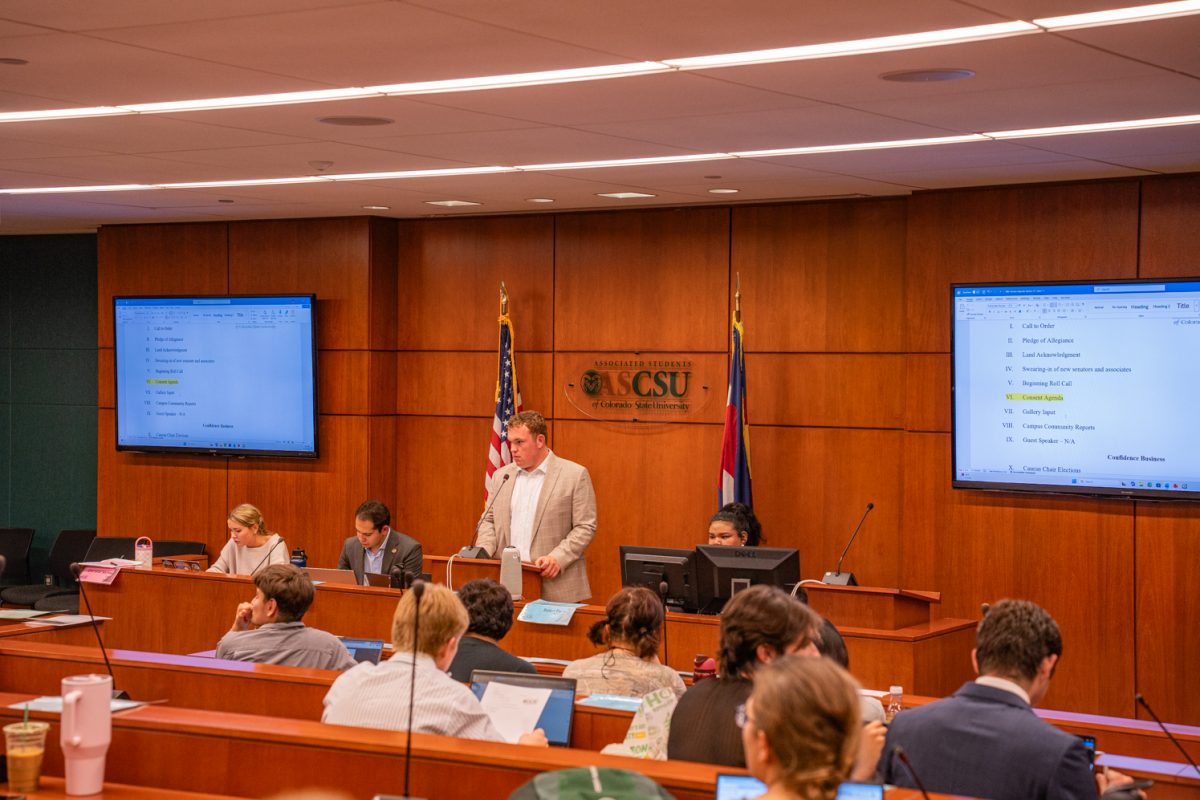
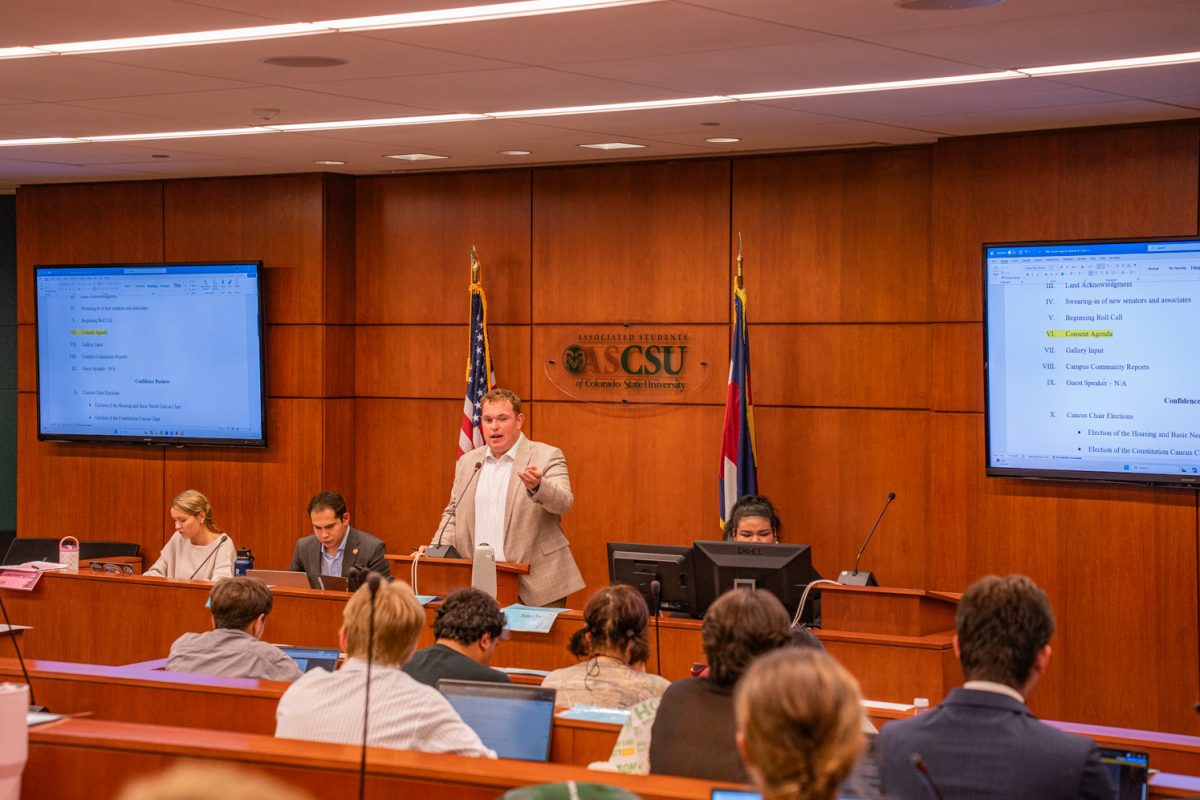
On Thursday, March 5, the Associated Students of Colorado State University hosted its annual debates, featuring the candidates for ASCSU president, vice president and speaker of the senate.
The presidential debate featured incumbent student-body president Jakye Nunley, as well as candidates Victoria Quesada-Stoner and Estevan Vega.
Kicking off the debate, candidates discussed their personal backgrounds, connections to CSU and the student body.
Nunley emphasized his campus involvement, his experience as the current student body president and his ability to connect with students.
“I am a heavily involved student on campus, and I believe that to know me is to know that there is not a student I don’t believe I can relate to,” Nunley said.
Quesada-Stoner highlighted CSU culture and touched on her experience as an ASCSU senator and co-president of The Body Project.
“One of the reasons why I am running for student-body president is because I believe in this university,” Quesada-Stoner said. “Students are the heart of this university, and it does not run without them.”
Vega discussed his path to higher education and emphasized ensuring students know they have a place at CSU.
“College was never just guaranteed for me,” Vega said. “It’s something that I had to work so hard to get every single day and reach out with arms fully extended because I know how difficult it is, and that’s something that I know that a lot of students here at CSU share.”
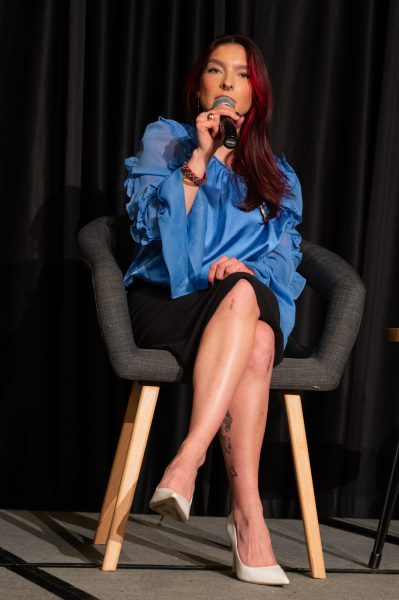
Candidates shared various motivations for running and policy priorities.
“We know that we need a new face in ASCSU,” Vega said. “It’s time that the dynasty ends. It’s time that a new face of leadership steps into power because we understand what students want and students need, and they’re not getting that. They deserve better.”
In terms of policy, Vega emphasized increasing parking affordability and accessibility on campus.
“We know that parking here on campus is ridiculously expensive, with those of you who hold passes paying anywhere between $600 to $800 for a parking pass that isn’t necessarily guaranteed,” Vega said. “That needs to change, and under the Vega-Hill administration, that will change. We plan to implement programs that will reduce costs for on-campus employees … as well as students who demonstrate financial need because we truly understand the burden that that puts on every single one of you all here today.”
Quesada-Stoner said her campaign focus is expanding access to ASCSU, transparency and advocacy, emphasizing that one-third of students are food insecure.
“Asking hard questions and really holding accountability is essential to truly having a student government for all,” Quesada-Stoner said. “Food and housing security is one of the biggest issues on our campus. A third of CSU Rams are food insecure. That is unacceptable.”
Nunley discussed his leadership experience within ASCSU and prioritizing student representation on the CSU Board of Governors.
“In our term as president, I think that it is a shame that students are the largest stakeholder at this university, and they are not represented with a voting seat on our Board of Governors,” Nunley said. “And so at the CSU System level, I think that it’s imperative that we push for change to create a voting seat on that board.”
Candidates were also asked about ASCSU engagement with the broader student body, addressing concerns about involvement.
Nunley began by saying that student leaders show up in spaces, even when it’s difficult, and that he has done that during his first term.
“Student leaders do, believe it or not, you know, have faith in their student government this year,” Nunley said. “This is imperative because student leaders need to know that you are not only just their student body president but their peer. And I think that’s what it is. That’s what’s happening. We show up in these spaces, and even when it’s hard, and even when challenging conversations are present in those spaces, we show up.”
Quesada-Stoner answered by saying that student engagement has “fell flat,” referencing last election’s 3.81% voter turnout, saying that connecting with students directly is necessary to increase engagement.
Vega responded by saying his administration aims to meet students where they are at, emphasizing increased engagement efforts if he is elected.
To close out the debate, the candidates took audience questions ranging from program budgets to CSU divesting from aerospace manufacturers.
A prominent topic brought up by the audience was how candidates aim to implement and fund new programs, as the student fee budget will be set before they take office.
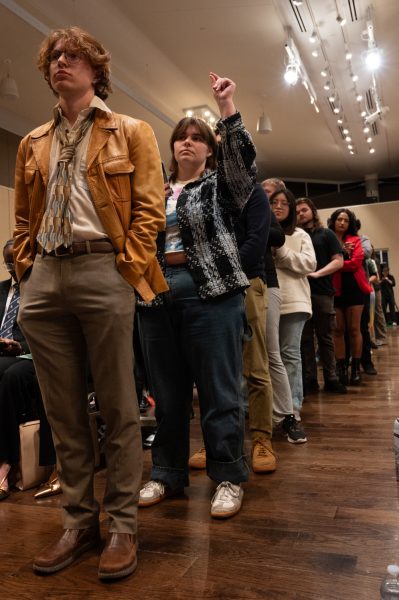
Nunley addressed concerns by saying the Nunley-Mapatano campaign is starting a foundation to fund ASCSU initiatives outside of the budget set by the Student Fee Review Board.
Quesada-Stoner responded by saying that they are not making fiscal promises due to the budget constraints, but there is a plan in place to cut Rams Against Hunger spending costs through monthly food drives to address ASCSU’s current budget deficit.
Vega said the Vega-Hill campaign will hire a smaller cabinet to ensure efficiency and reallocate funds that would fund the cabinet to other initiatives.
Another notable concern among the audience was CSU’s involvement with Woodward, an aerospace manufacturer headquartered in Fort Collins, which has a contract with the United States Department of War. Fragments of bombs and munitions used by Israel in its assault on Gaza were manufactured by Woodward. Audience members voiced concern with Nunley’s upcoming internship at Woodward this summer.
Vega was first to respond, noting that the Vega-Hill campaign does not support CSU’s engagement with Woodward.
“As a Hispanic, as a man of color, why do I have the opportunity to sit up here and run for president when there are people right across the ocean being killed by bombs that are made by this company?” Vega said. “The Vega-Hill administration absolutely will not support those companies. That is a top priority because we care, not just about the students here at CSU, (but) about everyone.”
Quesada-Stoner responded by stating that her administration will work to divest from Woodward, adding that student leaders must consider fellow students who are from places being bombed with weapons manufactured by Woodward.
“Ben and I are going to divest from these companies, but again, we can’t divest without having a replacement of companies that will do everything that Woodward does; … we need to make sure that we have a true, solid action plan,” Quesada-Stoner said. “If we are going to sit here and say that we are for all students, (we must remember) students have family members in these places, … (which is an important consideration) whenever we are supporting these companies.”
Lastly, Nunley addressed concerns with his internship directly, stating that he has accepted a position in human resources and change management.
“The statements that you all have made tonight are none that I disagree with,” Nunley said. “What I’ll say, though, is that it is imperative that when we talk about these companies and the things in our world that are of poor manner, … I want to say that I am working an HR function at Woodward this summer, and the function is change management. It is unbeknownst to me to think that change will ever happen in these spaces if nobody with good intentions or nobody with a nice heart ever get into these rooms and these spaces and these buildings and these companies to change those same things.”
As the debate closed out, candidates gave their closing statements, emphasizing their campaign goals and actions if elected.
Nunley said that he has the experience as an incumbent and that his administration will create a plan for students not just during their years at CSU but after they graduate.
Quesada-Stoner said in her closing statement that her administration will not think of leadership as a hierarchy, and that all students will be represented.
Vega closed by saying his support for all students will be unwavering, and that he will take tangible action rather than just using buzzwords.
Voting will open at 8 a.m. March 9 and close at 4 p.m. March 11. All students can vote online through RamWeb during this period, with results announced at 6:30 p.m. March 11.
Reach Laila Shekarchian at news@collegian.com or on social media @RMCollegian.