
As a public land-grant research university, Colorado State University stands as one of the oldest institutions in the state of Colorado. This year, as the United States and Colorado are both celebrating significant milestones in their respective histories, many members of the CSU community are taking the chance to reflect on the lasting impact that this history has left on the state they call home.
2026 marks the 250th anniversary of U.S. independence from Great Britain. At the same time, Colorado is celebrating the 150th anniversary of statehood, as Colorado entered the union exactly 100 years after nationwide independence. Notably, this is where the nickname “Centennial State” comes from.
CSU was founded as a public land-grant institution before Colorado was admitted as a state. A CSU Source article describes how CSU has served as an integral part of Colorado’s foundation throughout its development.
“As Colorado celebrates its 150th anniversary, alongside the United States’ 250th in 2026, CSU’s work reflects the enduring value of public higher education in advancing opportunity, strengthening communities and building the next chapter for Colorado and the nation,” the article reads.
Land-grant institutions like CSU were the result of the Morrill Land Grant College Act of 1862, a law passed during the Civil War that reserved federal lands for institutions focused in agriculture and mechanical arts while aiming to improve access to practical higher education in a growing nation.
Derek Everett, a CSU senior instructor who specializes in the history of Colorado and the American West, said that the land-grant mission represents CSU’s long-term commitment to bettering the state and the people within it.
“There’s definitely an undertone throughout CSU’s history that we exist more than any other institution of higher ed in the state to do good work for the people of Colorado,” Everett said. “To try to help make the lives of the people of Colorado better, more practical, more successful, (more) profitable — whatever that might be.”
Since its founding, CSU’s reach has extended to every corner of the state. Through CSU Extension, its off-campus educational service, residents and communities in all 64 counties of Colorado have access to services and expertise in dozens of industries, including agriculture, economic development, forestry, natural resources and more.
“We are conveners,” said James Pritchett, CSU’s vice president for engagement and extension. “We bring folks together to really work on tricky problems like, ‘How do you make the best use of water resources?’ We support decision-making with science.”
Pritchett also highlighted the importance of working with local communities to address their unique problems.
“Sometimes extension is about outreach, which is taking the knowledge and information out,” Pritchett said. “Other times, it’s really about engagement, which is being able to co-create solutions to problems.”
CSU carries an especially rich history in agriculture, having originally been founded as the Colorado Agricultural College. Today CSU features nationally recognized academic programs, research centers and extension programs that advance Colorado’s role as a leader in creating resilient food systems. Kim Stackhouse-Lawson, the director of CSU AgNext, described how the research collaborative is furthering practical solutions to the agricultural industry’s most pressing issues.
“It’s interesting when you can build a really strong culture around something that people care deeply about and then begin to really build trust,” Stackhouse-Lawson said. “It can be a really powerful space for people to get curious and really do some incredible work.”
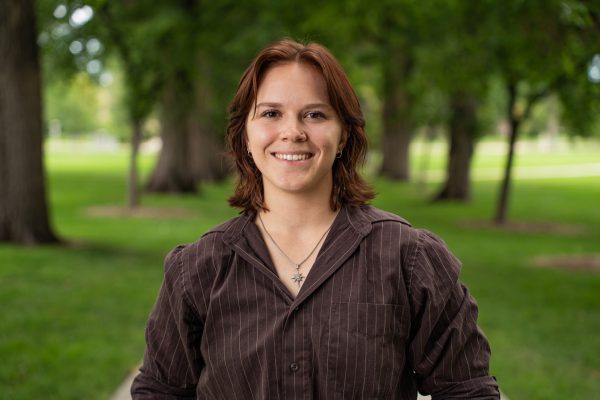
Students in the College of Agricultural Sciences also have the opportunity to gain hands-on experience in various industries in undergraduate classes. Morgan Nicklaus, a third-year animal science student at CSU who serves as ambassador for the college, said that access to those experiences were one of the main reasons she chose CSU.
“That was super important to me — to know that I’ll be able to get my hands dirty (and that) I’m not sitting in the classroom the whole time,” Nicklaus said. “The experiences you get outside of that classroom room is what’s influential.”
Alongside its growth and lasting achievements, CSU also faces a difficult history in its devastating impact on Indigenous populations; tribal communities lost tens of thousands of acres of land in the creation of CSU’s campus. Everett said that while CSU has made progress, it needs to continue to show it is serious about facing the complexities of its legacy.
“That’s why we have things like the land acknowledgement to recognize that,” Everett said. “The hope is that the land acknowledgement isn’t just something to say to just assuage the guilt but to acknowledge that none of this would exist, whether it’s CSU or the United States as a whole, without the foundation of the Indigenous populations that it was built upon. It’s the burden that we’re going to be carrying for the United States for the rest of time.”
Nicklaus said that CSU needs to continue to focus on empowering students to tackle difficult problems and not be afraid to have hard conversations with one another, in and outside of the classroom.
“The biggest thing that CSU can do right now is be transparent (about) what’s going on in our industries and let’s talk about it in our classrooms,” Nicklaus said. “You have people who are driven and who want to learn and who are studying this field for a reason. Let’s have those hard conversations because these problems aren’t going to disappear overnight.”
Reach Claire VanDeventer at news@collegian.com or on social media @RMCollegian.