
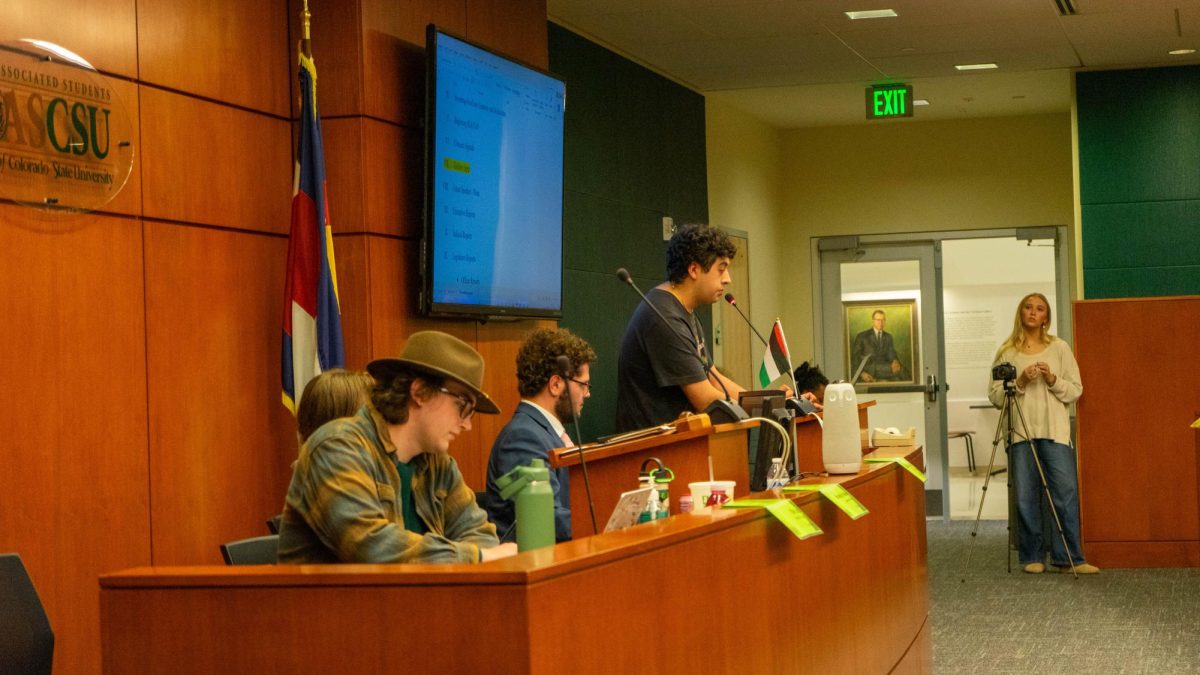
The Associated Students of Colorado State University convened Nov. 19 for the 14th session of the 55th senate.
To begin the session, multiple rotational interns for the executive branch were ratified by the senate and subsequently sworn in.
Following the swearing in of interns, several students spoke during gallery input, still citing concerns over free speech on campus.
Students also listed concerns with continued lack of transparency from university administration, despite the senate passing legislation demanding transparency and communication from the university weeks prior.
“It feels as though our complaints fall on deaf ears consistently,” Sen. Claire Pickerel said. “People aren’t listening to us, and there’s hurt, there’s hurt that has gone both ways.”
Pickerel went on to explain that the legislation asked administration to provide detailed information regarding the recently rescinded free speech policy that the university began enforcing without informing students. According to Pickerel, who co-authored the legislation, CSU administration has not acknowledged the legislation or provided any information requested by the senate.
Student Body President Jakye Nunley shared a letter, written by CSU President Amy Parsons that was passed to him and multiple leaders on campus regarding the free speech policy on campus.
The letter stated that CSU is required by law to uphold the First Amendment and embraces it, while also enforcing content-neutral time, place and manner restrictions. The letter also provided information about the change in chalking policies.
“Here at CSU, we have long permitted chalking on the Plaza, so long as it can be washed away with periodic cleaning,” the letter reads. “Over the last couple years, we started to see an increase in graffiti and chalking in other parts of campus and also messages that were aimed at personally attacking individuals or groups. We’ve heard from many students who are impacted by these messages, feeling unsafe or unwelcome, and from visiting families and prospective students who are surprised or disheartened by what they see.”
The letter continues to explain that the university’s goal is to hold space for both freedom of expression and community well-being. Rather than banning chalking altogether, the now rescinded policy was proposed, allowing chalking, but limiting it to event-related information.
Additionally, the letter provided clarification regarding the employee speech policy and the camping policy on campus.
The letter acknowledges that the changes to the policy were made through the “fast track” process, gathering input from Student Affairs, the Lory Student Center, and Facilities Management.
“Looking back, I recognize that when the revisions eventually came to me for my signature, I should have double checked that all constituent groups had the opportunity to review the new language…Today only the original policy remains in effect,” Parsons wrote. “I see this not as a setback, but as an example of shared governance working as intended: catching issues early, engaging diverse voices and improving our collective process.”
In the letter, Parsons went on to apologize for the behavior of CSU employees and administrators who engaged with students chalking on the Plaza. President Parsons requested the CSU Faculty Council and all others involved to review the current Free Speech and Peaceful Assembly Policy and provide any input regarding the chalking or employee speech policies, and that the Office of General Counsel has scheduled informational sessions to maintain transparency and provide information.
“Should we decide to move forward, our shared goal will be to strengthen the Free Speech and Peaceful Assembly Policy—to ensure that it upholds the First Amendment, protects academic freedom, reflects our commitment to shared governance, and fosters a campus climate of respect, inclusion, and intellectual vitality,” Parsons wrote.
Following the reading of the letter, several students critiqued Parsons’ letter, citing that chalk is still being washed away on the Plaza, and that there are multiple inconsistencies in the letter.
Following gallery input, the ASCSU Department of Basic Needs presented to the senate about the campus resources offered, including the Rams Against Hunger food pantry, free mental health counseling at the CSU Health Network, and RamRide.
Following the presentation, senate moved into reports, during which the legislative, judicial and executive branches provided updates on their respective work and initiatives.
Next, the ASCSU Elections Committee voting members were ratified by the senate. Following Q&A and discussion and debate, the candidates were approved and subsequently sworn in.
Non-voting members of the Elections Committee were ratified by the senate as well, and sworn in following Q&A and discussion and debate.
Andrew Nottberg was next announced as the Executive Branch’s athletics partnerships intern. Following Q&A and discussion and debate, the candidate was approved and subsequently sworn in.
Moving into old business, Lex #5521, “Editing the Elections Timeline,” was continued and sent to the Diversity, Equity and Inclusion Committee for further review. The lex aims to alter ASCSU’s election processes to begin election activity prior to spring break in an effort to provide ample time for hiring and training processes.
Moving into new business, Lex #5526, “Intra-university Department Inclusion Lex,” was introduced. The lex aims to edit Articles II and V of the ASCSU Constitution to distinguish the Intra-University Department from others and outline its rights. Following Q&A, the lex was sent to the University Affairs and Diversity, Equity and Inclusion committees for review.
Bill #5527, “2025-2026 ASCSU Supreme Court Job Descriptions,” was next to be introduced. The bill establishes the updated job descriptions for the ASCSU Judicial Branch for this school year. Following Q&A, the legislation was sent to the Internal Affairs Committee for review.
Bill #5528, “Funding Sexual Health and Safety Kits for Students Over University Absences,” was last to be introduced. If passed, the legislation would provide $1,700 from the Senate Discretionary Fund for sexual health kits to be assembled and distributed to students by ASCSU’s Women and Social Justice Caucus.
The legislation was expedited, and senate dissolved into committee of the whole to make edits on the senate floor. Once exiting committee of the whole, the legislation was passed by unanimous consent.
ASCSU senate will resume Dec. 3.
Reach Laila Shekarchian at news@collegian.com or on social media @RMCollegian.