
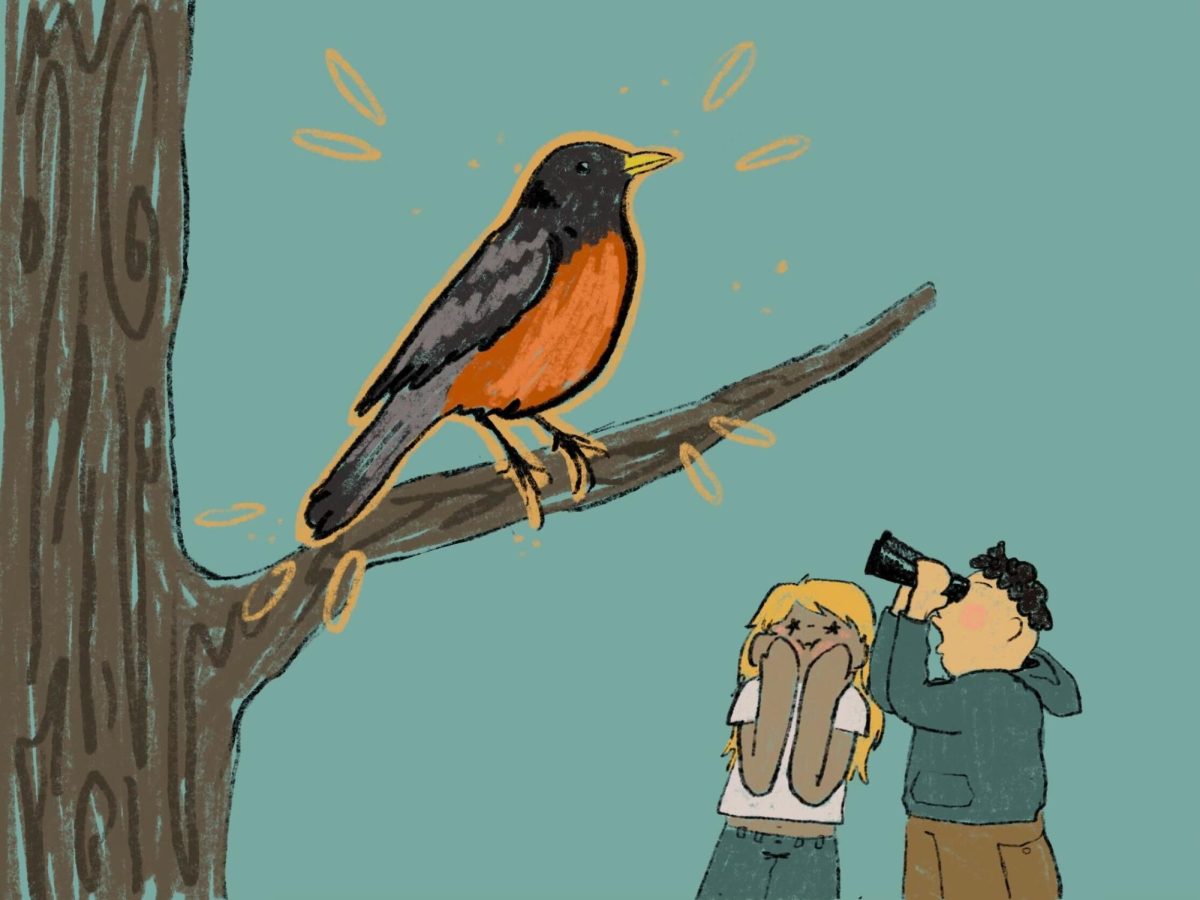
When one closes their eyes and pictures a birdwatcher, a certain image may come to mind: Wrinkled skin, stacks of field guide books and the kind of free time that only retirement could provide. Young birdwatchers, however, are rewriting that narrative.
For a generation deemed so chronically online, why does it seem like more and more young folks are drawn outside in search of rare birds? For some Colorado State University students, birding proves to be not only a hobby but an accessible form of escape from daily life.
“Birding is just when you start to notice birds and go from being like, ‘Oh, there’s a bird over there’ and to being like, ‘I wonder what bird that is,’” said Jazz Hennes, a CSU student studying fish and wildlife conservation biology who is involved in CSU’s Field Ornithologists Club. “You don’t need binoculars or a book. You just have to have this wondering of, ‘What is it? Why is it there? What is it doing?’”
Hennes’ interest in birds began during childhood, but they said it wasn’t until they arrived at CSU that they found community among other birders.
“I heard that there was a bird club on campus, and so I went to a few meetings, and then I started using the birding apps, and then I ended up getting a cheap pair of binoculars just to try it out,” Hennes said.
Birding apps, the most prominent of which being Merlin and eBird out of the Cornell Lab of Ornithology, have grown in popularity in recent years. Both apps are free databases that can help identify bird calls and keep track of the species a birder observes.
“I’ve definitely heard more people talking about the apps as time has gone on throughout my time in college,” said Valyn Highley, a CSU student studying fish, wildlife and conservation biology.
Highley’s journey to birding has, similarly, been a part of her college experience.
“Once I started to learn more about birds in college, I got really interested in them,” Highley said. “It kind of started with raptor identification. That grew to songbirds, where I was more interested in recognizing them based on their calls and what they look like and trying to identify them. I also went to the CSU Mountain Campus and took a class where we had to identify a ton of different species, and that included different kinds of birds.”
Highley is a user of the birding app Merlin in combination with some of the more traditional methods.
“I use Merlin to help identify bird calls and learn what they sound like,” Highley said. “I also do use binoculars to identify different kinds of birds when I’m out and go out with my friends.”

Others have leaned on apps like Merlin and eBird to help them get started birding, which in the past may not have been so easy.
“When I was getting into (birding), I was really struggling to find resources or find people who were willing to teach me and help me learn more,” Hennes said. “The apps were really, like, meeting me where I was at.”
Technology allows for identification to happen on a faster timeline, making the process easier and breaking down an entry barrier for beginners.
“I do think the introduction of these recent apps, like from Audubon Society and Cornell Lab, make it easier for people to learn about birds in real time,” said Liba Pejchar, a professor in the department of fish, wildlife and conservation biology at CSU. “They can use Merlin to listen to a birdsong, and it IDs the bird for you. It’s not 100% accurate, but it’s mostly there. You can learn about birds in real time as opposed to having to go home and look things up.”

Pejchar’s teaching and research are largely dedicated to birds.
“Birding and ornithology is integrated into my teaching and my research,” Pejchar said. “I teach a class called bird ecology and conservation.”
Pejchar hypothesized that external factors may also have had something to do with the growing popularity of birding.
“My sense is that it’s possible that COVID had something to do with this, too,” Pejchar said. “When people were home, they were paying more attention to the nature around them. There were people trying to get outside (of) their house but not in close quarters with other people. I don’t know if that has something to do with it or not, but I do think there was a spike in interest in things like birding and gardening during that time period.”
Another factor Pejchar cited as a potential reason for the rise in popularity of birding is the nature of birding itself.
“I think what’s really appealing about birds as compared to maybe other taxonomic groups is that they’re just diverse enough,” Pejchar said. “There’s a lot of diversity, but it’s not so overwhelming that you have to be an expert to ID.”
Along with the emerging birding apps comes a certain sense of competition. While some enjoy birding without tracking the number of species they’ve seen, others are committed to the “Life List,” which is a feature of eBird that tracks all of the species a user observes while using the app. Some users are drawn in by this added layer of competition, hoping to observe more species than any other user within a year or in a given county.
“For some people, there’s an element of competition,” Pejchar said. “That’s not me, and a lot of birders don’t feel that way. They’re out there because they like observing birds. But there’s also nothing wrong with the people that are interested in the competitive aspect of it. That might appeal to some people who like being out in nature but also like to be challenged in that way.”
Highley said that birding has become a type of escapism.
“I know a lot of people are kind of stressed in the current political climate,” Highley said. “It’s a really good way to de-stress by going out in nature and looking for different birds. I think that’s a really great way to decompress from all the stresses of life in current society.”
Birding may also appeal to young people due to its affordability.
“I feel like there’s kind of been a big switch in young people getting more invested in outdoor activities in general, and I think birding is just one of those activities that kind of comes with the territory,” Hennes said. “I think it’s one that’s a little easier and less daunting to get into.”
Reach Gracie Douglas at life@collegian.com or on social media @RMCollegian.