
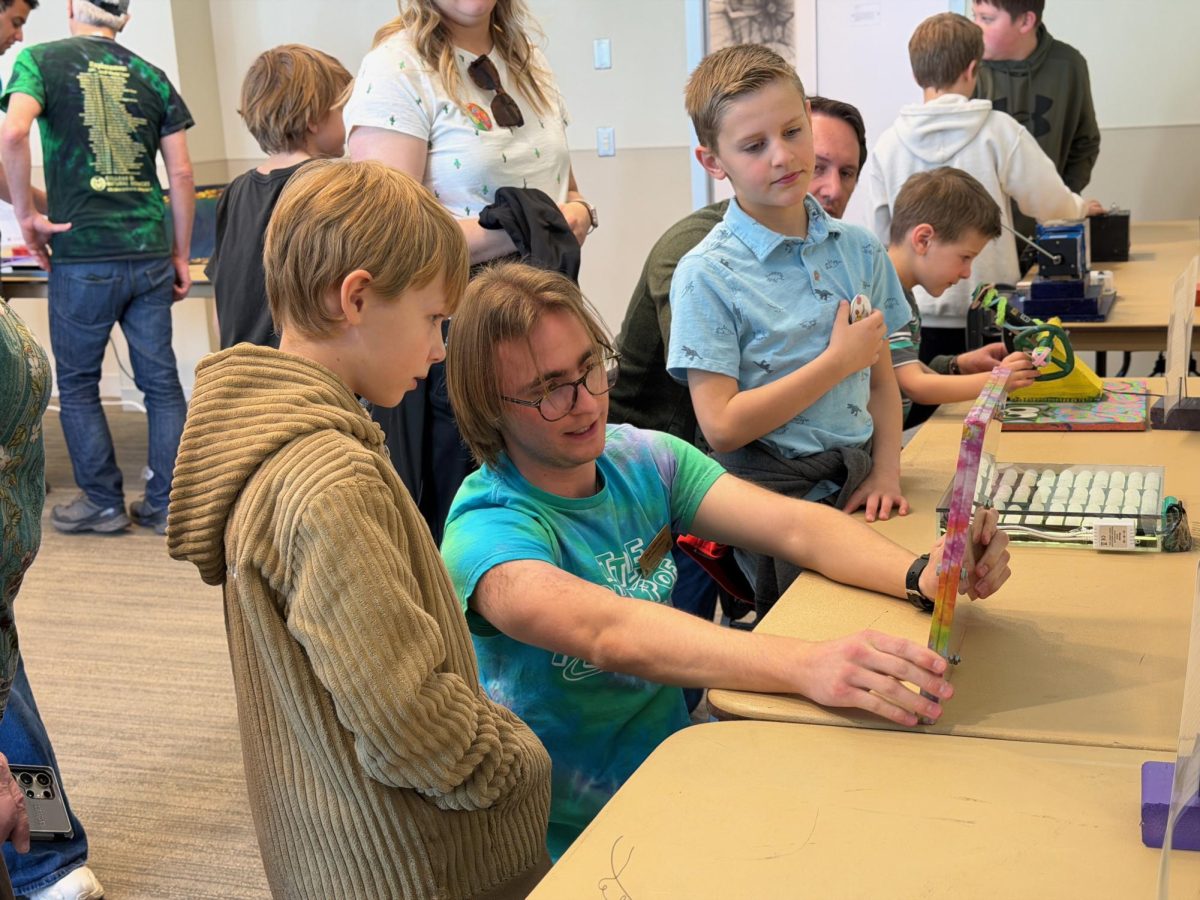
Inside the Little Shop of Physics workshop at Colorado State University, a hair dryer is pointed at a pinwheel rigged with color-coded LEDs. When air is shot at it with a certain force, a red light will flicker on. With greater pressure, the light turns orange, followed by blue. The miniature wind turbine was built by an undergraduate student to demonstrate, in the simplest possible terms, that some colors of light take more energy to produce than others.
It’s one of dozens of hands-on experiments the program is developing and expanding after receiving a $50,000 grant from the American Physical Society’s Division of Condensed Matter Physics — funding organizers say will let them reach more than 10,000 people this year alone.
The goal is to get complex science into as many hands as possible. Yulia Maximenko, an assistant professor in CSU’s department of physics, said the award marks the second year of the partnership she initiated with Little Shop after applying with a handful of ideas and asking the organization to help bring them to life.
“We were very excited, obviously, to participate in that,” Maximenko said, noting the program received seed funding of about $10,000 in its first cycle before securing this year’s $50,000 award. “We had lots of ideas for other activities. We wanted to organize a teacher’s workshop; we wanted to buy more materials and give them to teachers so they can take them to their schools and teach these concepts so kids can understand these underlying principles.”
Those activities include professionally produced videos explaining the physics behind each experiment and QR codes that will let visitors keep learning about a concept after they’ve walked away from the table. The money will also pay undergraduate and professional staff salaries.
Condensed matter physics, the field the grant supports, studies how atoms and electrons behave inside solid materials; the field explores the science behind things like semiconductors, LEDs, quantum computers and more.
Maximenko said students often don’t have the opportunity to learn this at the undergraduate level, let alone in elementary school, which made the outreach opportunity appealing.
“If you can’t explain your complex concept to a five-year-old, you’re a bad scientist,” Maximenko said, echoing Albert Einstein. “Even though these concepts are very complex, it’s very important to try to explain them to everybody, regardless of their background.”
Heather Michalak, director of Little Shop of Physics, said the grant will fund a dedicated condensed matter room at the program’s annual open house, which she said drew more than 8,000 attendees to CSU’s Lory Student Center last year. This year’s open house, set for March 7, 2027 is expected to draw more than 10,000 visitors, according to Michalak. The grant will also send staff and students to visit 25 schools across Colorado, South Dakota and beyond to build and demonstrate new experiments made from everyday objects.
Michalak, who returned to the program after working in the tech industry and running her own coffee shop, was herself an undergraduate at Little Shop in the late ’90s. She said the program, which started more than 30 years ago with a single employee, now employs 10 to 12 undergraduates, many of whom are paid.
“So this undergraduate student now is like first learning how to (use) science (communication),” Michalak said, describing how students design experiments, then have to translate their creations into something a child can safely interact with.
Not every experiment survives first contact with its audience. Maximenko said an early model simulating atomic vibrations in a crystal lattice, built with springs and toothpicks, fell apart quickly once children began playing with it, sending the team back to redesign it with sturdier materials this year.
“The biggest challenge in making condensed matter physics something that a kid can understand,” Maximenko said.
Maximenko said the point isn’t that every visitor fully comprehends the material but rather that the shop can spark a curiosity that can grow into a passion for science.
“Even if 2% of people who interact with it go and dig deeper afterward, it means we’re already achieving the purpose,” Maximenko said.
The new experiments are expected to debut publicly at the open house in March 2027, with additional appearances planned at the APS Global Summit in the spring.
Reach Maci Lesh at science@collegian.com or on social media @macileshmedia.