
Editor’s note: All wildfire statistics are updated to reports published July 24. Due to the rapidly changing nature of national disasters, up-to-date information can be found on the National Interagency Fire Center’s website.
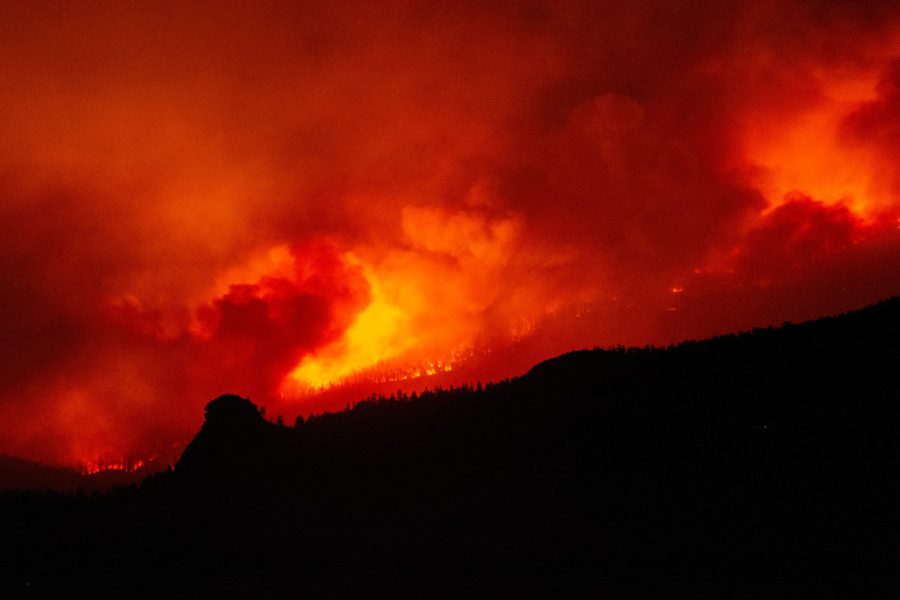
Eight large wildfires are currently burning across Colorado.
The Aspen Acres fire, the seventh-largest in state history, has destroyed more than 800 structures so far in the Custer and Pueblo counties. The Gold Mountain Fire has reached 27% containment near Ouray, Colorado. Statewide, fire crews are working under conditions shaped by the record-low snowpack, which totaled as little as 22% of normal by early April.
Six years ago, on a mountainside above Fort Collins, the largest wildfire in Colorado history left behind its own scar. In 2020, the Cameron Peak Fire burned nearly 209,000 acres between August and December. Today, that scar is a living laboratory. Researchers from Colorado State University’s Colorado Forest Restoration Institute are several years into a study that could shape how — and through what mechanisms — Colorado’s forests come back after fires like the ones currently afflicting the state.
“The truth is nobody really knew what the answers were,” said Camille Stevens-Rumann, CFRI’s director and an associate professor of forest and rangeland stewardship at CSU.
In 2022, her team began a large-scale experiment testing various conifer species across dozens of plots inside the Cameron Peak burn scar. The site was chosen because the fire’s footprint spans nearly the full elevational range of Colorado’s forests.
According to Maddie Wilson, crew leader and graduate student, crews now monitor almost 70 plots twice a year, hiking each spring and fall to measure every seedling: observing mortality rates, growth speeds and causes of death. They record burn severity, aspect, slope, soil type and more.
Wilson said it’s slow, physical work.
“It’s 10 to 12 hours each day and then at the end of the day, we come back to our campsite, sleep it off and do the whole thing again the next day,” Wilson said.
The early results were unsettling. Stevens-Rumann said she expected some die-off but was stunned by how many Ponderosa Pine seedlings failed in what were historically Ponderosa-dominated forests.
“That really shows how harsh those conditions are,” Stevens-Rumann said.
She explained that seedlings planted 2,000 feet above where those species are normally found — about 10,000 feet — are thriving. Colorado’s forests, in other words, may already be shifting uphill.
The study has become an unplanned case study in exactly the drought conditions gripping the state today. According to Stevens-Rumann, of roughly 3,000 seedlings planted in 2022, 75-80% survived their first year. Of nearly 8,000 planted in 2025, only about 47% did, despite similar total rainfall.
The difference, Stevens-Rumann said, was spacing. In 2022 rain fell steadily; in 2025, 35 days passed with none at all.
“If you think about your garden, you need to water it consistently, right?” Stevens-Rumann said. “You can’t just water it once a week and be like, ‘It’s good.’”
Marin Chambers, a CFRI senior research associate, said she expects this year’s numbers to be worse.
“We’re likely to see a bit more mortality due to the drought this year,” Chambers said.
A companion CFRI study gives the work another dimension: Species may not just determine whether a forest comes back, but how the next fire behaves when it does. Analyzing nearly 20 years of fire behavior across more than 300 southwestern United States wildfires, researchers found that fires burned roughly a third as fast through landscapes where aspen made up more than 25% of the vegetation, compared to areas with less than 10% aspen.
Stevens-Rumann said the study validated what firefighters were saying but with hard numbers behind it. Encouraging aspen regrowth, including through prescribed burns, could give land stewards a genuine tool for slowing the fires still to come.
“The more we can have those trees be grown here, the better,” Stevens-Rumann said.
Underneath the data, Chambers said, is a harder question than any spreadsheet can answer.
“As an ecologist who’s a forest lover and a tree lover, and who recognizes the incredible impact of the ecosystem services we reap from forests, I think there’s a question here,” Chambers said. “When we have post-fire landscapes with high-severity burn areas, … what do we want to do? What is our desired condition for those landscapes, … and what can we do to ensure that? It’s going to be desirable to put a forest back on that landscape … in a way that ensures long-term resilience.”
Wilson keeps one image from her years in the burn scar close at hand. She said was working a high-elevation spruce-fir site inside the Cameron Peak footprint when she came across a stump — roughly her own height and so wide she couldn’t wrap her arms around it — that was charred hollow through the middle.
“I looked down into the middle of it, and I saw this spillage of natural regeneration of some conifer species,” Wilson said. “They were too small for me to actually know what they were. It was almost like a tongue coming out of it, and it was just such an inspiring moment for me to realize that nature is resilient. It has so much resilience to it. You could focus on this really decimated stuff, or you can focus on the fact that it’s pouring out regeneration.”
Five years after the largest fire in state history, something is already pushing up through the ash, even as this summer’s fires put new ash on the ground.
Reach Maci Lesh at science@collegian.com or on social media @RMCollegian.