
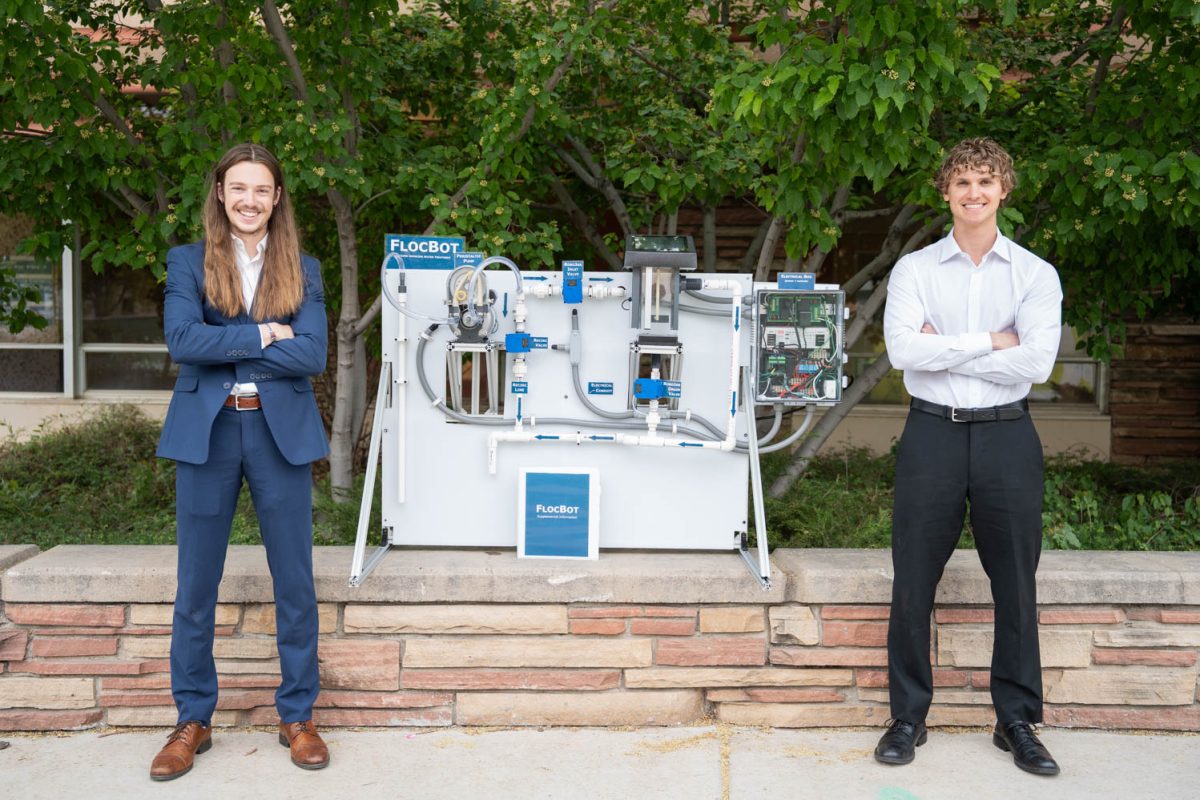
Two senior engineering students at Colorado State University have innovation at the forefront of their minds.
What began as a senior year capstone design project is now an award-winning device by Hugh McCurren, an environmental engineering student, and Josh Kates, a civil engineering student. The pair are the co-founders of FlocBot, a business startup that aims to improve the water treatment process.
The tool targets the early steps in the water treatment process, starting with coagulation, in which chemicals are added to water to bind small particles. Particles later become bigger in a process known as flocculation, forming what is known as “floc,” which the tool measures the formation of in real time, offering water treatment plant operators immediate feedback.
The absence of enough chemicals make water unsafe to drink, but too large of a chemical dose also impacts water quality, taking a toll on pipes, filters and financial cost. Because water conditions may vary, it is hard to know how many chemicals to add.
“Coagulant overdosing is an issue nationwide,” McCurren said. “The more systems we can implement, the more (sustainably) water can be treated, and that’s really what we’re striving for.”
FlocBot came to fruition after McCurren traveled to El Savador on a trip with Rams Without Borders, where he met Bert Vermeulen, instructor in the Walter Scott, Jr. College of Engineering. A part-time instructor, Vermeulen serves as a professional bridge for the FlocBot project, connecting McCurren and Kates with Roger Jorden, a globally recognized expert in flocculation and former professor at the University of Colorado.
Jorden, chief adviser on the project, is also the inventor of RoboJar, a tool that analyzes floc formation and provides water treatment plants with objective data on how to optimize their chemical inputs in 30 minutes or less. FlocBot builds off of RoboJar by collecting the imputed water sample and exporting the data in an automated manner.
“(RoboJar was) looking for some extra hands (and) an extra perspective at their product (to) see if it could be improved at all, and we were looking for an idea,” Kates said.

Following the words of their advisers, the pair investigated the problem and then came up with a solution, familiarizing themselves with water treatment plants nationwide. The pair visited over 20 water treatment plants across the Front Range and distributed a national survey, collecting over 250 responses from around 40 states. With that, their senior design project was put into motion.
The team behind FlocBot consists of an interdisciplinary array of 14 student members, whose focuses span mechanical engineering, chemical engineering, electrical engineering, computer science and business.
“They were not engineers in the classic sense where they were doing engineering, problem solving,” Vermeulen said. “They were providing the leadership and establishing the relationships with their potential customers.”
Alongside Vermeulen, the project called upon multiple advisers: Wade Troxell, former Fort Collins Mayor and associate professor of mechanical engineering; Pinar Omur-Ozbek, associate department head for undergraduate programs and teaching professor in the department of civil and environmental engineering; and Steve Henry, an electrical engineer and CSU alumnus.
Interdisciplinary collaborations are rare in the college of engineering, the duo said. FlocBot is an exception, and they hope to set a precedent for future projects.
“This was a project where we needed the knowledge from every engineering major in the college of engineering,” Kates said. “I think we had to really go out of our way to make an interdisciplinary project happen. The college is not against it, but there are not guidelines in place to make it easy to have happen. … I think everybody was extra motivated and excited to get to work with people from other engineering majors.”
Vermeulen, who has advised over 60 engineering projects, said the project’s large team and cooperation from Jorden’s outside company, Clear Corporation, is what makes FlocBot unique.
From the Venture Funded Senior Design Program in the College of Engineering, which provided funding to start-up the FlocBot, to delivering an elevator pitch in the Institute for Entrepreneurship Startup Showcase that landed them a first-place prize, the pair has received various funding sources to support their efforts. This summer, the FlocBot team will also be participating in an eight-week experience for entrepreneurs known as the Student Venture Accelerator this summer.
As McCurren and Kates prepare to graduate, they are looking ahead. Their next steps involve building three prototypes for plants and a software for operators to ease data interpretation, applying for grants and competitions and expanding sustainably.
Reach Chloe Rios at science@collegian.com or on social media @RMCollegian.