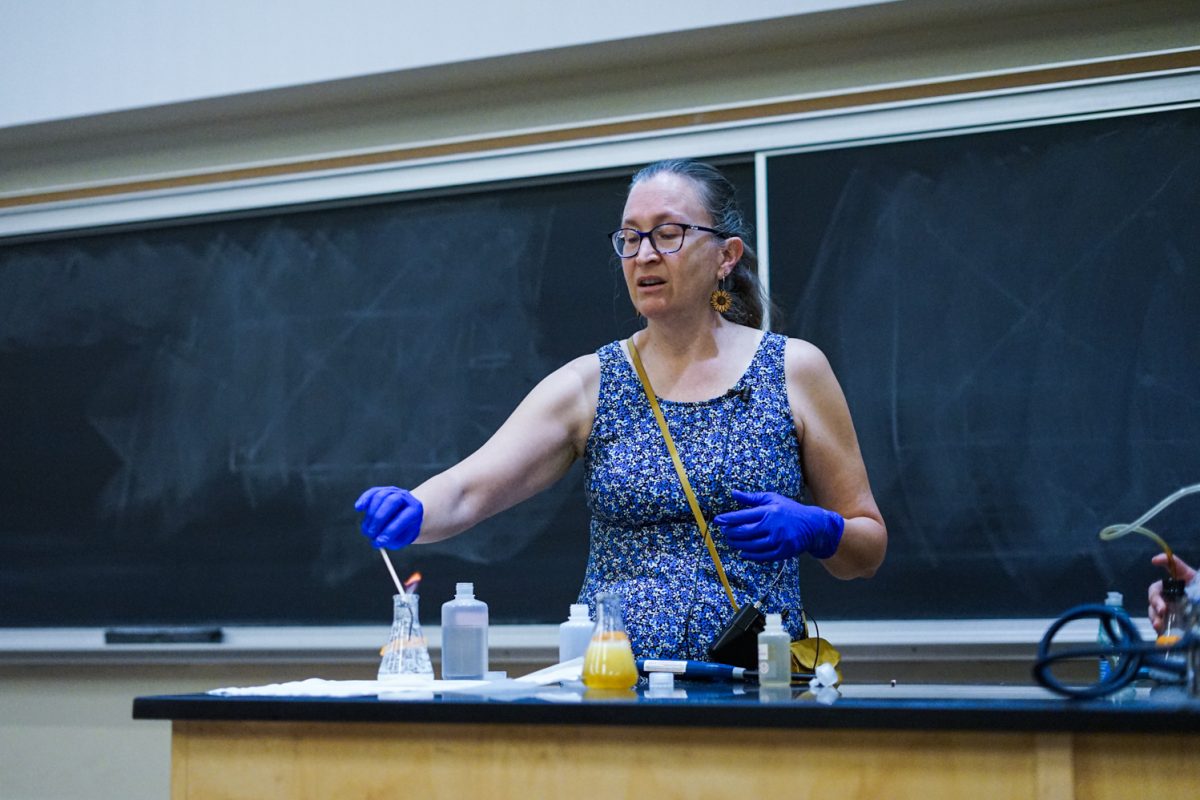


The aroma of dark chocolate wafted from the Fort Collins Welcome Center on Wednesday as community members filled the space to try samples and attend the March 25 installment of the Ram Talks lecture series. Caitlin Clark, a senior food scientist at CSU Spur’s Food Innovation Center, discussed the benefits and the risks associated with chocolate consumption and shared her extensive experience with her own chocolate laboratory.
Clark’s chocolate lab is a place where she not only conducts research but produces her own chocolate, a food that, while it can be well processed by humans, is very harmful to dogs.
One of the chemical compounds significant to chocolate is theobromine, which can have beneficial effects on people.
“Humans find it stimulating and relaxing at the same (time), but dogs can’t process it the same as humans,” Clark said.
To highlight the contrast between dark chocolate’s harmful effects on dogs and its positive effects on humans, Clark showed how much chocolate would be lethal for the average 65-pound Golden Retriever, which is Colorado’s most common dog breed. Assuming that true dark chocolate bars have at least 70% dark chocolate and 12 milligrams of theobromine per gram of a dark chocolate bar, Clark said it doesn’t take a lot before dogs start feeling the effects.
“Five chocolate bars would be lethal for a dog of this size,” Clark said. “One-fifth of this could cause seizures.”
It would take 140 dark chocolate bars, she said, to reach lethal levels in a 150-pound human. That would be the equivalent of about 500 milk chocolate bars, which Clark said contain much less dark chocolate.
“Bioaccumulation is a particular problem in dark chocolate. Cadmium (in particular) is an issue because it is taken up by the roots of the plant chocolate comes from.” -Caitlin Clark, CSU Spur senior food scientist
Clark said that to some individuals, theobromine’s effects may be more desirable than caffeine.
“It’s a longer-lasting mood booster,” Clark said. “Dark and unprocessed chocolate also has lots of polyphenols, which reduces oxidative stress. But everything we do to chocolate’s (processing) degrades the polyphenols.”
There are ways chocolate can harm people, though. While not immediately, chocolate is susceptible to contaminants like heavy metals and fungi-derived toxins, which have harmful effects when built up in the body over time.
The journey of chocolate from farm to bar starts with the cacao tree, where absorption of heavy metals can occur before the plant is even harvested, depending on where it has been grown.
“Bioaccumulation is a particular problem in dark chocolate,” Clark said. “Cadmium (in particular) is an issue because it is taken up by the roots of the plant chocolate comes from.”
Cadmium can cause cancer and kidney disease in humans. Another metal that has been found in chocolate is lead, which can lead to kidney damage, brain damage and birth defects.
Testing for heavy metals is possible and is often conducted by smaller chocolate companies that source their chocolate directly from specific farms. However, larger, more popular brands, Clark said, often pull from numerous farms and testing doesn’t always occur.
Another thing chocolate is susceptible to is mycotoxins.
“There are compounds produced by molds and don’t immediately hurt you but accumulate over time,” Clark said.
Moldy cacao beans are sometimes missed and included in the final chocolate-making process. Salmonella can be present in these beans, and there is a variety found in chocolate that’s resistant to dry heat. To make chocolate, a dry roasting process occurs. Clark said new practices are introducing steam to eliminate these bacteria, but it’s not a widely adopted process.
Despite the dangers, some companies are working to source directly from farms so they can more efficiently test their chocolate and work to minimize the dangers of its consumption. A personal favorite of Clark’s is Nuance, a Fort Collins-based chocolate maker and provider of the samples at the talk.
The talk concluded with Clark answering community questions. Overall, most people still said they’d still enjoy chocolate, just maybe not as much.
“I think we always know the artisanal, smaller chocolatiers are better, but of course (there’s) the cost and when you want your quick fix, especially Easter, right?” said David McLean, a Fort Collins resident.
Others mirrored his reaction.
“The information is helpful,” Michelle McLean said. “I’m not going to use much chocolate, but I’ve got my little chocolate-covered macadamia nuts in the cabinet. As much as I say no, I get this way right at 10 o’clock at night, and I will grab one of every single time.”
Some attendees shared plans of watching their chocolate consumption.
“It’s something to think about,” said Craig Soule, a community member and Ram Talks regular. “But you know, I think in moderation, same thing as, you know, not eating kilograms a day or whatever, probably you’re going to be OK.”
Reach Catherine Schladegg at science@collegian.com or on social media @RMCollegian.