

If you want to work in sports broadcasting, college can give you a lot more than a journalism degree.
A campus can be a newsroom, broadcast booth, production studio, and sports beat all at once. Students may get the chance to call games, interview athletes, produce shows, edit video, manage social media, or work behind the scenes during a live broadcast.
That experience is hard to replace.
Classes can teach reporting standards, writing, production, and ethics. Live sports add another layer. Games move quickly. Interviews can go in unexpected directions. Equipment can fail. A broadcaster may have only a few seconds to decide what the audience needs to know.
College sports give students a place to learn how to handle those situations before they enter the professional market.
College sports offer a lot of room to learn
There is no shortage of material for students interested in sports journalism.
The NCAA includes nearly 1,200 member schools and conferences across its three divisions, and many larger universities have dozens of teams competing throughout the year.
Penn State, for example, has 31 varsity teams. The university’s John Curley Center for Sports Journalism points to that environment as one reason students have so many opportunities to cover sports through writing, photography, video, audio, and multimedia reporting.
But the value goes beyond the number of games available.
A football broadcast is different from basketball. Each sport requires its own preparation. Covering a championship is different from producing a feature about one athlete. Even two games in the same sport can produce completely different stories.
Every assignment gives a young journalist another chance to figure out what works.
That is one of the real advantages of college sports broadcasting. Students do not have to wait for the perfect internship before they begin building experience. In many cases, the next useful assignment is already happening somewhere on campus.
Play-by-play is harder than it looks
Good play-by-play can sound effortless.
It isn’t.
An announcer has to identify what is happening, describe it clearly, provide useful context, and keep up with the action. At the same time, there is a fine line between giving the audience useful information and giving them too much.
A lot of that work happens before the game starts. Preparation may include:
- team and player statistics
- recent results and trends
- injuries and lineup changes
- player names and pronunciations
- season storylines
- previous meetings between the teams
Once the game begins, all of that information becomes a resource rather than a script.
A broadcaster still needs to decide when a statistic adds something and when the audience simply needs to know what is happening on the floor or field.
You develop that kind of judgment by doing it over and over again.
Penn State’s student media system is one example of how colleges can provide those repetitions. CommRadio, the Bellisario College’s student-run radio and streaming network, covers Penn State and State College High School sports while also producing news, talk shows, and other programming.
More than 150 students work across sports, news, production, marketing, and related areas.
For someone hoping to work on air, having regular access to live assignments can turn lessons from the classroom into actual habits.
Reporting matters just as much as the call
A good voice helps in sports broadcasting. Good reporting gives that voice something worthwhile to say.
Before a game, a reporter may research the opponent, look at recent results, or talk with coaches. After the game, the job may shift to interviewing athletes while the emotions and details are still fresh.
Strong interviews take more than a list of prepared questions.
You have to listen.
A reporter can walk into an interview with five questions and hear something in the first answer that sends the conversation in a completely different, and often better, direction.
College sports give students plenty of chances to practice.
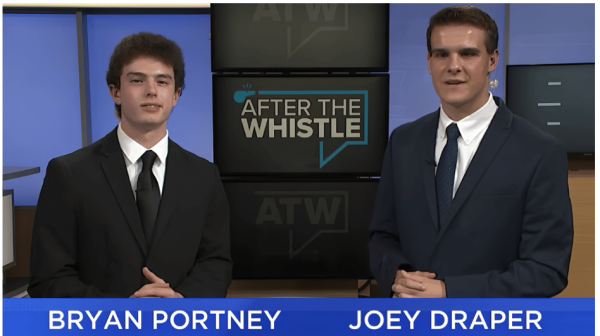
Penn State’s After The Whistle is one example. The student-produced sports show covers high school athletics in Centre County and Pennsylvania’s District 6, along with Penn State sports. Students travel to events, collect information and footage, edit highlights, and bring the material back for a live show.
The program was built in part to give journalism and production students real-world experience.
That experience is about more than getting on camera. Students have to find a story, gather what they need, meet a deadline, and turn raw information into something an audience can follow.
Those are skills that carry into almost any area of sports media.
Smaller assignments can sometimes teach you more
Students often judge an opportunity by the size of the audience.
That can be a mistake.
A high school basketball game with a small crew may give a young broadcaster far more responsibility than a major event where they perform one narrow task.
Joseph Draper’s early sports media experience is a good example.
Before graduating from Penn State with a B.A. in Broadcast Journalism in 2026, Draper covered high school sports for D11Sports.com in Pennsylvania’s Lehigh Valley. His responsibilities included filming games, collecting statistics, interviewing athletes and coaches, posting to social media, and providing play-by-play commentary.
Those weren’t unrelated jobs. They were all parts of covering the same event.
He later worked with Penn State Lehigh Valley athletics, where his responsibilities included interviews, social media, game-day communications, and serving as the play-by-play voice for the men’s and women’s basketball teams.
Smaller productions often create that kind of experience because there simply aren’t as many people around to divide up the work.
That can be useful early in a career. Instead of seeing only one part of a broadcast, students begin to understand how the entire process fits together.
Production experience makes better broadcasters
Most viewers pay attention to the person speaking.
A broadcast crew can’t afford to think that way.
Live sports depend on producers, camera operators, audio staff, graphics teams, reporters, announcers, and other crew members communicating with each other while reacting to things they cannot predict.
Working behind the scenes can give an aspiring broadcaster a much better understanding of that process.
An announcer who has spent time around production understands why timing matters. They know why a producer may need them to shorten an answer or why a camera operator needs a few extra seconds to get into position.
More importantly, they begin to see broadcasting as a team effort rather than a performance built around one person.
Penn State’s student media programs give students opportunities to work across producing, filming, reporting, broadcasting, and other parts of television production.
Nobody needs to become an expert at every job.
The benefit comes from understanding what the other people on the crew are trying to accomplish.
Editing changes how you see a story
Editing is useful even if you never plan to become a full-time editor.
Raw footage gives you everything. A finished story only has room for what matters.
That forces you to make decisions.
Which quote moves the story forward? Which play deserves another look? What can be removed without losing important context?
Those are editorial decisions, and they sharpen the same judgment broadcasters use during a live game.
A student might return from an assignment with several interviews, dozens of clips, and pages of notes. Turning all of that into a short package forces one basic question: What’s the story?
Once you get used to asking that in the editing room, it becomes easier to ask it during a live broadcast too.
Draper’s work with After The Whistle included post-game interviews, script writing, filming, and editing short broadcast packages in Adobe Premiere Pro.
The software is useful, but the bigger skill is learning how to recognize the strongest part of a story.
Software changes. Good judgment has a much longer shelf life.
Student media can feel a lot like a working newsroom
One of the best things about college media is that it gives students structure.
There are assignments, deadlines, editors, producers, and expectations. The audience may be smaller than it would be at a professional network, but many of the basic pressures are the same.
A story still needs to be accurate. An interview still requires preparation. A live show still starts when the clock says it starts.
At Penn State, students can work across sports shows, news broadcasts, radio and streaming programs, podcasts, and multimedia reporting. The John Curley Center for Sports Journalism says more than 1,300 students have earned its certificate since the center was established in 2003.
Students connected with the program have also covered major events, including the Little League World Series, NASCAR, the Olympics, Paralympics, and Super Bowl.
Those opportunities stand out, but the smaller assignments that come before them matter just as much.
Nobody starts with the biggest event.
The everyday work is usually what prepares someone for it.
Save the work as you go
Experience only helps so much if you cannot show it to an employer.
That is why college broadcasters should start building a portfolio early rather than waiting until graduation.
Useful material might include:
- play-by-play clips
- post-game interviews
- reporting packages
- on-camera segments
- podcasts
- feature stories
- edited video
- examples of production work
Not every clip needs to stay forever.
In fact, it shouldn’t.
Something that feels like your best work during freshman year may sound rough by junior or senior year. That’s a good thing. Replace it.
A portfolio should show what you can do now, not simply everything you have ever done.
Versatility does not mean doing everything forever
There is a difference between learning several jobs and never becoming particularly good at one of them.
College is a good time to explore, but students should also pay attention to where their strengths are developing.
One person may find that play-by-play fits them. Another may be better at reporting, producing, editing, or hosting.
Knowing a little about the surrounding jobs can still make someone better at their main one.
A play-by-play announcer who understands production can work more smoothly with the crew. A reporter who has edited video footage knows what footage will be useful later. A producer who has spent time on camera has a better idea of what the person on the other side of the lens needs.
The goal is not to do everything.
It is to know enough about the whole process to become better at the part you choose.
Start before graduation
Students interested in sports broadcasting careers do not need to wait until their final semester to start building experience.
College may be the easiest time in their career to find regular access to teams, equipment, instructors, student media outlets, and other people who are learning at the same time.
The earlier they take advantage of that, the more room they have to improve.
The first assignment does not have to be impressive. It might be a high school game, a student podcast, a college basketball broadcast, or a short reporting package.
What matters is getting the reps.
Joseph Draper’s path from local sports coverage to Penn State Lehigh Valley athletics, Pennsylvania State University Athletic Conference broadcasts, After The Whistle, and a production assignment with Fox Sports shows how those smaller opportunities can build on one another.
By graduation, that work had given him experience in play-by-play, reporting, interviews, podcasting, editing, social media, and production.
That is really what college sports media can offer.
The goal isn’t simply to graduate with a longer resume. It’s to leave school knowing how to prepare, communicate, make decisions under pressure, work with a crew, and tell a sports story in more than one way.
For someone trying to turn an interest in sports broadcasting into a career, that experience can make the jump from college to professional work much more manageable.