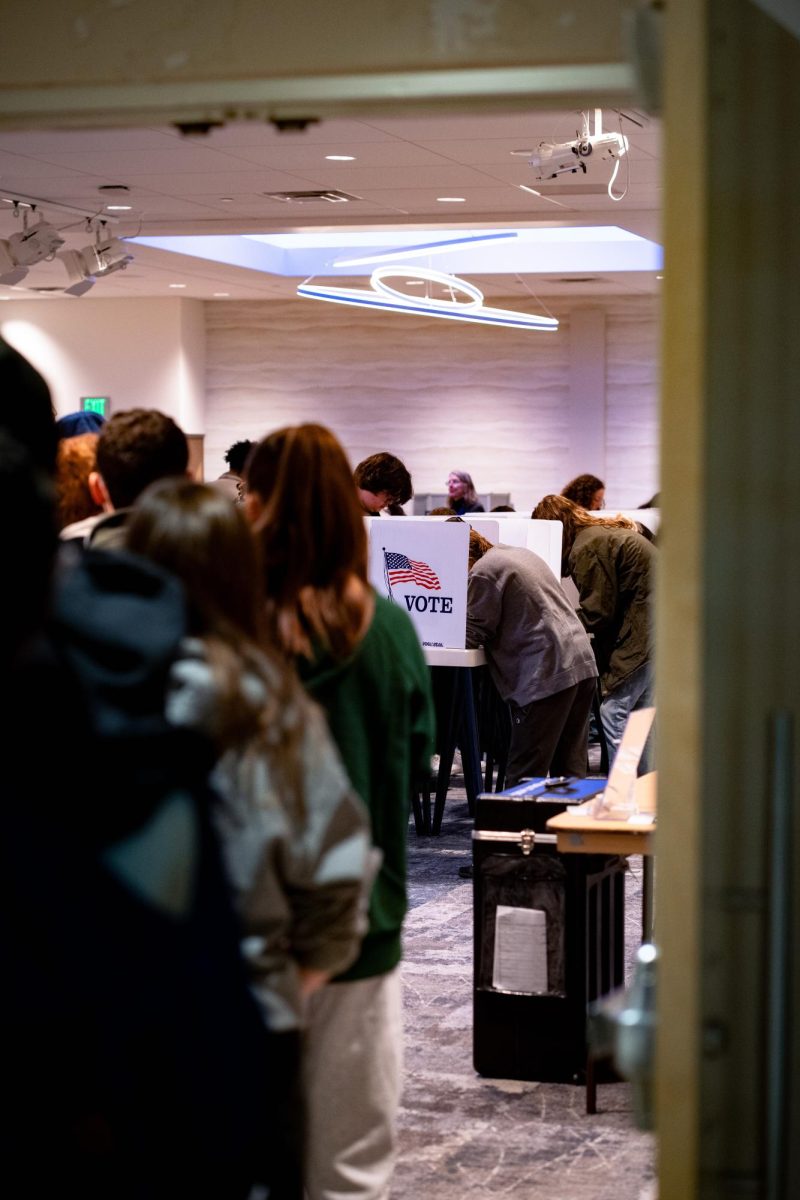

Colorado State University’s third annual Democracy Summit brought scholars, policymakers and students together this week to discuss civic engagement and the challenges facing democratic institutions in Colorado and across the nation.
On Tuesday, March 10, attendees gathered in the University Ballroom for a keynote conversation with U.S. Rep. Joe Neguse, the announcement of semifinalists for the inaugural Colorado Democracy Prize and a panel discussion examining the forces shaping the state’s political landscape.
The event opened with the announcement of the three semifinalist teams for the Colorado Democracy Prize, which recognizes student-led civic action projects designed to bring community members together across political and social divides. The selected projects include “Cultivating Civic Voices,” a youth civic engagement program led by Colorado Collegiate 4-H; “Civics by Design,” an art and democracy symposium organized by The People United; and “Walking Democracy,” a self-guided tour highlighting CSU and Fort Collins’ democratic history created by the Graduate Student Council.
Each team will spend the next year implementing its project before a finalist is selected.
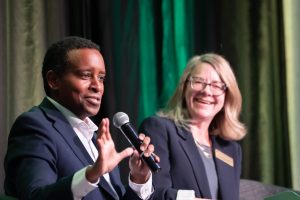
Following the announcement, Neguse joined College of Liberal Arts Dean Kjerstin Thorson for a conversation about civic participation, political polarization and the role of dialogue in democracy.
“The vision behind this particular summit — bringing together staff and faculty, students and stakeholders from across the community to talk about something as fundamental and as existential and as consequential as democracy — is really important,” Neguse said. “You’d be surprised at the dearth of conversations like the one that we’re having today.”
When asked what he viewed as the state’s greatest strength in democratic performance, Neguse’s answer was simple.
“I genuinely feel … that the greatest strength for our democracy in Colorado is our people,” Neguse said. “When you spend as much time on the road as I do, traversing our district and all the different counties that I represent, you find early on that people in Colorado are deeply engaged in trying to better our state.”
Neguse noted that Colorado’s 2nd Congressional District recorded among the highest voter participation rates in the nation in the 2024 election, something he attributed to a highly engaged electorate.
“I travel a lot of the country, (and) I can tell you that that is not the case in a wide variety of other congressional districts, coast to coast,” Neguse said. “So it’s something we ought to jealously guard and incubate and support because you can lose it.”
While praising civic participation, Neguse also expressed concern about polarization and performative politics in Washington, saying the environment for productive disagreement has become more difficult in recent years.
“The longer I’ve served in Congress, in my humble observations, the harder it has been to see productive disagreement come to the forefront,” Neguse said. “Our politics has become, sadly, very performative.”
He said healthy disagreement requires openness to new perspectives and a willingness to reconsider one’s views.
“The polarization that you see in Congress is a reflection of the polarization of society writ large, and we have to find a way to push back against it,” Neguse said. “It is not easy, and it’s not going to come without some concession and compromise on the part of everyone who believes that that’s not healthy for our democracy.”
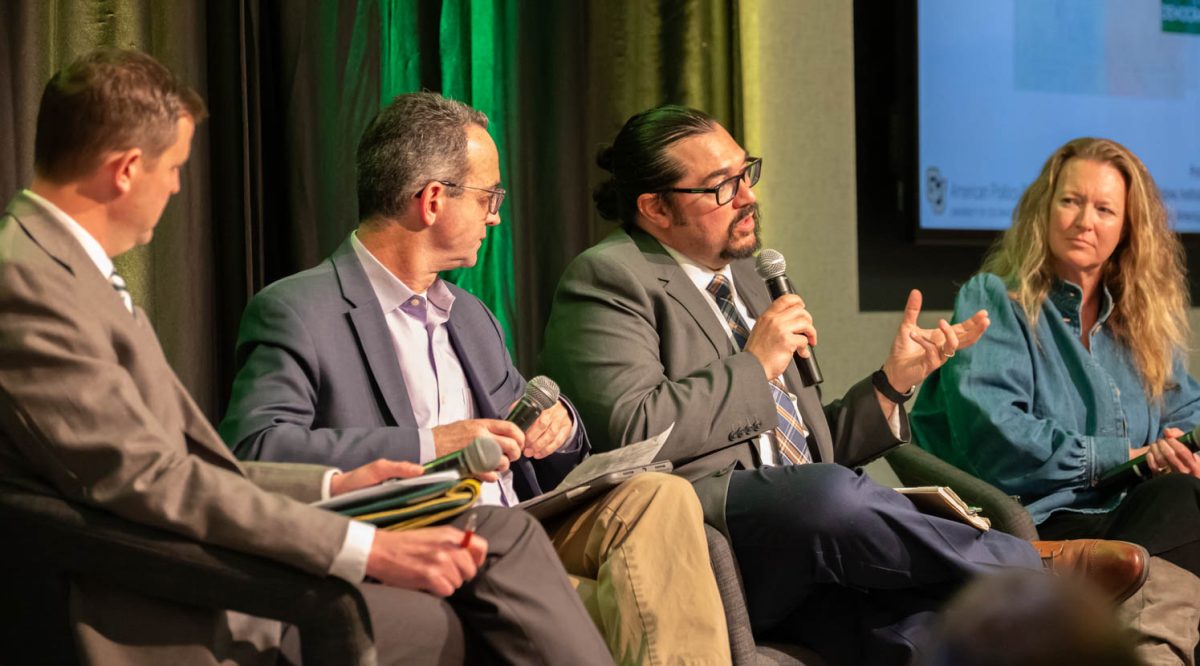
The keynote conversation was followed by a panel titled, “The State of Democracy in the Centennial State: Insights into Colorado’s Political Landscape,” moderated by CSU Associate Professor of political science Matthew Hitt. Panelists included University of Denver Professor Seth Masket, CSU Assistant Professor of Environmental Policy Kristin Olofsson and University of Colorado Boulder Professor Anand Edward Sokhey.
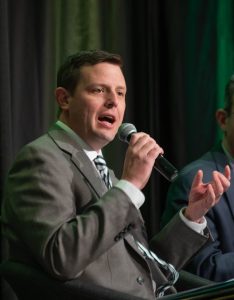
Opening the discussion, Hitt described Colorado as a particularly revealing case study for understanding democratic trends in the United States.
Panelists began by discussing indicators of democratic health in Colorado. Masket pointed to ongoing debates surrounding former Mesa County clerk Tina Peters, who was convicted in connection with efforts tied to election fraud claims.
Gov. Jared Polis has drawn pushback from Colorado democrats recently for considering commuting Peters’ sentence following urging from President Donald Trump.
“The governor could be considering this in any year,” Masket said. “But in this year, in this context, it means something very different. We are talking about acceding to a very inappropriate White House demand. … It strikes me as an important area.”
Sokhey emphasized public awareness and civic engagement, citing data from the Colorado Political Climate Survey conducted at CU Boulder.
“One thing that I think is a good thing is that you see that people are awake,” Sokhey said. “You see it in our data, that people recognize concerns about freedom of the press, about freedom of speech.”
Olofsson framed democratic health in terms of governance and implementation, describing what she called the “second act of democracy.”
“The first act being we elect people,” Olofsson said. “We pass laws, we create legislation, and then we turn to the second act. And that second act is implementation.”
She pointed to voter-approved measures such as the 2020 repeal of the Gallagher Amendment and the reintroduction of gray wolves as examples of policies that have faced challenges in implementation, raising questions about whether state institutions have the capacity and resources to deliver on voter mandates.
“This means that when we then go to implement something like that, we start to encounter a lot of friction,” Olofsson said, citing disagreements between counties and conflicts with neighboring states.
Much of the discussion focused on the complexities of governing in a state with strong ballot initiative powers and significant institutional constraints. Sokhey noted that Colorado voters are often asked to weigh in on complex policy questions.
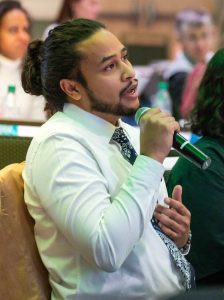
Olofsson argued that these challenges are compounded by Colorado’s unique institutional structure, which includes thousands of special districts and fiscal limitations tied to the Taxpayer’s Bill of Rights, or TABOR.
“In addition to our counties, we have over 3,000 special districts,” Olofsson said, explaining that the system can create tensions between urban and rural communities and complicate the implementation of statewide policies.
Environmental policy debates provided one example of these tensions. Olofsson said initiatives such as wolf reintroduction highlight conflicts between regions where policy decisions are made and communities must manage their impacts.
Audience questions broadened the discussion to issues, such as public trust in government, budget constraints and electoral reforms. Panelists discussed the role of local engagement in strengthening democratic institutions.
“I think a lot of it comes down to participation,” Masket said in response to a question about protecting democratic systems at the local level.
Throughout the discussion, panelists highlighted both challenges and opportunities for democratic participation in Colorado, including local engagement, electoral reforms and continued civic involvement.
For Neguse, the responsibility to address political division ultimately rests with future generations.
“To the young folks who are trying to figure it out: How are you going to bridge these divides?” Neguse asked. “What a tough problem to solve.”
Reach Hannah Parcells at news@collegian.com or on social media @hannahparcellsmedia.