
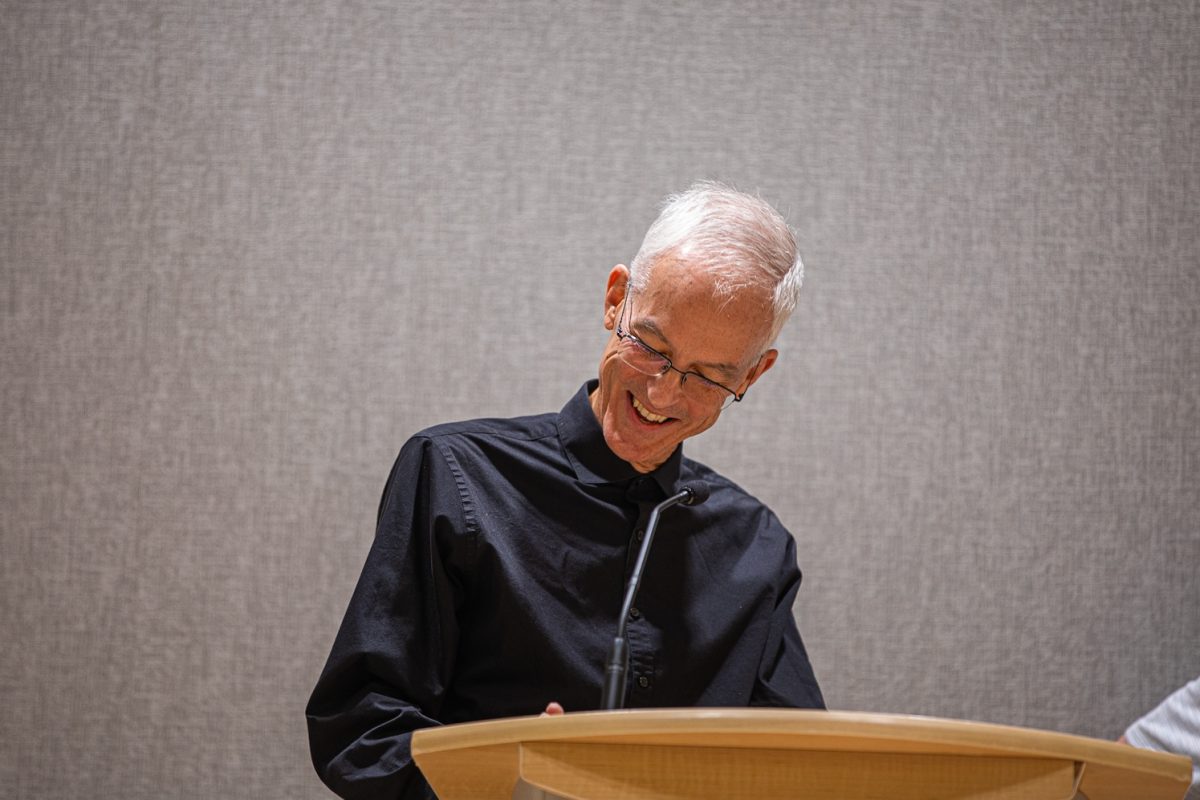
H. L. Hix carries the past in vivid textures.
Hix, an award-winning poet, philosopher and professor at the University of Wyoming, visited Colorado State University this September for the CSU Creative Writing Reading Series, a free recurring event organized by CSU professor Matthew Cooperman — a Guggenheim fellow and award-winning poet in his own right — with the intention of welcoming “distinguished literary voices to share their work and engage with the Northern Colorado community.”
At the Sept. 10 reading, Hix read from his forthcoming poetry collection, “As Wind Rounds Sandstone, As Ice Sections Schist,” which is set to release Oct. 27. He was joined onstage by 2025 National Book Award for Fiction Winner Rabih Alameddine.
Hix, a National Book Award finalist, has authored over 40 books and won multiple awards, including the T.S. Eliot Prize, the Peregrine Smith Award and the Scholastic Library Publishing Award, formerly known as the Grolier Prize. He has previously taught at the Kansas City Art Institute and was a Fulbright Distinguished Lecturer at Yonsei University in Seoul, South Korea.
The day before the reading, I spoke with Hix in an empty classroom after his guest lecture for University Distinguished Professor Camille Dungy. Perhaps inspired by the freshly vacated seats around us, we began to speak about teaching.
Hix discussed how, during his undergraduate degree, he was led to writing by the “breadcrumbs” dropped by his professors, which guided him to essential discoveries of his passions.
“I get to show people things that maybe nobody yet has shown them,” Hix said, describing the way that he now gets to be the one dropping breadcrumbs for students.
Though Hix primarily teaches in UW’s philosophy department, his teaching often strikes a poetic chord.
“The teaching seems to me to share something with poetry itself: It can be a vehicle for opening,” Hix said.
When asked about the intersection of poetry and philosophy, the author elaborated on the ways in which philosophical constructs sometimes appear in his writing.
“Occasionally, there’s kind of an explicit crossover,” he said, noting how his first poetry collection used quotes from philosophers as titles.
However, now he rarely intertwines the two blatantly, as the interaction between the two areas presents subconsciously.
“I think most often it’s just that they, because they’re both so sort of formative to the world, I’m sure they’re just kind of talking to each other,” Hix said.
As for writing, poetry wasn’t something that presented itself to Hix until he was working toward his undergraduate degree.
Hix smiled as he recalled Janet Wilson, the professor who introduced him to the works of the poet Gerard Manley Hopkins. From there followed Hix’s infatuation with language, truth and poetry.
“If you had told me in high school that I would end up being a poet,” Hix laughed, shook his head and let the thought’s absurdity speak for itself.
Although Hix has written a staggering number of books, including novels, translations, literary criticism and poetry, Hix and I met to discuss one work in particular: “Beckoned Back by Hell-Bent Blackbirds.” The collection was published in 2025 by Broadstone Books and is a powerful exploration of memory, time, family and spirituality.
Hix described how, during the process of writing “Blackbirds,” what really interested him were the “ways that physical presence and spiritual presence don’t necessarily line up.”
Hix gestured around the empty classroom, noting he didn’t expect this particular location to stay with him forever; he said several places from his life, however, have resided in his memory with a capacity almost spiritual in presence. One such place is an apple orchard that Hix recalled having known for around two years of his youth.
The orchard is a focal point of “Blackbirds,” with the orchard assuming an almost biblical, Edenic significance.
As he spoke about the orchard, Hix looked beyond me, as though he saw it there, and how one’s physical self may be lost in the grander considerations of such a spiritually resonant place began to make sense.
Hix supposed he now carries the orchard in textures — something innately visceral rather than cerebral.
“The texture of rotten apples and the texture of the bark, … there is a lot of palpable feeling,” he said.
I asked him about other places he might carry in a similar way, and though he could name more than one, he noted no two places carry the same presence or the same texture.
“It’s powerful how the past lingers,” Hix said.
He went on to describe the various ways in which the past can shift one’s conceptions of time, such as traumatic experiences that are often relived rather than merely remembered.
“We recognize that experiencing something traumatic changes time, and that event can very well continue even when the event has passed,” he noted. “The event somehow stays present for us in a very deep, experiential way.”
Not frequently explored are the ways in which memories and places linger for reasons that often defy description. Leading up to “Blackbirds,” Hix found himself wondering about the presence of places that didn’t necessarily have an articulable reason for existing in memory.
“It seems to me not only to be trauma, but that our pasts inhabit us in ways that are hard to describe and hard to isolate from other aspects of our experience,” Hix said.
In the book, the orchard mythologizes itself into a rural Midwestern Garden of Eden. I asked Hix about the character of the speaker’s brother, whose presence in the book seemed to be constructed as a foil to the speaker’s faith in the orchard’s spiritual essence.
“There needed to be a person who was the ‘other’ of the speaker in the poem,” Hix said.
Before the addition of the brother, Hix said he felt the book was lacking in tension. The character — a combinatory representation of many different people from Hix’s life — was needed to bring opposition and balance.
In his poem “No falling in the orchard but became a falling through,” Hix described the brother as a hunter, specifically targeting the creatures of the orchard: “He hunted what others hunted (squirrels, doves), but he shot, too, / anything that found the orchard: skunks, once a bobcat. Stray dogs.”
Hix said the speaker is the closest character to himself, although the speaker isn’t an exact match.
Then again, memory and reality don’t match perfectly, either.
The only truth we really have is feeling, Hix told me. The textures and resonances of a place may be vivid, but one’s recounting of the exact details can be clouded.
“My academic training is in philosophy,” he noted. “I’m all about truth, but I’m interested in the ways in which we have to deal with aspects of ourselves that get fuzzy.”
Hix discussed the ways in which these truths are braided with the flaws of memory; the past and the present tangle up within each other in the process of understanding.
“What do I think is in front of me and what do I understand is behind me and who do I understand is with me?” Hix asked.
While some of the book’s details are grounded in truths of reality, like the orchard and the house in Carbondale, Illinois, these details are wrapped in the truths of feeling — aspects that might not have actually been there but capture the sensations in the same tangible way.
He described how there are no strict borders in this recollection of experience, but rather a fluid timeline of what was and is felt. Hix said he hopes the book is open-ended, both to his and the readers’ experience. He said he wanted “the verge toward meaning to be a formative presence.”
I told Hix I couldn’t help but wonder how he had managed to capture so truthfully the feeling of a place that seemed beyond articulation.
“Part of what let me get started on it was letting go of some of the urge to get things right about the physical fact of the house and the shed and the orchard,” he said.
Hix described how, when he initially began working on the book, he contacted family members asking for descriptions, sought all the photographs that he could find of the place and even looked it up on Google Maps.
He said he came to a point of needing to give up the sense of accuracy to what really happened and arrived at the decision to instead express how the experiences felt.
“It was the ‘how it felt’ that made it last for me,” Hix said. “(It was) letting go of trying to just be true to the way it was and to be true to the way it felt, and to be true to the way that I understand in terms of meaning.”
We were both quiet, then. Hix gave me quiet to calm the lump that had formed in my throat.
Hix continued, “And that then liberates one to listen to the words and let the words guide you and let the images find each other.”
He described the image of his father’s boots referenced in the book, saying, “I don’t remember the boots from that house, but I remember the boots, and they feel like my father.”
Because the feeling of the boots fit, they became just as real as any other part of the house.
I then ventured to ask Hix a question that tends to be a least favorite among writers: Why do you write?
Of course, the often-repeated stock answer is that one writes because they feel a compulsion to do so. But, beyond that compulsion, Hix said writing is “a method of self-understanding — understanding of the world and experiencing the world as robustly as I can.”
He explained how, in the household he grew up in, there was a strict framework to understanding one’s life that eventually stopped working for him. Writing filled the empty space left in its stead.
“Writing is a way for me to construct a framework that allows for living as fully as I can,” Hix said.
To understand is to write. To write is to remember. To remember is to braid the truths of reality with truths of feeling.
Neither Hix nor I will likely remember the classroom we spoke in. But maybe we will remember the feeling of the conversation, and somewhere down the line, the texture of a plastic classroom desk or chair or whiteboard will insert itself into a truth within memory, creating a reality that escapes definition entirely.
In a transformation of the book’s epigraph — which defined in his own words the construct of “here” — Hix closes “Blackbirds” with an re-exploration of the concept: “There. Not how what did happen happened, but how what didn’t is true.”
Reach Addie Mitchell at entertainment@collegian.com or on social media @RMCollegian.