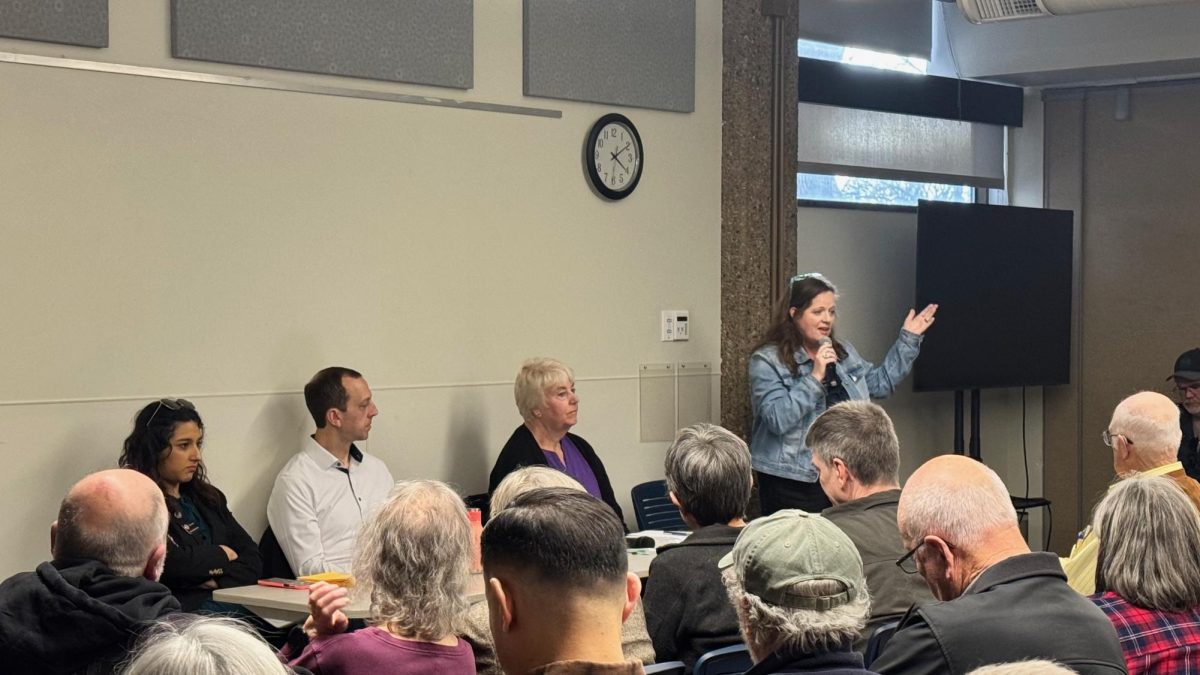
Fort Collins officials hosted a legislator town hall Feb. 1 where local lawmakers previewed priorities for the Colorado General Assembly’s second regular session, underway from Jan. 14 to May 13. State Reps. Yara Zokaie of District 52 and Andrew Boesenecker of District 53 joined State Sens. Cathy Kipp of District 14 and Janice Marchman of District 15 to answer questions from constituents and highlight bills they are working on.
Lawmakers discussed proposals related to consumer protection, local ordinance enforcement, data center regulation, state budgeting, federal agency oversight and online safety. Here is what each emphasized throughout the town hall.
Sen. Cathy Kipp
Kipp, a Democrat representing Larimer County, opened the session on the topic of data centers. She explained that a handful of pro-business democrats had introduced a bill in the Colorado General Assembly the week prior that would offer a 20-year tax exemption to data center developers in return for promised investment in high-paying jobs. Kipp said she plans to introduce an alternative bill.
“I am just going to call it the industry bill because, frankly, that’s what the sponsors of the other bill called it during a press conference,” Kipp said. “I will just say my bill was folded with pretty much all the environmental groups in Colorado right now.”
Kipp said her proposal, expected later this month, would more closely regulate data centers and require developers to invest in environmental protection measures.
“We are not banning data centers in Colorado,” Kipp said. “What we are doing is we’re putting guardrails on it. We don’t want you and I as rate payers to end up subsidizing the cost of enhancements to the grid or subsidize these companies. We want to make sure that there is transparency around water and electrical use. We want to make sure that as much of that electricity as possible is from clean renewable energy sources.”
When asked about the potential benefits of artificial intelligence, Kipp said she has met with a range of stakeholders and agreed that an outright ban on data centers would be extreme.
Kipp’s next priority was a bill she introduced with Zokaie that would require Colorado State University to comply with the Fort Collins sign code. Last year, CSU partnered with Street Media Group to erect electronic billboards throughout campus, many of which are visible from surrounding off-campus areas.
The billboards violate the city’s sign code, which prohibits billboards almost entirely. CSU, however, is a state entity and is not subject to city ordinance. Many community members have taken issue with the signs, claiming they are distractingly close to the road, hazardous to nighttime wildlife and disruptive to the city’s aesthetic, among other concerns.
“It’s just not OK,” Kipp said. “My personal opinion, and certainly what I’m hearing from people, is that people are pretty unhappy with having the places they live be disregarded and their comments disregarded by Colorado State University.”
The bill would require that all signs visible and audible from off campus comply with city ordinance, unless granted a waiver. Kipp said she is looking for a group of eight to 12 residents to testify in both the senate and house committees, and interested parties can reach her via email.
Kipp also highlighted legislation she has been developing with the attorney general’s office for more than a year that would strengthen state enforcement of antitrust laws in medical mergers and acquisitions. She said the bill was inspired by her own experience after her health care costs tripled when her doctor’s office was purchased by UCHealth.
“The attorney general’s office doesn’t know when the law is being broken because there’s no transparency around when these transactions are happening,” Kipp said. “So we’re saying if you’re doing a medical merger or acquisition, you need to let the (attorney general’s) office know so that they can be aware and they can intervene, if they feel it’s necessary.”
Kipp concluded by briefly noting legislation that would restrict the use, sale and distribution of rodent glue traps containing rodenticide, which is toxic to pets, and a proposal to require approval from the commissioner of agriculture for the use of certain insecticides.
During the Q&A period, Kipp fielded questions on university athletics spending, gender-affirming health care for minors, public education funding and climate policy. She said universities spend heavily on sports in part to comply with name, image and likeness requirements, and encouraged those unable to access gender-affirming care to file a report with the attorney general. She also noted lawmakers are drafting ballot language to raise the Taxpayer Bill of Rights ceiling to increase education funding. Kipp also pointed to bills she has supported on electrical mandates, data centers, carbon emissions and solar energy as examples of her pro-climate legislative work.
Rep. Andrew Boesenecker
Boesenecker, a Democrat and speaker pro tempore, spoke after Kipp and warned attendees that Colorado faces a roughly $1 billion budget shortfall. He said lawmakers may be forced to make difficult decisions during the budgeting process and encouraged constituents to communicate which programs they view as most essential.
“We have a constitutional mandate to pass a balanced budget each and every year, and that is a very difficult decision process when you are faced with cutting billion dollars after billion dollars after a billion dollars,” Boesenecker said. “The easy choices are gone. These are hard decisions, and please know we would depend on you to really prioritize what’s most important.”
The first bill Boesenecker discussed was HB26-1001, which would streamline land-use review for qualifying nonprofits seeking to dedicate portions of their property to affordable housing.
“Those processes are about 28% faster as compared with the traditional land-use review process,” Boesenecker said. “Twenty-eight percent faster means less cost to the end user in the form of construction costs (and) less unpredictability in terms of the capital stack.”
When asked whether churches and similar organizations already provide adequate housing opportunities, Boesenecker said smaller projects often struggle to gain approval because multiple parties can block development, making investors hesitant to move forward.
HB26-1001 passed its third reading in the Colorado House of Representatives Feb. 6 by a vote of 35-24 and will now move to Senate.
Boesenecker also referenced work on a bipartisan job-incentive tax credit, legislation eliminating paper title requirements for electric vehicles and a proposal that would allow county governments to dedicate additional funding toward affordable housing, which passed from the Senate to the House Feb. 4.
Boesenecker concluded with a bill that would require social media companies to respond to search warrants within 72 hours. The proposal follows Gov. Jared Polis’ veto of SB25-086, which would have prohibited online platforms from facilitating illicit sales, though Polis expressed support for provisions requiring warrant compliance.
“I’ve seen videos of Snapchat where you have users just scanning rooms of the firearms that they are making available for sale illegally in communities,” Boesenecker said. “We have several horrific stories of college kids and other folks who have gone on Snapchat or other platforms, purchasing a substance that they thought perhaps was oxy, only to find out it was fentanyl and died.”
One constituent asked Boesenecker and the other lawmakers how their policies address climate change. Boesenecker said his housing bill would ultimately reduce vehicle emissions associated with urban sprawl by strategically placing new housing projects closer to the city. Additionally, he said his proposal for a Front Range Passenger Rail system would further reduce vehicle emissions, adding that the system is expected to be in place by the end of 2028.
“Larimer County has the worst flooding affordability index in the state of Colorado, meaning that 80% of the folks who live in Larimer County cannot afford to buy a home in our county, but they still work here,” Boesenecker said. “This should concern all of us in terms of the long-term sustainability, not only of the environment, but really our tax base here in Fort Collins.”
Another constituent asked whether his legislation would address the cost of building accessory dwelling units. Boesenecker said his bills do not directly focus on ADUs, but provisions allowing smaller construction lots could create more opportunities for ADU development.
Sen. Janice Marchman
Marchman, a Democrat representing parts of Boulder and Larimer counties, outlined several proposals focused on accountability, public safety and protections for young people. She began with legislation requiring childcare centers to disclose that employees are mandatory reporters and notify families of any video surveillance on-site.
From there, she touched on a mix of economic and local governance issues, including a forthcoming bill that would expand where craft distilleries can sell alcohol beyond their tasting rooms while requiring food service on the premises.
She also described a proposal aimed at giving local taxing entities more leverage in long-term development agreements by requiring clearer financial reporting to the state’s Joint Budget Committee.
“We want to make sure that our taxing entities have as much information as possible,” Marchman said.
Marchman then turned to public safety, highlighting prospective legislation that would create a rapid-response network between law enforcement and the media to quickly alert communities when someone age 17-25 is reported missing. She said the measure would help prevent delays in notification, including those permitted under The Clery Act.
“The sad thing is, sometimes when kids go missing, the universities are waiting for 24 hours and they don’t want to call it a crime, maybe because then it looks a different way,” Marchman said.
As a former teacher, Marchman also discussed prospective legislation to update educator licensing requirements by requiring recent classroom experience and creating a pathway for teacher candidates to be observed in schools.
She finished her summary by emphasizing protections for minors through legislation that would eliminate judicial approval for child marriage, effectively ending all legal avenues for underage marriage in Colorado.
Teachers in the crowd pressed Marchman on education funding during the Q&A period, raising concerns about potential budget cuts. Marchman affirmed that growing Medicaid costs and shifting federal priorities are expected to strain Colorado’s budget this year, creating uncertainty for public schools.
She criticized recent state proposals that would reduce funding for school districts by about $30 million, adjust Medicaid spending to be far below the known need and sell off state shares in workers’ compensation without backup provisions. Marchman said she intends to fight against what she described as yet another effort to destabilize school finances after years of underinvestment.
“I will fight very hard to make sure that we’re not pulling the rug out from beneath our schools,” Marchman said. “If you were to talk to any teacher or any administrator in your school district, you will know they are freaking out about what was just proposed by the governor’s office.”
Rep. Yara Zokaie
Zokaie, the final speaker of the town hall, emphasized priorities including consumer protection, immigration enforcement, housing regulation and online safety.
“A lot of folks asked going into this session, ‘What is top of mind for me,’ and the two things that I heard a lot from all of you during the interim is affordability and fascism,” Zokaie said.
Zokaie said her affordability agenda centers on curbing what she described as increasingly aggressive forms of corporate price manipulation. She introduced legislation aimed at preventing companies from tailoring prices based on personal data, a practice known as surveillance pricing. She also pointed to pricing practices that leave consumers “captive” in limited-supply areas, where companies raise costs knowing cheaper alternatives are unavailable.
Zokaie added that her legislation would address price discrimination by expanding small businesses’ access to the same discounts offered to major retailers, allowing local shops to compete more fairly.
Zokaie then turned to immigration enforcement, outlining a bill that would place stricter regulations on federal officers operating in Colorado. She said the bill is intended to strengthen civil rights protections and increase oversight of detention practices.
“I think we all know that we are in a time of government overreach, and the federal government (is) working intentionally to dismantle constitutional and civil rights and really enacting a racist agenda that is putting our community at risk,” Zokaie said. “There’s crucial importance to put as much forward as we can right now. That is what we are doing.”
The bill would allow the state to sue civil immigration enforcement officers accused of violating constitutional rights, require detention centers to meet humane standards under oversight from elected officials and prohibit federal officers from wearing nonmedical face coverings. It would also bar individuals who have worked in civil immigration enforcement from holding state employment.
“My goal is to abolish (Immigration and Customs Enforcement),” Zokaie said. “When that happens, I do not want those ICE officials to fall back into law enforcement because what I have seen from the way ICE enact their policies is that they are not here to protect and serve us.”
To enforce the measure, Zokaie said local law enforcement would be able to arrest federal officers accused of violating civil liberties under the bill’s provisions. Officers found guilty in court could face permanent decertification.
When asked about President Donald Trump’s order to create an ICE detention center in Hudson, Zokaie said she could not directly block federal immigration procedures in Colorado. She said the bill would instead raise the requirements for opening a facility, creating delays while ensuring detainees are treated humanely.
Zokaie also highlighted HB26-1045, which would restore certain federal housing protections by ensuring individuals with disabilities receive reasonable accommodations, including equal access to housing when using service animals. The bill passed the House Feb. 4.
Last of the bills was HB26-1148, which would place a duty of care on online gaming services to protect minors from internet exploitation. Zokaie said she sponsored the bill with platforms such as Roblox in mind, citing recent instances of online predation.
During the Q&A period, Zokaie chiefly answered questions about her immigration enforcement bill, but she also addressed concerns about gender-affirming care and climate change. She said she had considered sponsoring legislation asking hospitals not to terminate gender-affirming care, but concluded such a measure would likely be struck down in court. When asked about climate policy, Zokaie said she has supported efforts to prevent consolidation in the oil industry and is in discussions around potential AI regulations.
Reach Chloe Waskey at news@collegian.com or on social media @RMCollegian.