
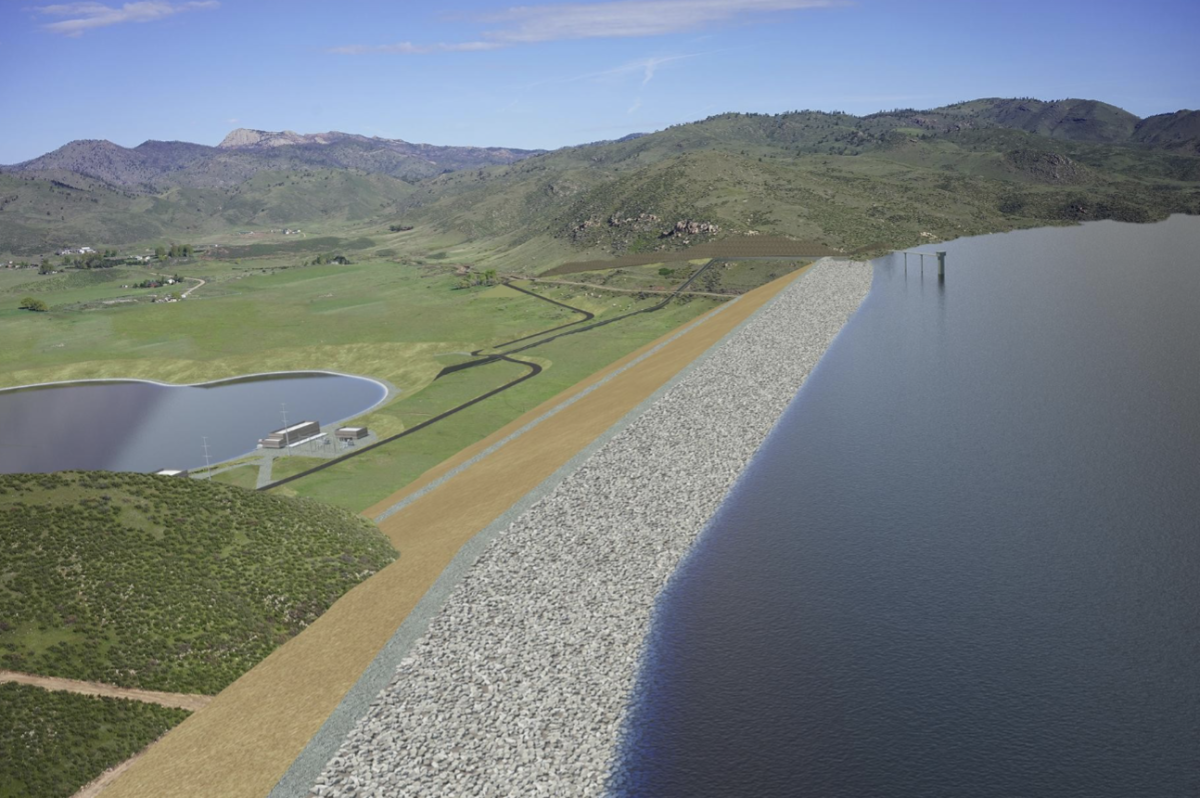
The Glade Reservoir project, a cornerstone of the Northern Integrated Supply Project intended to provide a reliable water source to roughly 15 municipalities and communities, might be in jeopardy after a key investor withdrawal.
In an arid state like Colorado, water security is a major concern, especially as residential areas continue to grow and the population increases. The Northern Integrated Supply Project was created to combat those issues by constructing two new reservoirs near Fort Collins and Greeley as part of their goal to provide 40,000 acre-feet of water to Northern Front Range communities. Glade Reservoir alone is eventually expected to hold roughly 170,000 acre-feet of water.
“We anticipate that we might not have 40,000 acre-feet of firm yield demand, but we’re certainly going to be in the middle 30s for when we’re completely spoken for on this,” said Jeff Stahla, public information officer at Northern Water regarding adjustments to the plans after the recent investor shift.
“We’re taking a brief pause. That’s given us an opportunity to step back and begin processes to resize the project. It’s certainly still a very viable project and an important one for the region.” –Brad Wind, Northern Water general manager
The project carries an estimated cost around $2.2 billion to be funded by participating communities and other investors. Northern Water has also promoted the project to create construction jobs and support economic growth by guaranteeing a sustainable water supply.
“This is a milestone day for the communities (that are) participating in the project,” said Northern Water General Manager Brad Wind when NISP received the environmental approvals.
The project hit a significant roadblock in August of this year when The Fort Collins-Loveland Water District — the project’s primary investor — decided to withdraw under the current terms. This decision followed the $100 million settlement of a 20-year legal dispute with the advocacy group Save the Poudre.
“Nature has to be on the balance sheet, and this settlement fund sets that important precedent in Colorado,” said Gary Wockner, executive director of Save the Poudre. FCLWD was expected to fund roughly 20% of the project’s cost and water supply. Rising construction costs, increasing environmental concerns and questions about water quality pushed the district beyond what developers can pay.
“The project was beyond our ability to not only carry financially, but (also) the net unit cost of the water resulting from it was 50% larger than what our market can carry for buying new taps,” said Chris Pletcher, general manager of FCLWD. “The risk is all put on participants with no guarantee of any yield.”
Projected total costs increased from $2 billion to roughly $2.7 billion. There are also concerns about the amount and quality of water that the project would deliver.
“Maybe you’re building a custom house, and your home builder says, ‘I’ll build you a house, but I’ll decide what I’m going to build.'” Pletcher said, comparing the current financial structure to an unclear investment. “Nobody would do that.”
The impacts of the withdrawal could force the NISP to scale back the project. Currently, both the design and the construction is on hold while NISP and its partners reassess their options.
“We’re taking a brief pause,” Wind said. “That’s given us an opportunity to step back and begin processes to resize the project. It’s certainly still a very viable project and an important one for the region.”
The delay sets back development on the project that was expected to begin in early 2026 and could impact communities relying on the water supplies.
“We thought that with the settlement of the lawsuit in February of 2025 that we could get started by 2026,” Stahla said. “Because of the indications from participants that they want to reevaluate their level of participation, we’re now anticipating that, you know, we’ll find out those numbers in the first quarter of 2026.”
Some communities may scale back their participation or drop out entirely. Even with the lawsuit resolved, FCLWD’s withdrawal and increased costs has renewed questions about river flows, watershed health and water quality.
“The water that is going to be produced out of this project is certainly going to very much match the water quality that the participants are currently using,” Stahla said. He noted that water quality challenges are common to any community drawing from Northern Colorado rivers — not just unique to Glade.
In the interim, other partners could carry a greater financial burden, sparking some concern that additional investors could withdraw from the project in the coming months. However, Stahla emphasized that some of the major project costs are fixed and remain unavoidable.
“It doesn’t matter how big or small the reservoir is; we’re going to have to move the highway,” Stahla said. “And so that highway move, it costs X amount of dollars, we’re going to have to build a way to get water into the reservoir. And that’s going to cost a certain amount of dollars, whether it’s a big reservoir or a small reservoir.”
Northern Water insists the project will continue, though likely in a scaled back or restructured form. FCLWD has suggested they may return to the project if the cost, yield and water quality terms are solidified.
“If there is a possibility of adjusting the project to something that has a different level of risk and certainty,” Pletcher said. “We don’t see how we can move forward with it as it’s currently put together.”
While the loss of the FCLWD is a major setback to the project and goals of NISP, it is not the end. The need for water will continue, and the participating districts can choose to pursue another direction or stick with the planned project, Stahla said.
“We’ve got the water to meet the needs for tomorrow, for next year, for even five years from now,” Stahla said. “But this is a project that’s really going to be beneficial for Northern Colorado long after I’m gone. … This is being built really for a very long-term need.”
The project is expected to move forward in whatever revised form emerges in 2027.
Reach Noe Edstrom at news@collegian.com or on social media @RMCollegian.