
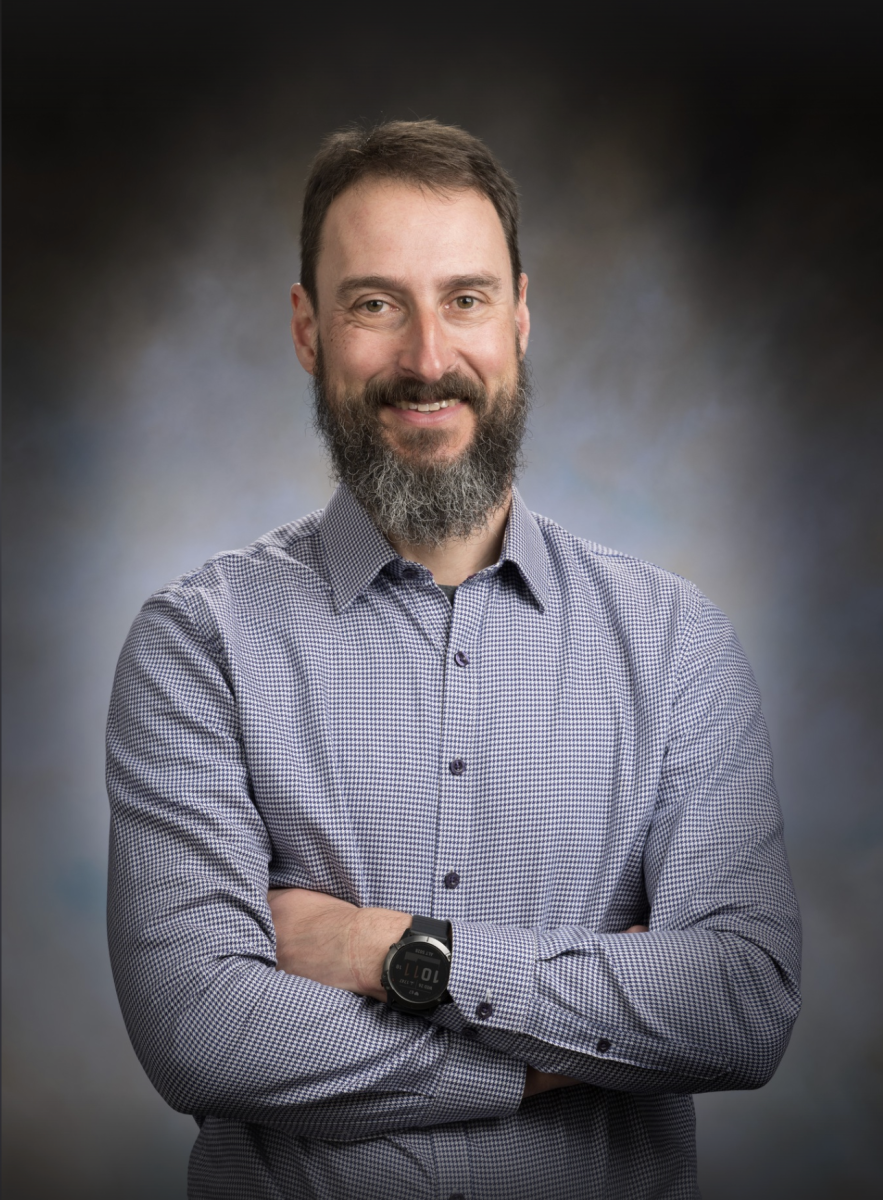
Wolfgang Bangerth is a mathematics professor at Colorado State University. He studied in Germany and Switzerland before moving to the United States for postdoctoral research at Texas A&M University, and he considers himself a computational scientist.
“The question when I went to college (was): ‘What do I want to study?'” Bangerth said. “I decided that I wanted to study physics, but I did some programming at the same time, and I also enjoyed sort of the mathematical side.”
Despite his initial path in physics, Bangerth later earned a doctorate in mathematics.
“Then I worked in a computational science institute, and then I’ve also worked in a geophysics institute, and then I became a professor of mathematics at some point,” Bangerth said. “So my trajectory was never along a straight line.”
One of Bangerth’s most notable pieces of work is deal.II, software he initially developed for his 1998 thesis.
“I was writing software for myself, and then we decided, when the World Wide Web came around, we’ll just put it on a website, and people realized it’s useful for their own work, and so they started to use it, and then they started to contribute to it too, and so I started it for my own work, and now I think over 450 people have contributed to it in the 20-some years since then,” Bangerth said.
The software, Bangerth explained, can be used when developing element codes.
“You can think of it as a toolbox to build simulators, and so our goal is if you’re a company that wants to simulate whatever process, you can use this toolbox to put together with relative ease something that simulates airflow, water flow (and) mechanical deformation,” Bangerth said.
Bangerth said he created deal.II to assist his research on error estimation.
“Error estimation fundamentally asks, ‘Can I say something about the difference between the true but unknown answer and the approximation that I computed?’” Bangerth said.
He said computer simulation underlies the design of nearly every manufactured object.
“If you look around you, basically every single thing that you see was designed on (a) computer,” Bangerth said. “That’s true for cars, for planes, for tires, for diapers and for food storage boxes.”
He used a bridge as an example: A civil engineer designs its shape, while software simulates how it will behave when a truck drives over it. Engineers need to determine under what weight the bridge’s steel beam will deform.
“The bridge has a steel beam in it, and the steel beam is going to deform,” Bangerth said.
If the deformation when a truck of a certain weight drives across is outside the designated safe range, “you need a bigger beam,” he continued.
Similar tools are used in the car and airplane industries to determine how air flows around the object being designed.
“They all use computational mathematical tools under the hood, and this is sort of my background,” Bangerth said. “I researched techniques that, 10 or 20 years later, find their way into these commercial tools to simulate whatever it is that you want to design.”
Now as a mentor and leader of a research group, Bangerth said his day-to-day involves less research and more mentoring and writing.
“A lot of my time really is focused on these aspects: giving directions, writing, getting funding (and) mentoring — that sort of work,” Bangerth said.
One of Bangerth’s graduate students, Fernando Herrera Valverde, talked about his experience working with Bangerth.
“He has pretty much everything you can ask for in an adviser: he’s great as a person, very kind, encouraging but also keeps you accountable,” Herrera Valverde said. “His expertise is super broad, so he might not know specific details of something, but he can always point you in the right direction.”
Until two years ago, Bangerth was the co-editor in chief of the Association for Computing Machinery. He has since stepped down from that role and now remains with the ACM as an editor.
“As an editor, you’re the person who’s in charge of determining whether a paper that somebody submits to you is good enough to be published or not,” Bangerth said. “That involves assessing the technical quality of something. It also involves assessing whether it is actually interesting and useful.”
Artificial intelligence is changing how computer science is taught and practiced. Bangerth said the number of students entering computer science is now less than half of what it was just a couple of years ago.
Bangerth shared his perspective on AI, talking both about how it can be a helpful tool and his concerns about how it will effect entry-level positions.
“I can see this in my own environment and in my software projects: People who are good at what they do with AI become much more productive because they can direct it fundamentally instead of doing it themselves,” Bangerth said. “They become managers of tools that do the work, and a good manager with the right tools can achieve quite a lot. I think the part that we all worry about is that AI is going to make the life of junior programmers, junior developers, much harder. They just don’t get the time anymore to learn as they did in the past.”
Despite these concerns, Bangerth said his biggest advice to undergraduate students is: “If there’s something that you’re passionate about, spend the time to become good at it.”
When asked what he thinks most people misunderstand about computer science, Bangerth pointed to those who software is written for.
“We write software for other people, and that means that there are very different requirements,” Bangerth said. “It doesn’t just have to be correct. It also has to be well documented and understandable. So that’s really one of the things that I think is quite misunderstood about software: We write software for people, not for machines.”
Bangerth said what he values most about his work are the opportunities for collaboration.
“At the end of the day, the thing that makes it worthwhile is actually working with others,” Bangerth said. “I like working with people. This is true in teaching. This is true in research, and this is true in software too.”
Reach Olivia Kyazze at science@collegian.com or on social media @RMCollegian.