

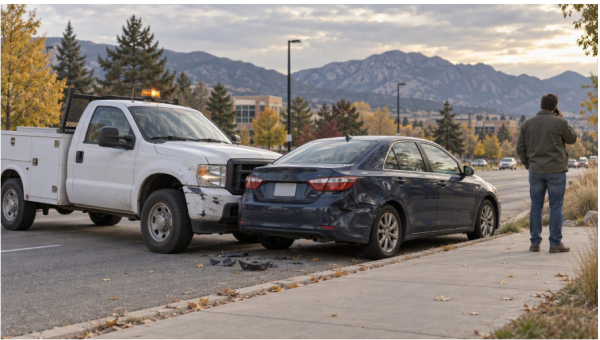
A collision with a city truck near CSU puts an unfamiliar agency in your path alongside the usual insurer. Even in 2026, with a police report on file and an adjuster already calling about your car, the Colorado Governmental Immunity Act can demand its own written notice. So start with the agency name on the vehicle door.
Protect yourself and document the crash
Get medical help and report the collision
Get out of traffic if you can do it safely. Call 911 for injuries or an immediate hazard. Just don’t cause a second collision in the process. When the officers respond, ask them how to get the report, and note its number. Pain that shows up later deserves a proper medical evaluation. Tell the clinician exactly when the collision happened, and keep a dated record of the visit.
Capture details that identify the public entity
Take photographs only when it’s safe, but take a lot of them. Record the driver’s information and the road conditions, and shoot the visible damage from several angles. Get the unit number, the license plate, and the agency lettering. Save witnesses’ names and contact details. Ask who employs the driver, and write the agency or department name down exactly as it’s given. A Fort Collins address or a campus location doesn’t necessarily mean the city or CSU owns the vehicle. Don’t throw away damaged belongings. Save repair estimates along with your original crash photographs, and back the original files up somewhere safe.
Confirm who owned or operated the vehicle
Follow the records, not the vehicle’s appearance
Check the crash report against the registration information and the driver’s stated employer. A public logo alone proves little. Contractors perform public work all the time, and not every resulting claim is a government claim, so keep conflicting records together instead of guessing which description is right. Ask the agency named at the scene to confirm, on the crash date, who owned the vehicle and who employed its driver.
If records are missing, ask which office handles them or handles claims. Not every record will be available, and requesting one doesn’t pause any deadline. Keep your request, and preserve the agency’s exact response, including the responder’s name and email address.
Apply the Colorado Governmental Immunity Act deadline
Who may be covered by the special rules
The Colorado General Assembly’s official Title 24 statutory compilation contains the Colorado Governmental Immunity Act in Article 10. The Act’s written-notice provision is C.R.S. § 24-10-109, which generally applies to injury claims involving public entities or public employees. Under C.R.S. § 24-10-118, notice compliance is also a jurisdictional prerequisite for employee actions, including allegations of willful and wanton conduct.
Mistakes at this stage can jeopardize a claim. Section 24-10-109 sets out who must receive the document, what it must contain, and how it must be delivered. For a supplemental overview, consult this resource on the colorado governmental immunity act. A mistake in these requirements can prevent a court from hearing an otherwise valid claim.
How Colorado limits qualified immunity
Colorado did not remove qualified immunity for every type of claim. State law bars peace officers from using qualified immunity as a defense to claims brought under C.R.S. § 13-21-131, but that does not eliminate the doctrine in federal civil rights cases. Qualified immunity is also distinct from the Act’s notice requirements that may apply to a vehicle-crash claim.
The notice deadline is not a lawsuit deadline
Under C.R.S. § 24-10-109, the notice deadline is generally 182 days after discovery of the injury. The statute requires written notice. Noncompliance is generally a jurisdictional bar that keeps the court from hearing the action. You don’t need complete knowledge of every possible claim element to give notice.
How delivery and the waiting period work
Under the same provision, notice becomes effective upon personal service or registered or certified mailing with return receipt requested. A lawsuit generally must wait until the entity denies the claim or 90 days pass, whichever happens first.
| Stage | General rule | Record to retain |
|---|---|---|
| Injury discovered | Discovery generally starts the notice period | Medical and incident records |
| Notice delivered | Use a recognized delivery method | Receipt or proof of service |
| Post-notice period | Denial or the end of the waiting period precedes a lawsuit | Denial letter and delivery dates |
Notice and lawsuit-filing deadlines are separate, and the latter depends on the defendant and the legal theory. An insurer’s claim number is not a notice receipt.
Troubleshoot delayed injuries and missing information
If symptoms appear later
Get appropriate care when symptoms show up, and preserve the first record describing them. A later appointment doesn’t automatically extend the statutory period. The discovery standard turns on when you discovered the injury, not the date on a medical bill.
If ownership or records stay uncertain
Keep a separate log for each plausible agency, with request dates and copies of responses. Don’t wait for a complete file before investigating your notice obligations. If ownership or the injury-discovery date stays uncertain, seek legal advice promptly. Ask about preserving agency-held video before it becomes unavailable, and keep a copy of that request.
Note the 2026 damages limit
The statutory damages limit is separate from the government-claim notice requirement.
Common question: What changed for these claims in 2026? Direct answer and authority: Colorado session law sets the statutory damages limitation at $530,000 for covered acts or omissions during 2026.
After the scene is cleared
Keep your medical records with the vehicle photographs and the responsible agency’s details. Insurance work can continue on its own track. Verify the separate notice process for your circumstances, and save a dated copy of the notice alongside proof of delivery, such as a certified-mail receipt.