
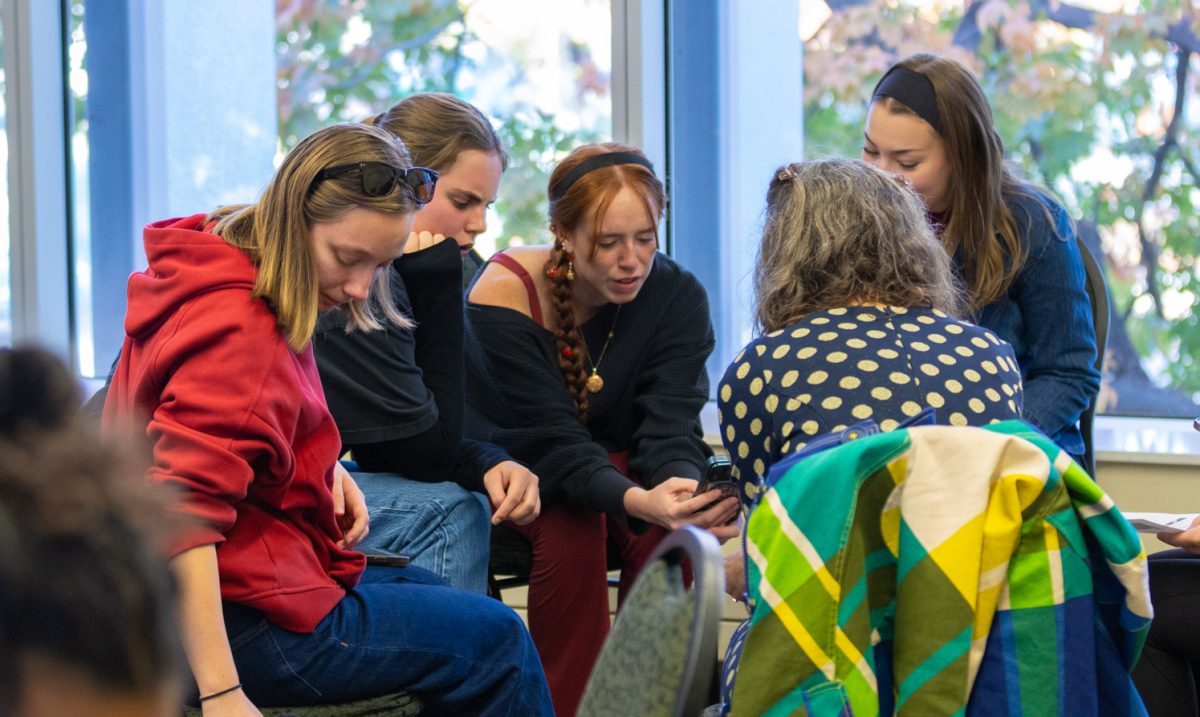
Colorado State University students and staff gathered Monday, Oct. 26 as part of the 2026 Democracy Summit to consider the democratic implications of pop culture artifacts in the department of communications’ Center for Democracy, Art and Pop Culture event: “Where Politics and Pop Culture Collide.”
In discussions led by Karrin Vasby Anderson and Nick Marx, who are co-founders of the center and professors of communications studies at CSU, students and other faculty took a look at podcast clips, online viral videos, websites and advertisements and asked: Do these media support a healthy democracy?
In one activity, Vasby Anderson and Marx showed a clip from “Last Week Tonight with John Oliver,” a satirical late-night news program. In the clip, Oliver spoke about the Colorado gubernatorial candidates for the Republican Party. He highlighted viral debate moments and interview responses. Event participants said rather than promoting open discussion and healthy democracy, the clip poked fun at opponents via inflammatory clips, which although entertaining, doesn’t encourage earnest discussion and candidate research.
Another pop culture artifact under the microscope was a clip from the viral series “SubwayTakes” by Kareem Rahma. In the clip, Rahma held a tiny microphone up to then New York mayoral candidate Zohran Mamdani and asked him a few rapid-fire questions. The overall consensus was that the clip did promote the health of democracy due to the open-ended nature of Rahma’s questions and the straight-forwardness of Mamdani’s responses.
This event was the first of its kind at CSU. Marx and Vasby Anderson said they saw a need for the explicit consideration of pop culture sources, rather than just news, in the social perception of democracy.
“Where Karrin and I came in, was (in) noticing that a lot of our students, especially, came to politics through culture, through comedy, video games (and) movies,” Marx said.
The conversations at this event focused less on the partisan messages in pop culture and more on their support of democracy as an institution. Marx explained the Center for Democracy, Art and Pop Culture was created to find and highlight research and student engagement situated at the intersection of culture and politics. Some of their other events, unaffiliated with CSU, bring students to the burgeoning festival and events culture, like the Sundance Film Festival, Telluride Film Festival and even San Diego Comic-Con.
“A lot of those opportunities have to do with social justice issues and getting students to think about their place politically through culture: Creating community with people in a room (and) showing up and talking about their favorite band instead of the hyperpartisan stuff that people tend to tune out,” Marx said.
This rang true for Ava Rodriguez, a sophomore in the communication studies program. She said she avoids explicitly political conversations online and makes a concentrated effort to keep her algorithms mostly free of that kind of content.
Events like this one attempt to move a step beyond identifying partisan messaging and toward considering the health of democracy in the minds of citizens. Rodriguez, for example, said she takes pride in her ability to vote in the midterms.
“I think even if one vote is just such a small part of something; it all adds up, and, like, getting your voice in anywhere — even somewhere like this event — speaking your mind and really having a passion or wanting to go for something, is really important,” Rodriguez said. “Knowing where you want your life and your direction to go … is really intertwined with politics these days.”
Although brand new this year, the Center for Democracy, Art and Pop Culture already has a website stocked with polls, books and events, along with podcasts published on The Conversation featuring CSU professors. Vasby Anderson described her goal as shifting the political conversation toward the messages we produce and share rather than what we consume online.
“We also want (students) to think about how they can use — whether it’s digital media or interpersonal communication — how they can communicate in a way that makes for healthier democracy,” Vasby Anderson said.
Reach Kooper Hahn Shagena at life@collegian.com or on social media @RMCollegian.