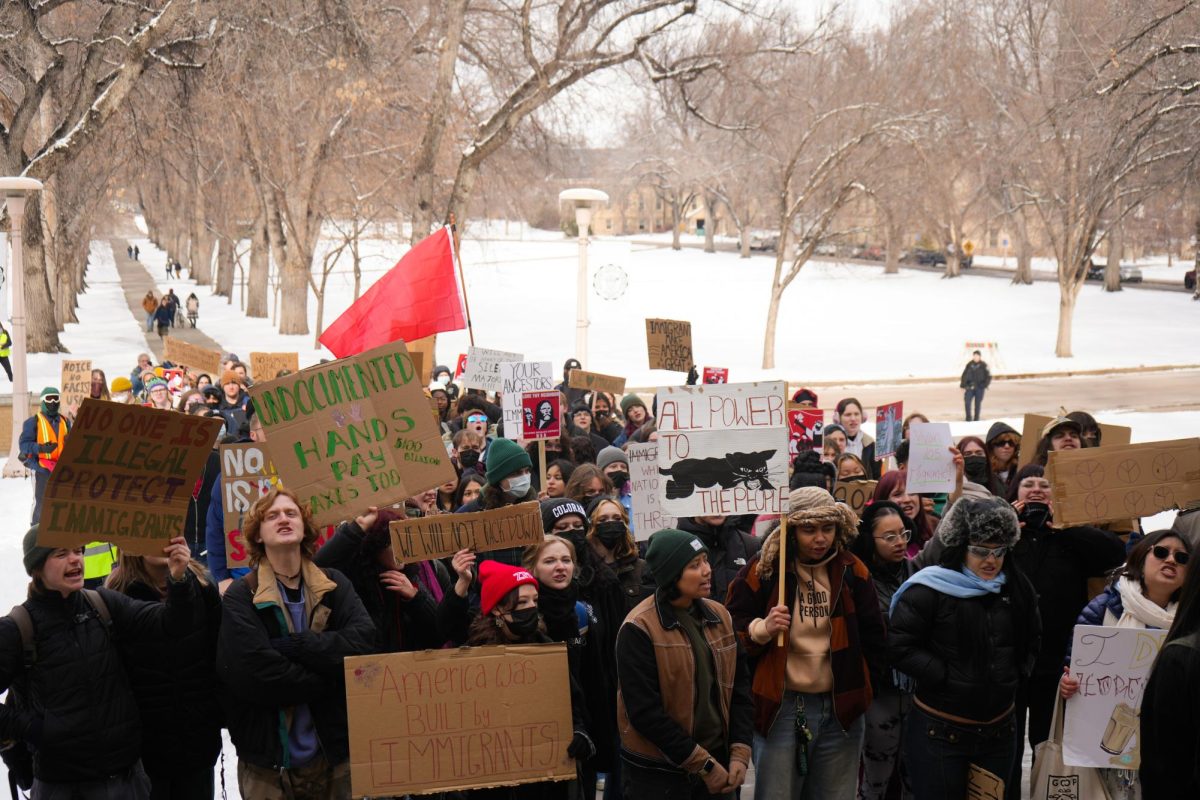
The United States Department of Homeland Security recently attempted to make significant changes to student immigration regulations for both undergraduate and graduate international students. The new rule would have taken effect Sept. 15 and limited how long international students could stay in the country, their ability to change their degree programs, transfer schools and more.
The changes, which would have primarily impacted F-1 and J-1 visa holders and their dependents, were blocked after a federal court issued a nationwide preliminary injunction Sept. 14, postponing the implementation of the rule just hours before it was set to take effect.
According to a letter sent July 23 by Greg Wymer, director of International Students and Scholar Services at Colorado State University, the change would have eliminated the Duration of Status rule, which has allowed international students to remain in their country of study as long as they maintain their immigration status — a policy that has been in place since the early ’90s.
Under the new rule, F-1 and J-1 visa holders who are newly admitted would instead receive a fixed period of admission, which in most cases limits the length of their academic or exchange program to four years. This requires individuals who need additional time to complete their program to file an Extension of Stay application with U.S. Citizenship and Immigration Services within six months prior to the expiration of their stay.
Additionally, the rule would have placed significant restrictions on students who wish to change their academic program or transfer schools, as well as students who are on academic probation.
“These changes represent one of the most significant revisions to F-1 and J-1 immigration regulations in decades,” the letter reads. “Our office is carefully reviewing the final rule and any implementation guidance issued by DHS and the Student and Exchange Visitor Program.”
Wymer and the ISSS office sent out another update Sept. 16 acknowledging the rule was postponed and said the next court hearing is scheduled for Oct. 2.
The majority of accredited degree programs are based on credits rather than years, and extenuating circumstances can oftentimes extend the amount of time needed to complete an academic program, meaning there is often no traditional timeline for the completion of undergraduate or graduate degrees. Susana Muñoz, associate director for faculty development and inclusive excellence in the School of Education, said the change to the D/S rule does not consider this and may bar some students from being able to complete their degree programs at all.
“This notion that a four-year sort of set timeline for these degrees is really detrimental for the livelihood of them coming here,” Muñoz said. “We have students that step out sometimes just to take care of family (and) take care of themselves. We’re asking these particular students to be superhuman.”
This attempted change is just one example of the many sweeping federal actions the Trump administration has taken in its second term to limit immigration and alter how the government treats immigrants who are already in the country. Jessica Jackson, a CSU associate professor of history with a specialization in immigration history, said while this approach to immigration is not unprecedented, it does reflect a broader shift in how the federal government approaches race and immigration.
“Racial projects are linked across time and space,” Jackson said. “This idea that even the way race is being constructed in or discussed or talked about when the 14th Amendment is being adopted — that’s a project related to whether or not Black Americans have access to citizenship — that same racial language is co-opted in later times and spaces that validate xenophobic policies like the Chinese Exclusion Act. … I don’t want to say it’s completely unprecedented, but we have a situation that the current administration is operationalizing xenophobia in a different kind of way.”
In higher education, universities across the country have seen a notable decrease in international student admissions, with the Common App reporting first-year international applicants fell 10% for the 2025-26 cycle. While CSU’s enrollment reached a record in the fall 2025, there was an 8.3% drop in international students when compared to fall 2024.
Jackson said this trend could have far-reaching consequences in several industries and in the diversity of talent in the nation.
“It certainly means that we’ll see a decline in some of the advances in various industries that maybe we’ve enjoyed up to this point because of the extent to which they benefited from immigration,” Jackson said.
Jackson also acknowledged how the experience of international students in the U.S. is unique and only being here temporarily can impact their sense of belonging and connection with others on campus. Muñoz said this — combined with new restrictive policies — can add additional stress on top of just being a student.
“If you think about a typical student, there’s no timeline,” Muñoz said. “They can learn more about themselves, get involved and so they’re not really focused on the timeline. They can just exist, whereas this sort of puts a little bit more parameters on their existence and what they’re able to focus their time on. … It’s the psychological stress, too.”
A CSU international student, who was interviewed on the condition of anonymity due to fears of retaliation, spoke to The Collegian about their experience in the U.S. on an F-1 visa. When asked about how potential policy changes regarding their immigration status impacts their wellbeing and academic performance, they said the stress often distracts from their studies.
“It gives me a lot of sleepless nights stressing over how I’m supposed to navigate (this),” the student said. “I’d have to do potential flights to and from (my home country) which will just rack up so much money out of pocket. (It’s) monetary pain, academic pain and the time I’m spending worrying about that I could be working on my stuff.”
The student said shifts in immigration policies like these have forced them to consider pursuing degree programs in other countries where immigration policies are less restrictive.
“It kind of upends my entire life plans in a way,” the student said. “Sure, I can probably adjust to it, but the pain that it will take for me to adjust might force me to consider some other country, (like), in Europe, maybe, or to go back to (my home country). It just changes everything.”
The student said that while their F-1 visa and corresponding Form I-20, or the Certificate of Eligibility for Nonimmigrant Student Status, are valid, policy changes and increased arrests by U.S. Immigration and Customs Enforcement have given them significant anxiety around traveling in and out of the country.
“I feel a lot more jaded,” the student said. “I go home every winter and I’m not planning to go this time, just in case by the time I’m in (my home country) and I’m coming back, somebody comes in and they stop me at the border. (It) just makes more sense for me to stick around here for the duration of my (degree program) and then move, which is sad, because I’d like to visit my family every year.”
Looking ahead, Muñoz emphasized higher education institutions like CSU must work to project the international student community and said the inclusion of international students is integral to the success of the university.
“In the future we’re going to have to do a lot of repairs to gain a lot of trust and a lot of confidence back in how we welcome newcomers in this country,” Muñoz said. “As institutions, I think we have to be mindful of our mission first (which is) that we are here to provide good education and a diverse climate and environment for our students to thrive, and that includes our international students.”
Reach Claire VanDeventer at news@collegian.com or on social media @RMCollegian.