
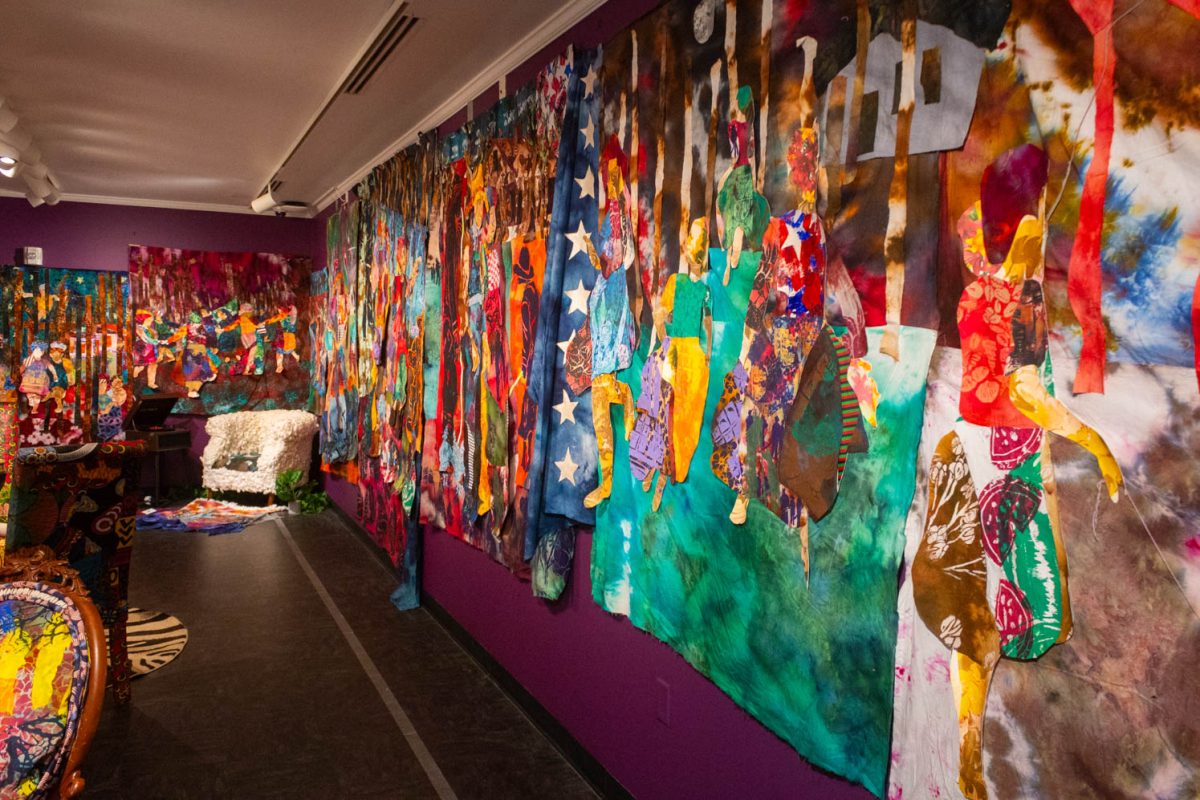
On Sept. 2, the Gregory Allicar Museum of Art debuted Zsudayka Nzinga’s “AfroBohemian Home” exhibit, which will run until Dec. 13 and is free to visit for students and the public.
Nzinga — an Aurora, Colorado resident — is an artist, curator and educator. Her AfroBohemian exhibit focuses on how the multifaceted aspects of Black culture have presented themselves in homemaking throughout the history of the United States.
Nzinga said she has always been an artist. When in elementary school, she would sell paper earrings she made to match people’s outfits. In the ’90s and early 2000s, she was a spoken word artist and would make art on the side. She said she got into selling her art when she started an art festival in Aurora, and one of the vendors canceled, so she decided to sell some of her own stuff.
When Nzinga realized people wanted to buy her pieces, she worked to transition the practice into something long-term. While she graduated with a Master of Fine Arts in painting from the Maryland Institute College of Art in 2025, she is primarily self-taught, and she recalled spending her days scouring books and watching every video she could find to develop her skills.
“In, like, 2015, I think that my work started to be really good, and so, then I just started getting, like, a lot of opportunities,” Nzinga said. “I’ve always had, like, a super business minded and a business background. So that has been, like, very helpful as well.”
Nzinga’s art is often inspired by history. When she’s at her studio, she spends a lot of time listening to American history audiobooks. She said she often thinks about images of history that are normally not shown, particularly regarding Black history during Reconstruction and how she can incorporate them into her work.
“I’ll hear something said and be, like, ‘Oh, you know, I think that there needs to be a depiction of that,’ or ‘I would love if there was an image that told that story instead of some of the ways that we are commonly depicted,’” Nzinga said.
Her love for history is written all over “AfroBohemian Home.”
The exhibit features hand-dyed textile collages surrounding the room. These tapestries depict various figures, hands and patterns. When asked what her favorite piece in the exhibit was, she said “For Opalanga Pugh” — one of the textile collages. Nzinga went on to explain the reason this piece has a special place in her heart is because Opalanga Pugh was a Denver storyteller through whom she heard a lot of important African American stories.
She continued to explain her thought process going into this piece, noting, “I was, like, man, you know, there’s not a, like, Opalanga Pugh Center or anything like that in Denver. There’s nothing that honors her. So I love that one because I wanted to honor, like, the spirit of storytelling and, like, the things that she taught us.”
In her work, Nzinga used cowry shells that were historically used for trade. An piece especially powerful piece is a textile featuring a red background covered in plants, white stars and blue guns. The plants Nzinga used were not unintentional: They are species each in some way relevant to the history of labor and enslaved communities in America. The colors red, white and blue and imagery of stars and stripes are displayed throughout the exhibit.
Nzinga includes various types of media that enhance the immersion of the exhibit, one of which is a bookshelf that features major literary contributions to African American history. Some of the titles featured include “Black Sexual Politics,” “In Praise of the Goddess,” “Patternmaster” and more. The exhibit also includes multiple Bibles throughout, as the Bible is often used to track Black lineage.
When tracing family history, Nzinga said one of the first questions asked is “What is the oldest Bible in the family?” This is because the Bibles hold records of their ancestry.
The exhibit features music that is often played in Black households. Nzinga explained the type of music she picked was based on she would hear on Saturday mornings. She would know what kind of cleaning up they would be doing that day based on the sort of music played.
Family is an important aspect of this exhibit. Nzinga mentioned that her family has resided in America for generations, and she collaborated with her daughter to create many of the pieces in the exhibit.
Gregory Allicar Museum’s website for the exhibit states that a key piece of the exhibit “is the collaboration between Nzinga and her daughter, Satra Terrell, who is also a multi-disciplinary artist working with animation, painting, furniture building and upholstery.”
Presented in the exhibit are multiple chairs Terrell upholstered using African fabrics. Furthermore, there is an altar that displays the card sets and clay items Terrell created. The idea that the home is a sanctuary is essential to Nzinga’s work.
The description of her exhibit promotes home as a place “where traditions are upheld, stories are told and futures are forged.”
When asked what she would want viewers to take away from the exhibit, she said she’s noticed that herself and others often don’t visit the houses of those from other cultures, and she wants people to feel as though they are coming over to her house.
“I really want people to feel like they’re inside a house of somebody of a different culture, and getting the opportunity to experience that person and experience their culture, and then kind of look around our social circles and think about how we build community and how we build family,” Nzinga said.
Reach Olivia Kyazze at entertainment@collegian.com or on social media @RMCollegian.