

Many dream of sailing around the world to see different lands. But for Andrea Duffy, an environmental history associate professor at Colorado State University, it can also reveal nature’s less-than-beautiful scars.
In spring 2019, Duffy boarded the MV World Odyssey for Semester at Sea, an educational voyage on a cruise ship through various countries. While there, she found herself comparing and contrasting the destinations they stopped at and, in turn, began to write “The Nature of Empire.”
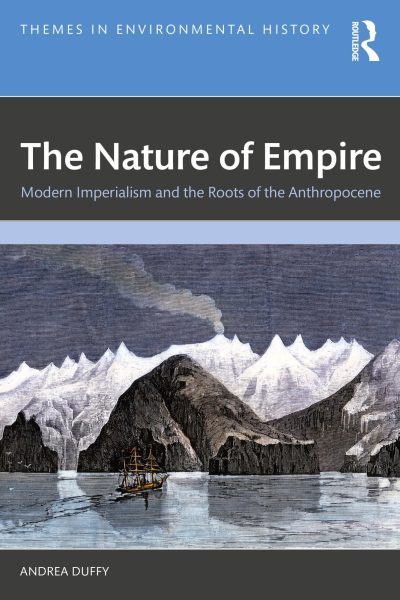
The book, published Sept. 15, 2025, originally argued about the role of imperialism in the rise of modern conservationism; but after more research, Duffy found a different perspective.
“I became aware of imperialism’s role in inspiring climate science and the concept of the Anthropocene,” Duffy said. “So I fine-tuned the final chapters to highlight this important and underappreciated point.”
The resulting book sought to explain the world’s current social and environmental inequalities through a historical lens. Whether it is the replanted forests in Hokkaido, Japan, or the tropical rainforests in Ghana, each location is rich with context to uncover.
“The book speaks directly to contemporary global climate and environmental challenges,” Duffy said. “By telling the story of imperialism with an environmental lens, it shows how we got to this point.”
Duffy’s research drew on past works that explore global environmental imperialism, including some by her fellow CSU faculty member, Doug Sheflin. Also from the department of history, he has written about the issue as it exists closer to home. In his 2019 book, “Legacies of Dust: Land Use and Labor on the Colorado Plains,” Sheflin described how the actions of the federal government interact with people and the environment.
“The book is very powerful in sketching the way five very different modern empires used the control of nature to exert power over people. The lessons of the British, French, Ottoman, Russian and Japanese Empires shed brilliant light on the state of the world in 2026.” –Scott Denning, atmospheric science professor
“It complements previous scholarship on empires and the environment,” Duffy said. “It uses this content to expose modern imperialism’s central role in the rise of global environmental awareness.”
Duffy’s intentional use of previous works helped her to bridge important gaps in the research and uncover connections between seemingly distant imperial powers. She was surprised to find a connection between French foresters and the Ottoman Empire, who hired them to implement forestry management.
Those small moments were a driving factor in Duffy’s authorial style. The massive scale of history can be daunting, and she said it sometimes overwhelmed her as she tried to keep the book engaging and personal.
“I addressed this issue by frequently zooming in and out in the book, providing big picture overviews as well as the specific, detailed stories and examples that make history come to life,” Duffy said.
Her effort is embodied through the introduction to the book, which tells the story of an Ottoman governor of Algeria who smacked a high French economic adviser with a fly swatter. She described the moment as both entertainingly petty and emblematic of imperial brutality.
“I also like that it brings in an environmental element,” Duffy said. “It shows the importance that even tiny pesky insects can play in human history.”
Her attention to detail paid off in making “The Nature of Empire,” a book people would gravitate toward. Scott Denning, a professor of atmospheric science at CSU, was among those who were drawn to it.
“The book is very powerful in sketching the way five very different modern empires used the control of nature to exert power over people,” Denning said. “The lessons of the British, French, Ottoman, Russian and Japanese Empires shed brilliant light on the state of the world in 2026.”
Denning said one of his biggest takeaways from the book was having a better understanding of how empires manipulate and are manipulated by nature and other people. He said he was also surprised to see just how much of it is reflected in modern natural science.
“Most of the history of the past 500 years can be seen as societies and economies around the world coming to terms with our changing scientific understanding of the world,” Denning said.
Both Duffy and Denning are taking “The Nature of Empire” back to the sea this spring semester. Duffy is using it herself as an aid to her HIST 470 World Environmental History course, taking place on board the very same MV World Odyssey.
“It’s perfect because many of the examples I used in the book come from my experiences from my last voyage,” Duffy said. “They align very well with the ship’s itinerary and our experiences in the port countries we’re visiting.”
Denning is working alongside her on this trip and found the book a useful supplement to his own teachings.
“Every country we visit is a former colony and bears the unmistakable scars of imperial extraction and domination,” Denning said. “My teaching about climate change is deeply interwoven with her teaching about empires.”
Reach Maiya Kreamer at science@collegian.com or on social media @RMCollegian.