

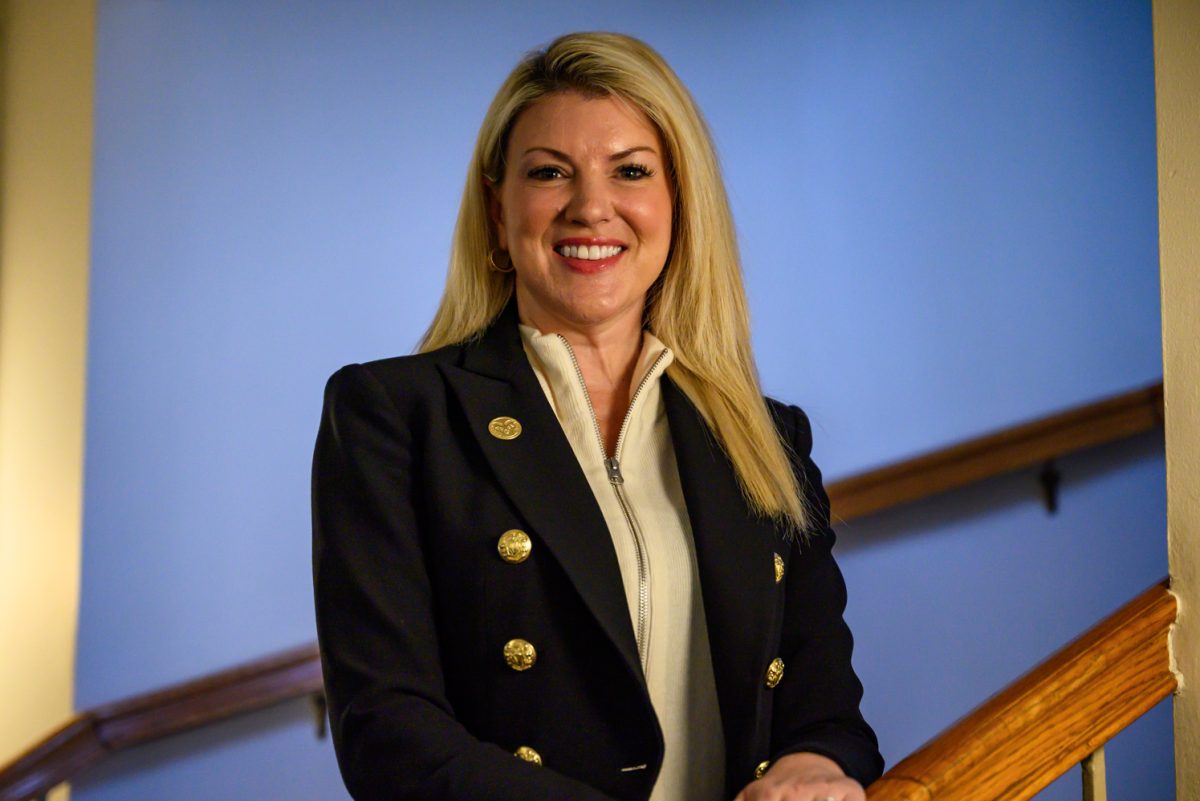
Note: The following is a letter from Colorado State University President Amy Parsons addressed to the Associated Students of CSU. All content was authored solely by Parsons and is not attributed to The Collegian or its editorial board. The letter has been lightly edited to adhere to Collegian style guidelines.
Thank you all for continuing to work with me and our team on gathering input on the various aspects of the Free Speech Policy. There are many important voices and perspectives on the choices we make as a campus, and you each represent constituent groups that hold divergent yet deeply held views. To my mind, this is exactly where our system of shared governance shines — bringing forward the range of perspectives, surfacing pros and cons and ensuring that our decisions reflect the collective wisdom of the CSU community. Thank you for your leadership in helping to navigate these important issues. Shared governance, academic freedom and freedom of expression are bedrock principles of Colorado State University and of higher education itself.
Our ability to engage in open debate, to challenge ideas and to speak freely — even when the speech is uncomfortable or controversial — is essential to the pursuit of knowledge and to the culture and vibrancy of any public university. That said, we also recognize that free expression exists within a living community, and that words, symbols and messages — especially those that target or demean groups or individuals — can have a real and painful impact. Balancing these values is not easy work, but it is vital to who we are as a university: A place that defends the right to speak while also striving to uphold respect, safety and belonging for every member of our community.
As a public university, CSU is both required by law to uphold the First Amendment (which we embrace) and is legally permitted to create free speech policies that contain content-neutral “time, place and manner” parameters (which are governed by our own policies). Here at CSU, we have long permitted chalking on the Plaza, so long as it can be washed away with periodic cleaning. That is what has traditionally been in our policy and is reflected in the policy that was reinstated on Oct. 8.
Over the last couple years, we started to see an increase in graffiti and chalking in other parts of campus and also messages that were aimed at personally attacking individuals or groups. We’ve heard from many students who are impacted by these messages, feeling unsafe or unwelcome, and from visiting families and prospective students who are surprised or disheartened by what they see. These are not easy concerns to dismiss, and I appreciate how challenging it is to hold space for both free expression and community well-being. Some universities have chosen to ban chalking altogether in response to similar challenges. We have not proposed that. Instead, last spring, our staff began exploring changes that would still allow chalking but limit it to event-related information. These changes were reflected in the updated — and now rescinded — policy. Additionally, these provisions were analogous to provisions in the university’s longstanding Signs, Posters, Banners and Flyers policy.
In addition, the employee speech provision was meant to address numerous questions the university received about when and how employees could engage in free speech as employees of a public university. Those questions, in turn, highlighted the lack of guidance for employees contained in our Free Speech policy. The employee speech provision expressly contained a carve out for academic freedom and reflected longstanding U.S. Supreme Court precedent regarding speech by public employees as well as state law and CSU System policies. The revision also contained a clarification around camping on campus. Although the free speech policy already contains night limitations (from 7 p.m. to 7 a.m.) we sought to clarify/enhance the policy further and explicitly state that camping was not permitted on campus without university approval. This change was made with an eye toward public safety, after witnessing various safety issues related to encampments on other campuses.
This set of changes proceeded through the normal Fast Track process which gathered input from Student Affairs, LSC and Facilities. Looking back, I recognize that when the revisions eventually came to me for signature, I should have double-checked that all constituent groups had the opportunity to review the new language. I do not believe anyone involved had ill intent; everyone acted in good faith and with the best interests of our students and employees at heart. Still, the process could have been better. We have since tightened up our review steps to ensure ample opportunities for feedback before any future revisions advance. When we began hearing concerns from students and faculty about the new provisions, we moved quickly to meet, gather feedback, and ultimately rescind the revisions — reinstating the previous version of the policy to allow time for fuller discussion and shared governance review, which is happening now.
Today, only the original policy remains in effect. I see this not as a setback, but as an example of shared governance working as intended: catching issues early, engaging diverse voices, and improving our collective process. I also understand that there were a few unfortunate interactions on the plaza between university employees, who were trying to enforce the updated policy, and some students. I am sorry for the confusion and distress those moments caused. Having been part of this community for nearly three decades, I know that we are at our best when we assume good intent, extend grace and move forward together. Personal attacks and assumptions of bad faith are not reflective of who we are as Rams — they don’t strengthen our dialogue or our community.
In that spirit, my request to the councils is to take time this semester to review the current Free Speech and Peaceful Assembly Policy and provide advice on whether we, as a community, should explore revisions regarding chalking or employee speech. The Office of General Counsel has already scheduled informational sessions to help inform this work. While there is no fixed deadline, I would appreciate hearing from each of you by the end of the semester, so that if revisions are recommended, we can begin that work early in the spring semester. I’ll schedule meetings with each of you the week of Dec. 15 to check in on your progress and gather your recommendations.
Should we decide to move forward, our shared goal will be to strengthen the Free Speech and Peaceful Assembly Policy — to ensure that it upholds the First Amendment, protects academic freedom, reflects our commitment to shared governance and fosters a campus climate of respect, inclusion and intellectual vitality. Thank you, as always, for your partnership and for all that you do to sustain the spirit of this remarkable university.
With gratitude,
Amy
Reach Collegian staff at letters@collegian.com or on social media @RMCollegian.






N/A • Dec 4, 2025 at 10:40 pm
The most nothing burger response, ignored the majority of what we were voicing our concerns over and returned the question of asking what she would need to do to better reflect the student populous’ ideas of free speech, idiocy.