

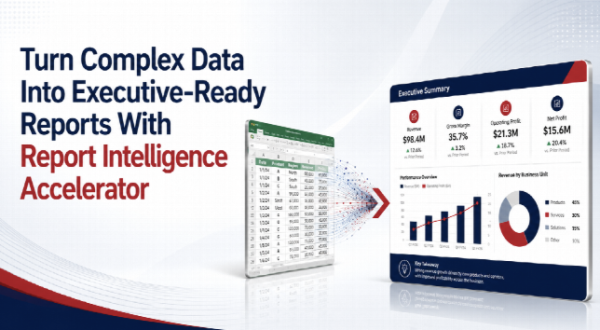
Enterprise teams have become increasingly efficient at collecting and analysing business data. Yet the final step between a completed workbook and a report ready for leadership often remains heavily manual.
Analysts may already have the required calculations, metrics, and underlying data. What follows is another substantial workflow: validating findings, deciding what deserves attention, creating charts, writing the narrative, assembling slides and checking the finished report against organisational standards.
For recurring outputs such as monthly reviews, client assessments, board packs and transformation updates, much of this preparation is repeated even when the underlying reporting structure remains largely unchanged.
This is the problem GeekyAnts is addressing through its Report Intelligence Accelerator, a system designed to convert structured and semi-structured business data into analysed, visualised and branded presentations while keeping analytical judgement and approval with the people responsible for the report.
Since 2006, GeekyAnts has built digital products and platforms for organisations across financial services, healthcare, retail, logistics and enterprise technology. The Report Intelligence Accelerator applies that engineering experience to a specific reporting challenge: reducing the repetitive work between completed analysis and decision-ready reporting.
Automating the Reporting Workflow End to End
The reporting process begins with the source data.
Users can upload an Excel or CSV file or connect an approved source such as SharePoint, OneDrive, cloud storage, a data warehouse, CRM, finance system or internal API.
Before analysis begins, the engine profiles the dataset by identifying sheets, columns, data types, missing values, distributions, relationships and structural inconsistencies. Configured cleaning rules, mappings, calculations and validation checks can then prepare the data for further processing.
The analytical layer identifies patterns, trends, anomalies and correlations within the prepared data. It can then select visualisations suited to the reporting context and structure findings into executive summaries, observations, implications, risks and recommendations.
These outputs are placed into an approved PowerPoint template rather than generated as an unstructured presentation.
The accelerator supports XLSX, XLSM, XLS and CSV inputs and can process workbooks containing 22 or more spreadsheet tabs.
The broader objective is not simply to automate slide creation. It is to reduce the repeated production work involved in moving from a completed workbook to a report that an analyst can review and prepare for leadership.
“Consulting and enterprise teams solved data collection a long time ago. What still costs them weeks each quarter is the stretch between a finished workbook and a report a board will accept. We built the accelerator to take the repetition out of that stretch without taking out the judgment,” said Kumar Pratik, Founder and CEO of GeekyAnts.
Holding Judgment, Governance and Brand Control with the Team
Automating the reporting workflow does not remove the need for human judgement.
Generated findings may be technically valid without being relevant to the business context. A chart can accurately represent a dataset while placing emphasis on the wrong information. Recommendations can also require context that exists outside the source data.
Human approval is therefore a fixed part of the workflow rather than an optional final step.
Analysts review the generated findings, visualisations, narratives and slide structure before a report is approved and exported. They retain control over which observations reach leadership, and generated analysis that does not meet the required standard can be discarded.
Governance is another important consideration, particularly where reporting involves financial, operational, client or other sensitive data.
The platform can be deployed within client-controlled infrastructure with configurable model, access and governance policies, allowing organisations to keep sensitive information within their chosen environment.
Presentation standards are handled in a similar way.
Existing PowerPoint templates can define approved layouts, typography, colours, terminology and disclaimers. The reporting workflow then works within those established constraints rather than recreating brand rules each time a report is produced.
This type of approach can be applied across financial consulting and advisory, audit, risk and compliance, management consulting, banking, fintech and insurance, private equity and investment teams, and enterprise PMO and transformation offices.
GeekyAnts plans further development around analysis profiles, enterprise integrations and deployment options for reporting environments with more stringent governance requirements.
About GeekyAnts
GeekyAnts is an AI-powered digital product engineering and consulting company that integrates design, engineering and AI to help organizations build, modernize and scale digital products and platforms.
Contact information
US Office
GeekyAnts Inc.
315 Montgomery Street
9th & 10th Floors San Francisco
CA 94104
USA
+1 845 534 6825
India Office
GeekyAnts India Pvt Ltd
No. 18, 2nd Cross Road
N S Palya, 2nd Stage BTM Layout
Bangalore – 560076
Karnataka, India
+91 80 4305 8884
UK Office
GeekyAnts UK Ltd
SPACES Finsbury Park 17 City North Place
London N4 3FU
England, UK
+44 1702 655221
Media Contact
GeekyAnts Inc.
press@geekyants.com
+1 845 534 6825