

Editor’s Note: All opinion section content reflects the views of the individual author only and does not represent a stance taken by The Collegian or its editorial board.
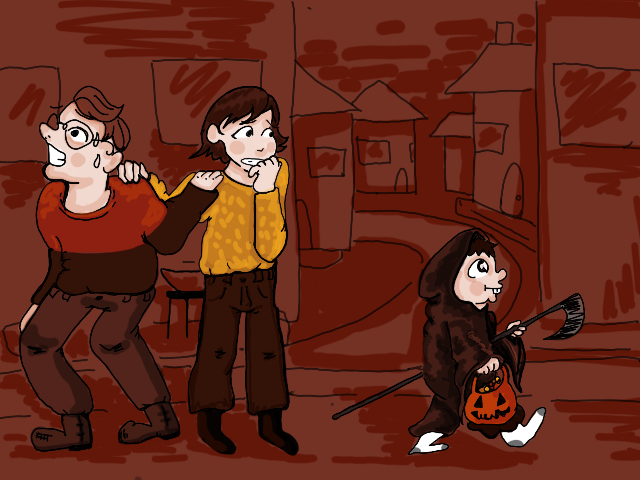
Trick-or-treating is the best part of Halloween. Kids dress up as whatever they want and go door-to-door, receiving pounds upon pounds of candy. It’s loud and fun — everything childhood should be.
But each October, parents start to panic, becoming more hesitant to let their child go trick-or-treating. They obsess over checking candy for drugs and weapons, they follow their kid door-to-door and they constantly remind them to watch out for strangers. These precautions are reasonable — to an extent.
Trick-or-treating may not be completely risk-free, but it is one of the safest, most community-centered traditions for kids. Children stroll through familiar neighborhoods in groups, greet neighbors and enjoy a sliver of independence; it gives them a chance to explore a little while parents are still close enough to keep an eye out.
But some parents are so caught up in their kids’ physical safety during Halloween that they are blinded by a much greater danger right in front of them: phones and social media.
Many children ages 10 to 13 have smartphones and social media. This online presence exposes kids to a world far less kind than any Halloween night. Parents might lock the front door after the last trick-or-treater leaves, but they let their kids have apps where they can come across strangers.
Ironically, trick-or-treating teaches skills that social media takes away. Going door-to-door encourages confidence, communication and camaraderie. Kids learn how to say “thank you,” take turns and connect face-to-face. These things may seem small, but they matter, a lot. On social media, these lessons vanish. Halloween builds real-world connection and memories, while social media slyly takes those away.
“The scariest thing in a 10-year-old’s life is not what goes down on Halloween night, but rather the algorithm waiting for them when they get home.”
So when parents obsess over Halloween safety, it feels misplaced. Kids are much more likely to be emotionally scarred by social media than harmed while trick-or-treating. But because one danger is displayed through viral dances and heart buttons instead of fake blood and zombies, it somehow feels safer. The truth is that it’s not.
If you allow your child to be on social media at such a young age, then you might as well let them trick-or-treat alone. You have no idea who they are talking to, what they are seeing or how their self-perception changes online. At least with trick-or-treating, you know the neighborhood and the people behind the doors. On social media, doors never fully open, but risks certainly do.
While technology is a part of modern life and denying a child a phone can make them feel left out, protecting kids sometimes requires saying no — or at least waiting until they are ready. Parents should be more afraid of a phone in their child’s pocket than a sack of candy.
Halloween lasts one day, but the internet never turns off. One night of costumes and candy may build a lifetime of memories, but hours of scrolling can build insecurity, isolation and anxiety. Parents choose how they want to parent; that’s fine. But maybe instead of inspecting Hershey bars and Sour Patch Kids, they should delete social media from their kids’ phone. The monsters that come out on Halloween are nowhere near as scary as the ones online.
So sure, walk your kid to the next house or carry a flashlight, but don’t prevent your kid from going trick-or-treating because you’re afraid of something bad happening. The scariest thing in a 10-year-old’s life is not what goes down on Halloween night, but rather the algorithm waiting for them when they get home.
Reach Charlotte Seymour at letters@collegian.com or on social media @RMCollegian.