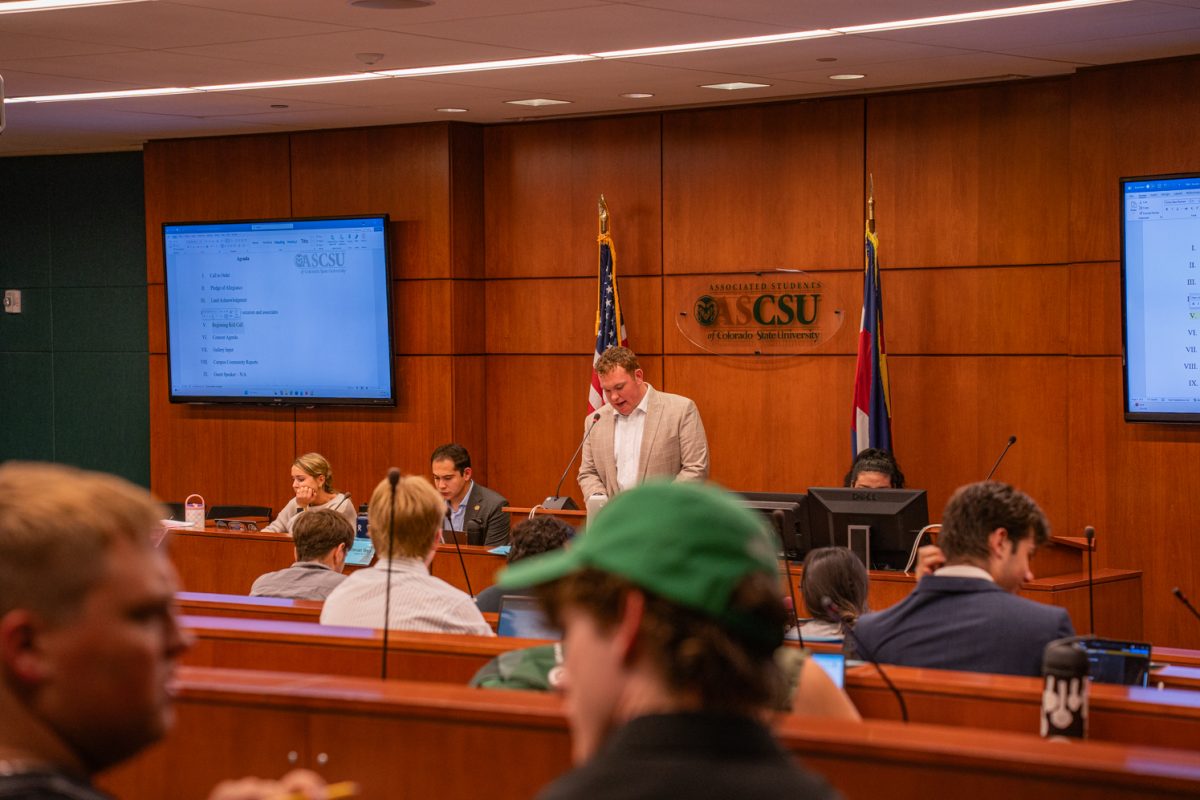


The 2026 Democracy Summit, hosted by Colorado State University’s College of Liberal Arts, welcomed Jake Grumbach, associate professor at the Goldman School of Public Policy at University of California Berkeley, to deliver a keynote speech titled, “What Did 2025 Teach Us About American Democracy?”
This year’s Democracy Summit theme examined “Democracy at the Crossroads: 250 Years as a Nation, 150 Years of the Centennial State,” inspired by the America 250/ Colorado 150 project.
“This summit reflects our commitment to fostering dialogue, bold, imaginative, critical thinking about our democracy and meaningful collaboration across our disciplines and communities,” said Kjerstin Thorson, dean of the College of Liberal Arts, prior to Grumbach taking the stage.
To begin, Grumach outlined three pieces of conventional political science wisdom: politicians act as Madisonians, or how James Madison, an author of The Federalist Papers would have predicted; money in politics has small effects; and the age of politicians and voters aren’t a big deal.
Grumach went on to share events in 2025 that challenged each of these wisdoms, using a variety of research done by himself and others and various examples to support his points.
Grumbach defined Madisonian politicians as “politicians who are guided by their own ambitions to rise in their particular institutional chamber.”
Yet in recent years, political polarization and nationalization, along with other aspects, have incentivized politicians to “focus on their base being their party and their national party team, rather than their institutional ambition as Madison would have predicted,” Grumbach said.
Grumbach elaborated on this by discussing a concept known as minority rule, which he described as a long-term crisis of American democracy, citing various historical examples.
“The Constitution actually very much provides for strong bases of minority rule and prevention of majorities getting what they want in the US political system,” Grumbach said. “However, before 2025, we kind of all agreed (we) follow this system, for better or worse. You have to follow the Articles of the Constitution.”
Grumbach said both Article I, which outlines congressional powers, and Article III, which defines judicial powers, were violated in 2025. Article I violations began with the Department of Government Efficiency Initiative, which lacked congressional approval.
Breaches of Article III have occurred throughout Trump’s second administration, with it repeatedly ignoring judicial orders, especially those pertaining to immigration, as well as ignoring individual liberties in the Bill of Rights, such as due process.
“This is a new form of acute national crisis that the U.S. really hasn’t seen,” Grumbach said. “American democracy has been on the brink, particularly during the run-up to the Civil War. This particular national constitutional crisis is something previously unknown.”
Grumbach then moved to the second assumption: Money in politics has small effects.
“In the U.S., in large part thanks to the federal judiciary in the U.S., campaign contributions are just a very central part of political participation in the U.S.,” Grumbach said.
Following the rulings of Citizens United v. Federal Election Commission and Speech Now v. FEC, money began to gain greater influence in politics, with the latter being more consequential, Grumbach said, because it established that individuals can give unlimited independent expenditures.
He extended the conversation of money in politics to media conglomerates, mentioning various media companies that are owned by “Trump-aligned billionaires,” such as Elon Musk, owner of X and Jeff Bezos, owner of The Washington Post.
Finally, Grumbach evaluated the role of age in politics and gerontocracy. He noted that the United States has the oldest national politicians in a democracy worldwide.
The conversation about gerontocracy bled into his points about money’s role in politics, as he noted the median age for individual donors in American politics is 66 years old.
Grumbach said that when running for a congressional election, older candidates are more likely to be able to self-fund their campaigns, while younger candidates face disadvantages because they need seed funding, or early donations, in the first couple of weeks of campaigning.
“(Young people) don’t have much money to dominate in politics, and in primary elections, their candidates very quickly become unviable,” Grumbach said.
Following his presentation, Grubach engaged in a 30-minute Q&A featuring both moderated questions from Thorson and audience questions.
Em Stacker, a senior majoring in political science, attended the event.
“I think he had very clear points about how democracy is changing and how 2025 really proved to be an outlier among the pattern of democratic institutions that we’ve seen throughout America,” Stacker said. “He had some really good examples and graphs, and I think that he pulled data from a wide range of sources, which really added credibility. ”
Reach Chloe Rios at news@collegian.com or on social media @RMCollegian.