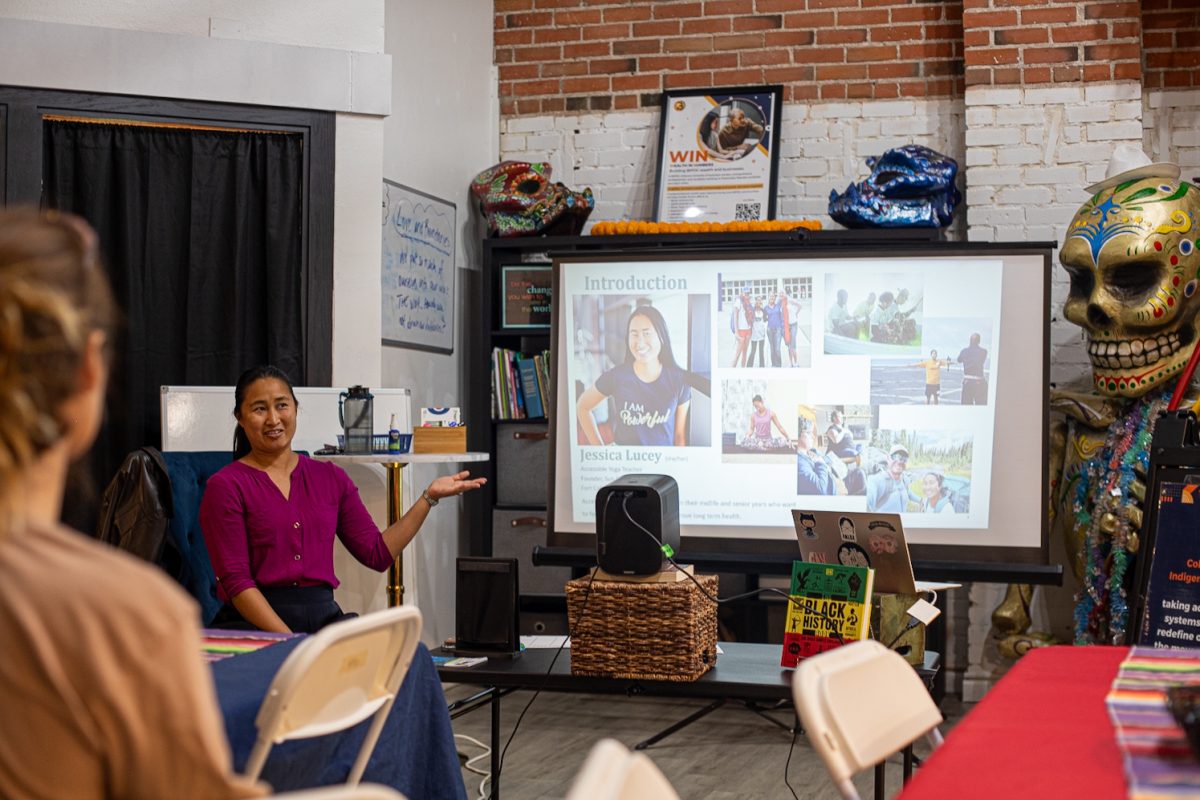


Students stepped into the shoes of policymakers during an interactive exercise presented by The Concord Coalition Monday, March 9 at 10 a.m. at the Lory Student Center as a part of Colorado State University’s Democracy Summit 2026.
The Concord Coalition is a nonpartisan group that visits colleges, universities, organizations and town halls across the country to educate Americans on the federal budget: the financial plan that outlines the government’s combined tax revenue and spending.
The mission of the coalition is to address the U.S.’s growing federal debt and unsustainable future that will greatly affect younger generations.
One major tool the coalition uses to facilitate conversations on the federal budget are group role-playing activities. This time around, CSU faculty and students participated in the coalition’s Principles and Priorities: Federal Budget Exercise.
“People actually get their hands dirty, and they get to have a hands-on experience on how to build a federal budget,” said Phil Smith, national field director of the Concord Coalition. “The goal of the exercise is for people to assemble a federal budget that is fiscally responsible.”
Smith started off the dialogue Monday by supplying information on the current state of the federal budget. Smith told participants that just for the fiscal year of 2024, the U.S. saw expenses pass revenue by $1.907 trillion, according to the Congressional Budget Office’s January 2025 report.
He also highlighted that 2024 was the first year that the amount spent on debt interest was larger than what the U.S. government spent on defense. These trends in the federal budget continue to worsen, Smith said.
“Interest on the debt is the fastest growing part of the federal budget,” Smith said. “Last year, it was actually greater than what we paid in national defense.”
In addition, younger generations, such as college students, are disproportionately affected by the growing federal debt and demographic shifts. The decisions made in Washington D.C. right now will significantly affect young people’s access to programs down the road.
“Because of lower birth rates and an aging population, the United States is entering a period where fewer workers will be supporting more retirees through programs like Social Security and Medicare,” Smith said. “At the same time, rising health care costs and growing interest payments on the national debt are putting additional pressure on the federal budget.”
The goal of the exercise was for participants to come together and create solutions for the future of the federal budget. More specifically, the group was given the projected 2035 fiscal year deficit number of $2.7 trillion given by the CBO and were told to try and reduce it over a 10-year plan. It’s important to note that this figure was calculated before executive branch tariffs and the passage of the One Big Beautiful Bill Act.
To start the exercise, all participants assumed the role of member of Congress. They were then tasked to make decisions on various spending and revenue policies regarding four categories: General government spending, national security and defense spending, healthcare and Social Security, and taxes and revenue.
Naturally, conversations on where the government should increase or decrease spending are challenging, and it is almost never that Congress unanimously agrees, hence why a majority rule is needed in the U.S. for a policy to pass.
U.S. Congress members also have to think about re-election when voting on policies, and Smith told participants to keep this in mind when passing or rejecting a policy.
“Will voters react to your decisions?” Smith asked. “This is the hardest thing to simulate. Members of Congress really want to be re-elected, and it drives a lot of decisions.”
All six participants on Monday were required to unanimously vote for a policy to pass that either added or reduced the federal budget debt. These guidelines facilitated in-depth conversations for each policy, as the pretend members of congress had to both consider their priorities and identify ways to reduce the projected deficit.
Conversations held by the role-playing Congress members went far beyond simply deciding whether to extend or cut a level of government funding for a program. Many participants were concerned with how programs might use the money or that the flawed systems had no easy fix.
“The hard part about a lot of these is it assumes we can just cut this funding and then fix it,” CSU student Jeff Moore said on the complexity of deciding what programs should receive government funding.
At the end of the two-hour simulation, the group was able to reduce the projected 10-year deficit by about $4.6 trillion.
CSU student Calvin Satterfield participated in the exercise and said he found it to be a very productive and eye-opening experience. He also learned that balancing the federal budget is not an easy task and that it is now more important than ever that everyday Americans become involved in the process.
“I learned that balancing a federal budget is hard but also that our elected officials don’t know everything and have to rely on lobbyists and staffers to educate themselves on many issues,” Satterfield said. “It is very important to have conversations on the budget because it directly impacts us.”
The Concord Coalition collects the many 10-year plans Americans from all over collaborate on in order to show them to policymakers for their insight.
“When we come back to Washington, we’re then able to say, ‘Well, you know, the folks down in Florida said this,’ or, ‘The folks in Colorado said this,'” Smith said. “Our executive director is a former member of Congress, so when she testifies before congressional committees, oftentimes we’re asked, … ‘What are you seeing when you travel across the country?'”
The Concord Coalition has three other exercises they host around the U.S. and a podcast called Facing the Future. They can be reached through their website concordcoalition.org.
Reach Katya Arzubi at news@collegian.com or on social media @RMCollegian.