
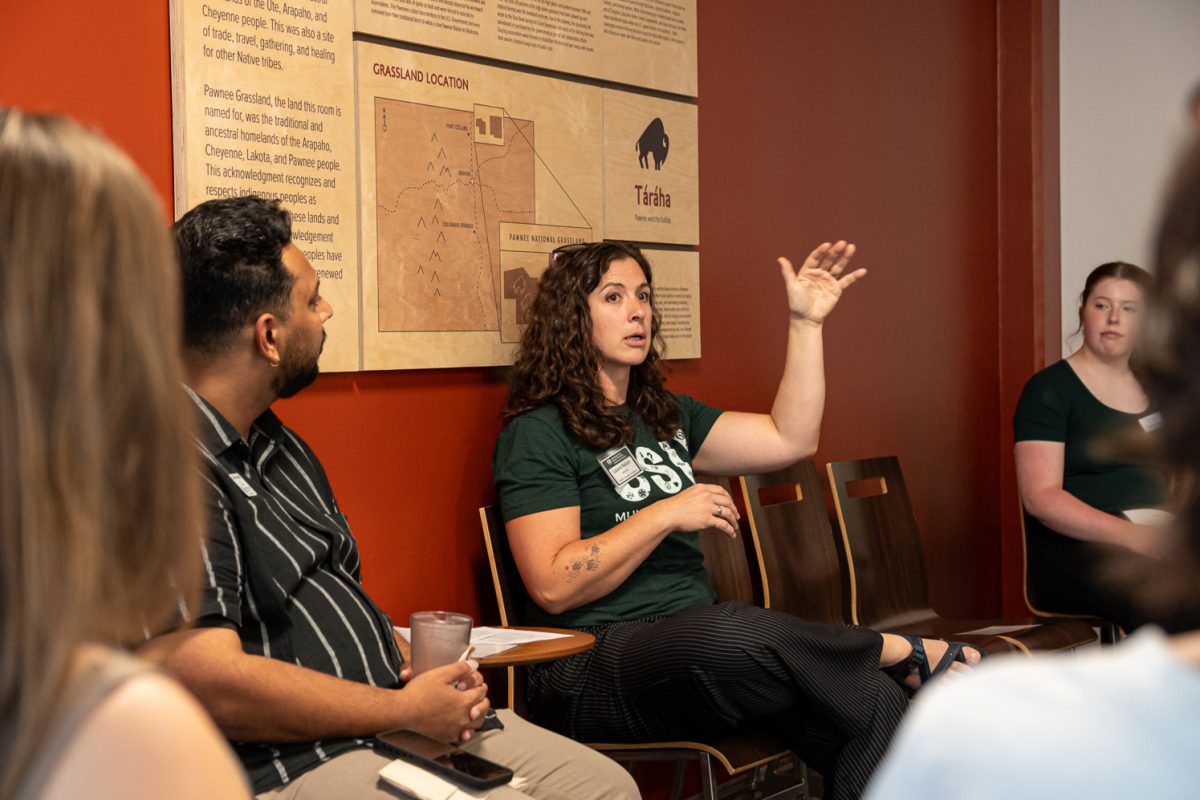
On Thursday, Sept. 10, participants of Food for Thought brought in plates of dinner and dessert, over which they introduced themselves and their religious affiliations — or lack thereof — before gathering around in a circle to discuss the topic of the day.
The reoccurring dinner and dialogue event, held by the Colorado State University Multifaith and Belief Initiatives and hosted by the Division of Students Affairs, aims to bring college students together as they prepare to make their way out into a world often fraught with tension.
Before the conversation picked up any steam, the students and faculty facilitators passed around a tub of fidget toys and brought to the floor the foundational principles of the Multifaith and Belief Initiatives: nonproselytization, empathy and debate-free language. These tenets strive to keep the Food for Thought meetings safe and nonadversarial, regardless of anyone’s religious or spiritual identity. Keeping the commitment to a comfortable environment for all is anything but easy — as the student facilitators recognized right away in their address to the group.
Xander Browning, a returning Food for Thought participant and second-year natural resource management student, said religion and spirituality are often tightly woven with a person’s sense of identity, so it takes practice and focus to follow the threads of discussion fruitfully without getting lost or offended.
“The hard work is allowing yourself to hear those different perspectives,” Browning said. “And to not (speak) in a way that makes others feel like their personal identity and their personal system of beliefs (are) being attacked.”
According to Sierra Brewster, a Food for Thought facilitator, this is an endeavor that must be taken up, especially by college students.
“It’s important because we’re kind of the ones going out into the world and figuring out how to be better,” Brewster said. “We’re the ones who get to go out and teach other people about having a constructive dialogue rather than just arguing to argue and not listening to each other.”
She went on to describe college as a transformational time when people move away from home and decide for themselves what they want religiously or spiritually, and open, welcoming spaces to explore those aspects of life are invaluable.
Each facilitator also recognized these spaces may be scary. A wide range of sensitive issues, like the current sociopolitical climate or an individual’s childhood experiences with religion can bubble together in these conversations, and they said confronting these topics can seem impossible.
“The way you grow up and what you’re exposed to — you don’t have control over that,” said Alex Beasley, a second-year psychology student and Food for Thought facilitator. “So when we’re asking you to open your mind, it can be like you’re trying to maybe attack your own personal values sometimes, or, like, ‘How can I separate from something that’s been a part of my entire life?”’
Though daunting, he said he believes these are the conversations that can gently chip away at any harmful prejudices that may be left over from one’s upbringing.
“Maybe you learn how to better deal with being uncomfortable and being willing to reshape your own opinions and your own thoughts, which is definitely not always easy,” Beasley said.
The generation of students currently in college are also facing unprecedented challenges relating to technology and digital communication, according to Beasley.
“To us — especially now, from what I’ve researched — our generation is (finding it) harder and harder to communicate, especially with AI or social media that introduce issues we have not seen before,” Beasley said.
Interim Multifaith and Belief Initiatives Lead Laura Nelson added that the skills exercised at events like these are attractive to future employers, saying religious pluralism is becoming akin to bilingualism in the workplace.
“Eighty-five percent of employers are looking for entry-level folks with bridge-building skills, and interfaith dialogue and pluralism efforts are a place to teach and learn those skills,” Nelson said.
Laura Richards, a Multifaith and Beliefs Initiatives intern, shared a personal anecdote that illustrated how attending Food for Thought has given her a renewed sense of peace.
She remembered being approached by “the people with their little green Bibles” in the campus plaza last year and feeling accosted and upset by their advances.
“This semester, when I walked past them, I could see they genuinely cared,” Richards said. “They weren’t trying to be pushy. They really wanted to bring something beautiful in their lives to others, and I just wasn’t upset anymore.”
Reach Kooper Hahn Shagena at life@collegian.com or on social media @RMCollegian.