


Colorado State University recently moved forward with the beginning stages of installing 12 digital billboards across its campus. This move clashes with the policies and interests of the City of Fort Collins, which prohibits billboards within the city limits.
In 2018, the Fort Collins City Council passed Ordinance No. 141, which amended the city’s Land Use Code to prohibit temporary or permanent signs located off business premises, including print and digital billboards. The ordinance affirmed a similar law passed in 1997.
“The purpose and intent of the Sign Code is to set out reasonable regulations for the design, location, installation, display, operation, repair, maintenance and removal of signs in a manner that advances the City’s legitimate, important, substantial, and compelling interests, while simultaneously safeguarding the constitutionally protected right of free speech,” reads Section 3.8.7 of the Land Use Code.
The code goes on to define the city’s rationale for prohibiting billboards, citing the city’s interest in preventing sign clutter, ultimately protecting the health of the tree canopy and maintaining the aesthetic environment of the city.
As a state land-grant institution, CSU operates as a separate entity from the City of Fort Collins, meaning that the university is not required to follow the same land-use regulations that govern the rest of the city.
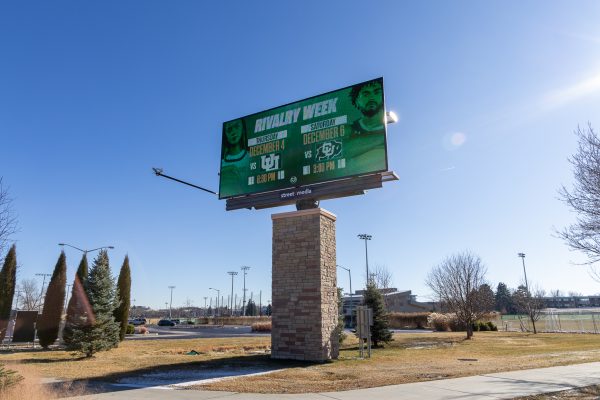
So when Street Media Group, an advertising company, approached CSU with the proposal to install digital billboards across campus, the plan was deemed legal due to the loophole in local land-use authority.
“It’s just so frustrating to go to class everyday for the past four years and you learn, ‘Here’s how we’re causing climate change,’ and then the university puts in something that’s so energy intensive and so negligent and ignorant of all these issues and the student body culture.” -Ariel Sutherland, CSU student
The City of Fort Collins provided The Collegian with a statement regarding the upcoming billboard installations:
“The City works closely with CSU, and they have been transparent about their intent to install these digital signs around campus,” the statement reads. “While City officials have shared with CSU that installing them would run counter to decades of work to minimize billboards and digital signage across Fort Collins, we also understand that for other reasons they have decided to proceed with the installations.”
CSU also provided The Collegian with a statement explaining the university’s reasoning for the new installments:
“CSU installed digital signs to strengthen campus communication and to provide an additional tool for sharing critical updates during emergencies,” the statement reads. “Through a no-cost partnership, revenue from the signs supports improvements to campus and campus safety infrastructure.”
Digital signs have now been planted in various locations across campus, including near Moby Arena on South Shields Street and West Elizabeth Street, the CSU Transit Center and on the Lory Student Center Plaza — with more to be installed in the coming months. Matt Wells, a sales manager with Street Media Group, highlighted the benefits that CSU will experience from the new billboards.
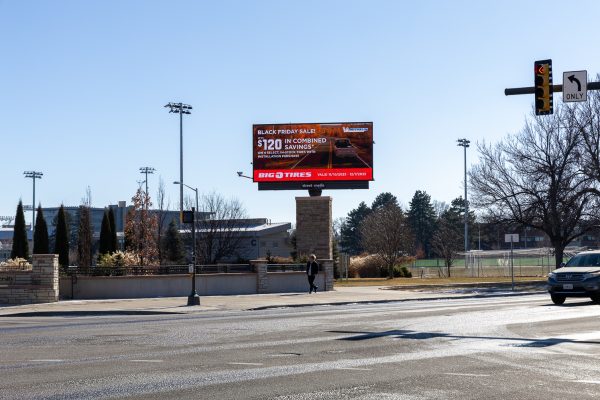
“I mean, CSU loves the idea of being able to instantly reach people,” Wells said. “CSU gets a portion of the ad space because the ads rotate, and they also get a portion of the proceeds.”
Wells also emphasized that the billboards can serve as a tool in emergency situations on campus.
“CSU can take over our network of digital assets at any time,” Wells said. “God forbid there is a school shooter; boom, they pop it up.”
Student reactions to the billboards have been mixed, ranging from indifference to concern about the potential impacts on campus and the city.
“I don’t have super strong opinions on the billboards, (but) they’re kind of lame,” said Myles Brown, a CSU student studying fish and wildlife conservation biology. “I don’t really know why they’re here. I don’t think they serve any purpose.”
Ariel Sutherland, a CSU student in international studies, recently wrote a letter to The Collegian about her concerns surrounding light pollution, energy usage and the distractibility of drivers.
“It’s just so frustrating to go to class everyday for the past four years and you learn, ‘Here’s how we’re causing climate change,’ and then the university puts in something that’s so energy intensive and so negligent and ignorant of all these issues and the student body culture,” Sutherland said. “We are environmentalists.”
The billboards use LED lights, which are considered to be one of the most energy efficient options. However, they are known to generate light pollution through their blue light content, as it scatters into the atmosphere and increases the brightness of the night sky. To address this, Wells pointed out the company’s use of light louvers in their LED signs, which can block or redirect light beams.
“So you’ve got your LED light bulb (and) you’ve got the hood over it,” Wells said. “So you and I on the streets can see our signs great. If you were to be on a drone and just barely get over the sign, it disappears.”
The potential distractibility of the billboards remains understood. In her article, Sutherland referenced Scenic America, a nonprofit that showed research suggesting crash rates can be 25% to 29% higher in areas near digital billboards.
“I am definitely worried about intersections, especially at the first billboard I mentioned: Shields and Elizabeth,” Sutherland said. “So I feel like that’s something we should definitely be monitoring.”
Reach Claire VanDeventer at news@collegian.com or on social media @RMCollegian.








Nicole May • Dec 2, 2025 at 9:13 am
Capitalism State University….it’s one thing if they were exclusively used for campus communication. It’s another when it’s used for more corporate advertising. Do we really need more of that???
Zachary Cramton • Dec 2, 2025 at 6:41 pm
It’s funny how CSU said they were primarily for campus communication but SMG said they “could also be used for communication.” On a side note… who’s looking at a billboard during a school shooting.
I can see it being useful by a parking garage to communicate a road or lot closure but not so much in the middle of the plaza or the edge of campus. Still not my favorite but at least it’s less obviously money hungry.
Catherine Stager • Jan 2, 2026 at 10:53 am
It is hard to understand why CSU would violate Colorado accessibility laws. Definitely not accessible for emergency communication unless they are also speaking or have Braille output.