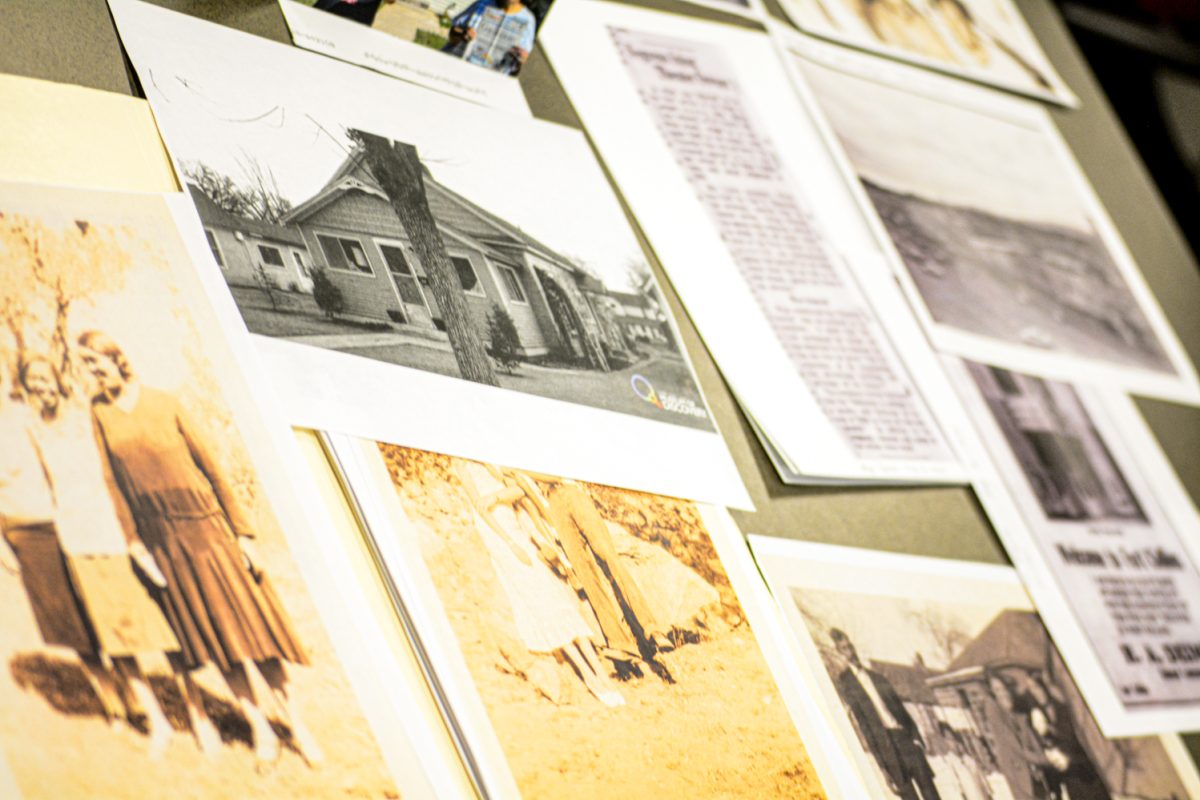

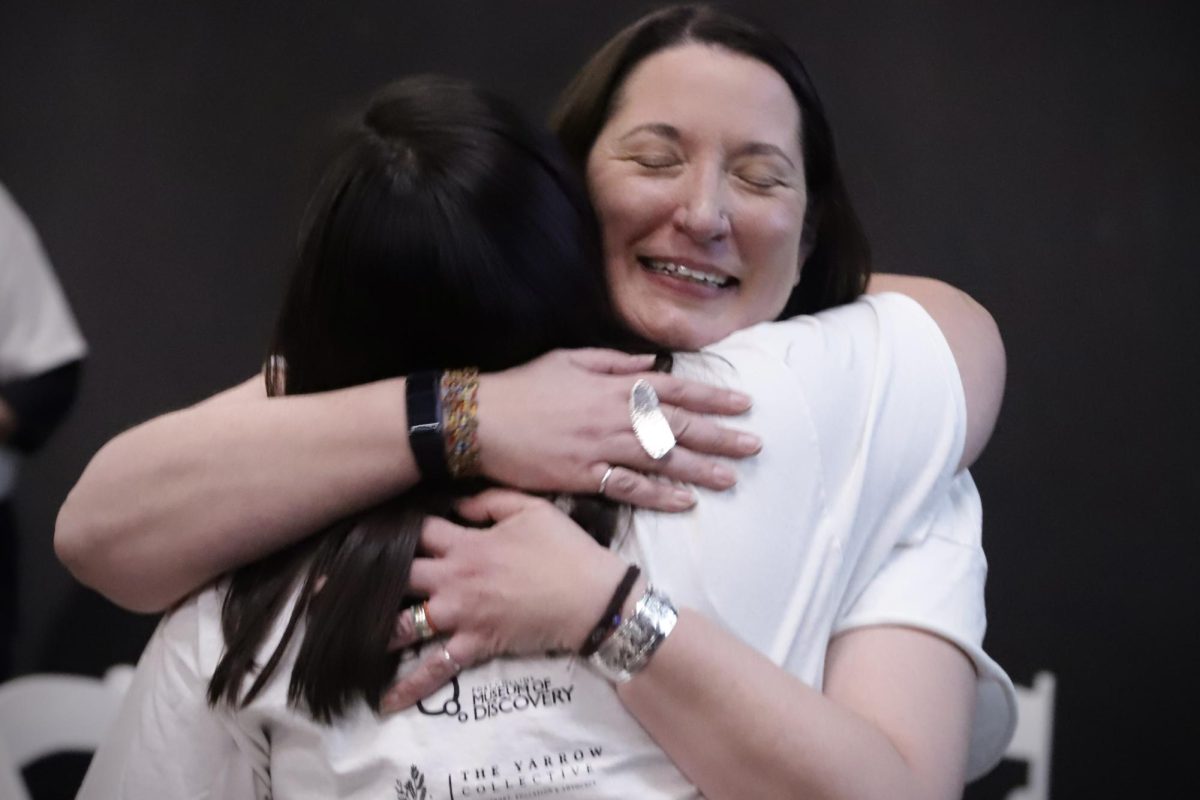
From animal skeletons and bicycles strung from the ceiling to metallic wind walls, the Fort Collins Museum of Discovery features a wide array of oddities and attractions for visitors to see. Yet, on Feb. 22, the most interesting part of the museum was an everyday scene: people engaged in conversation with one another as part of the museum’s Human Library event.
Founded in Copenhagen, Denmark, The Human Library Organization invites “readers” worldwide to engage in dialogue with “human books” to challenge stereotypes and reduce bias. Twenty-eight Fort Collins residents volunteered as human books, sharing their experiences with prejudice, bias and discrimination during the Sunday event.
The event marked the third year the Human Library has been hosted in Fort Collins, and it supports the museum’s focus on universal issues through a local lens, said Bryan Simpson, a spokesperson for the museum.
“Through our experience with the previous two programs, the impact this program has on people understanding individual differences (and) individual experiences (that) people have here in the City of Fort Collins has been so important and … (pushes) the ball forward towards a community where there’s greater acceptance and understanding of differences,” said Beth Jaeger, chair of the City of Fort Collins Human Relations Commission and a partner on the Human Library Committee.
The program was a piece of the museum’s series titled, “The Year of Conversations,” which celebrates 250 years of the United States and 150 years of Colorado. The event was hosted in partnership with the City of Fort Collins, Poudre Libraries, the Yarrow Collective and the Fort Collins Area Interfaith Council.
From 2-5 p.m., attendees of the event had the opportunity to exchange dialogue with four human books. The conversations focused on different aspects of identity, from race and religion to sexuality and more.
Among the collection of books was community member and “exvangelical,” Steve Martin, who shared his story of leaving the Christian faith after 50 years and deconstructing it from his life.
Martin said he wasn’t there to convince people to leave Christianity, but rather to help them understand experiences like his and to let them know that it’s OK to “take another look at yourself.”
“(Have) the courage to turn your world upside down in search of a way to be better on the planet,” Martin said.
One human book, Karen Wong-Brown, shared her story of personal growth. Wong-Brown discussed her journey of being a “model minority” to finding herself. Wong-Brown has lived in Fort Collins for 30 years and is the executive director of Unified Workforce, a nonprofit that helps people in underrepresented communities find jobs through career coaching and academic advising.
“I hope that people know that … Asian-American Pacific-Islanders are not quiet,” Wong-Brown said. “If you challenge us, if you ask us questions, we’ll be open to share our stories so we’re not being tokenized as a model minority.”
The event was free, but attendees were encouraged to pre-register.
“It was really incredible, all the different stories and perspectives that were going on,” said Ali Niaz, an attendee of the event. “There were multiple times where I almost cried today just hearing all the cool stories. It was cool. I learned a lot today about a lot of different things.”
Niaz said his favorite human book came from a lesbian-identifying woman who shared her story about being a social activist for the LGBTQIA+ community, working to perpetuate change in Fort Collins during the 1990s.
While many human books focused on a specific part of identity, some like Everton, a community member who did not provide a last name, discussed identity broadly.
“If we can stay curious about each other and each other’s lives, I think our ecosystem might thrive just a little bit more.” –Melissa Lozano, Yarrow Collective youth program lead
A Colorado State University graduate, Everton shared his story of finding a community in Fort Collins through student leadership opportunities, like being a residential assistant or volunteering. Everton labelled these experiences as part of his “less sticky identities,” in contrast to others, like being a biracial man.
“There are so many different facets of identity and so many different lived experiences and a lot of questions and insights that I think a lot of people from different walks of life have,” Everton said.
Everton said the questions he received led him to believe that people have kindness and empathy but struggle to find reliable and accessible sources to ask uncomfortable questions.
“I think there’s a lot of fear and/or uncomfortability in having almost half of the answer or half of the curiosity to interact with people that are different from you,” Everton said. “This is a great opportunity to kind of allow that curiosity and to come with your half-answers or half-questions and get that other half of insight to help fill that in and/or give you a little bit more than half of the knowledge before.”
Another CSU graduate, Fatima, who also didn’t provide a last name, shared her story as a Latina woman in Fort Collins.
“I want (attendees) to understand that Fort Collins isn’t as progressive as it seems,” Fatima said. “I think there is still a lot of invisible barriers for communities of color to find support and to feel like they belong.”
Fatima said that she never felt scared to be herself in her hometown of Aurora, Colorado. However, that changed when she came to CSU.
Even though she changed her mannerisms and clothing choices to avoid stereotypes, Fatima shared that she still faces discrimination in Fort Collins. She also said her experiences have led her to experience tension between staying in Fort Collins or leaving.
As attendees left, they were greeted by a bus from Poudre Libraries with curated books relevant to themes from the Human Library. The bus’ purpose was to encourage attendees to stay curious and learn, said Jacob Hershiser, outreach librarian at Poudre Libraries.
“I want to acknowledge that everyone who stepped into the museum today was brave and curious,” said Melissa Lozano, youth program lead at The Yarrow Collective, during closing remarks. “May you take with you the warmth and the conversations and the learning that happened here today. May it go out into our community and ripple and amplify. … We’re this ecosystem, right? Fort Collins, we have this community and we all affect one another. If we can stay curious about each other and each other’s lives, I think our ecosystem might thrive just a little bit more.”
Reach Chloe Rios at life@collegian.com or on social media @RMCollegian.