

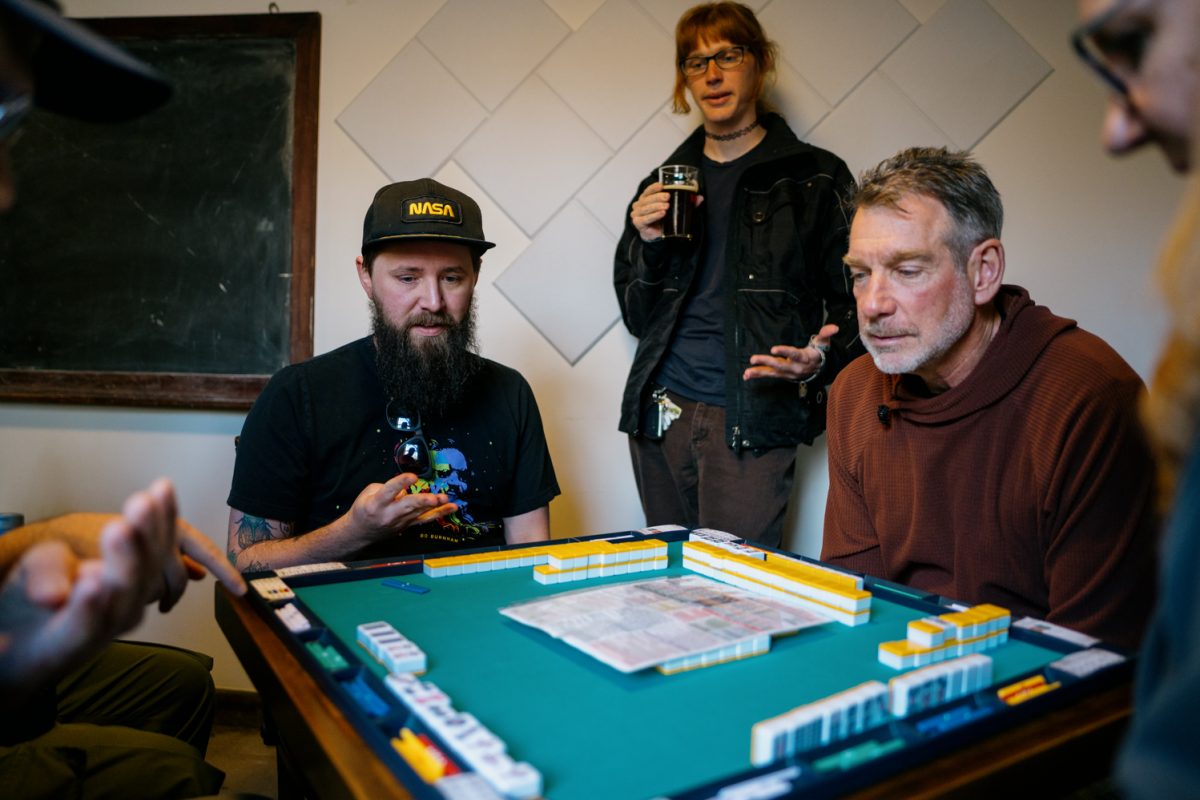
The little room past the bar fills slowly on Saturday afternoons at Stodgy Brewing Company.
People trickle in holding drinks, looking for name tags and scanning tables to see where they fit. Some arrive with friends while others come alone. Most newcomers of Riichi NoCo mahjong start the same way: sitting down with tiles they don’t fully understand yet and someone willing to explain to them.
Japanese mahjong is the reason they showed up, but the routine of showing up is what keeps the room full.
What began as a few players looking for a game has turned into a weekly gathering that now stretches beyond the space it was originally meant to occupy. Beginners share tables with regulars, extra sets appear from backpacks and car trunks and conversations move easily between rules, strategy and banter.
For founder Brad Ray, the idea started simply.
“I’m pretty sure (I started playing) just during COVID-19, and we were, like, trapped at home,” Ray said. “But there was a club where I used to live, and so I started playing with them in person. And so then when I moved here, I was looking, you know, for something to do, meet people. And so it kind of just started up like last summer, and then six months later, now we run out of space every week.”
The early weeks were informal, though.
A table or two, messages sent online, plans made week-to-week depending on who was available. The shift came when the group chose consistency on the same day, the same place, the same expectation that someone would be there.
And it also reframed the club from an activity into a space, something people could rely on rather than schedule, like long-time player and Colorado State University Ph.D. candidate Yifan Yang.
“Well, I played with different people in this town already before I knew Brad,” Yang said. “So we played regularly with my friends at CSU. … Actually, one of my friends, she went to Arizona, and we stopped playing because, you know, it’s a four-player game. And (you can’t play) if you are, like, missing one person, or if these four (people) are not at the same level.”
Yang’s experience reflects one of the game’s central challenges.
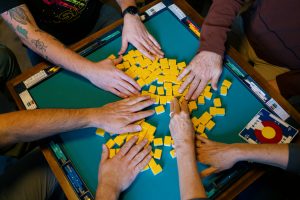
Riichi mahjong traditionally requires four players, often similar levels of understanding and a shared willingness to learn — conditions that are difficult to maintain without structure.
The game is approachable at the surface, matching tiles and building sets, but expands quickly into strategy, probability and long-term decision making. Each week offers incremental progress rather than a finished learning curve.
The experience reflects that pacing because the rules feel dense at first. Tiles blur together and instructions sometimes come faster than understanding. But then the structure begins to settle, and the game shifts from intimidating to engaging.
“You can play online, but it’s just more fun to play in person,” Yang said. “And (I) just enjoy the game I play. I miss my family a lot. I mean, I played with my family when we lived together every weekend. So this is a game I feel like I want to keep playing.”
The in-person element shapes the local club’s identity more than the game itself.
Some arrive for strategy while others arrive for routine. Many arrive for both without fully separating the two.
“I need to get out of the house,” Catherine Garabedian said. “I work in front of a screen all day. I need to see humans. But yeah, so I came out for the first event and like, Brad’s a great guy, like he’s super friendly. So it’s a great place to get out of the house, go play a game, interact with some really nice humans.”
What the group has built is not unusual in concept but increasingly rare in practice: a consistent, free, low-pressure third place. Attendance fluctuates, skill levels shift and players come and go, yet the sets roll out every week.
As a local hub for a lesser-known game, Garabedian said people drive from Denver and Wyoming to participate. Many find the club through Reddit, while others may notice a sign at the brewery and return the following week.
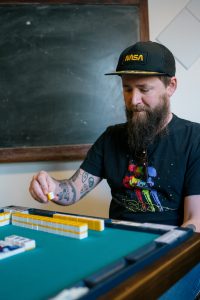
“For a lot of people, it’s kind of like it was for me,” Ray said. “They want to do something in person. They’re looking for ways to meet people and, you know, find some friends, which can be really difficult once you’re out of college, especially post-COVID where people either, like, work remotely or (are) just very busy in general.”
The club’s future remains open with plans for a website, interest in hosting a tournament and ongoing conversations about space. Growth is both the goal and the challenge with no playing fees and inventory consisting of founding members’ personal supplies.
But on Saturdays, a small room at a brewery continues to offer something simple: a place to learn a game and a reason to come back.
“It’s grown so fast,” Ray said. “So it’s exciting, but it’s also like, where do we find space for that? So that’s always the hard part. We’re very thankful for Stodgy letting us hang out here for the price of a beer every week or something. … We kind of set out goals at the beginning of the year in terms of how many new players we want to teach, which I think we met today already, so we need to revisit that goal because it’s (only) February.”
Reach Michael Hovey at life@collegian.com or on social media @michaelfhovey.